
Content Menu
● What Is Die Cutting in Packaging?
● Why Die Cutting Matters for Custom Paper Packaging
● What Is a Die? Tools, Reuse, and Investment
>> Can the Same Die Be Used More Than Once?
● From Dieline to Die: How Manufacturers Engineer Your Packaging
>> Step 1: Dieline Creation (CAD)
>> Step 2: Transferring Dieline to Die Board
● The Die Cutting Process: Step‑By‑Step on the Production Floor
● Core Die Cutting Functions in Custom Packaging
● Die Cutting Methods: Structural Possibilities for Paper Packaging
● Finishing Techniques That Complement Die Cutting
● Cost, Efficiency, and Reusability: A Practical Buyer’s View
● Common Mistakes Buyers Make With Die Cutting
● How Custom Paper Packaging Manufacturers Add Value
● Call to Action: Partner With a Die Cutting Expert
>> 1. How long does it take to create a new die for custom paper packaging?
>> 2. Can I reuse an existing die if I change my artwork?
>> 3. What materials work best with die cutting for custom paper packaging?
>> 4. How does die cutting affect packaging cost for short runs?
As a custom packaging manufacturer, I rely on die cutting every day to transform flat paperboard into high‑performing boxes that protect products and elevate brands. Understanding this process is essential for buyers who want consistent quality, cost‑effective runs, and truly custom structural design. [kylinmachines]
What Is Die Cutting in Packaging?
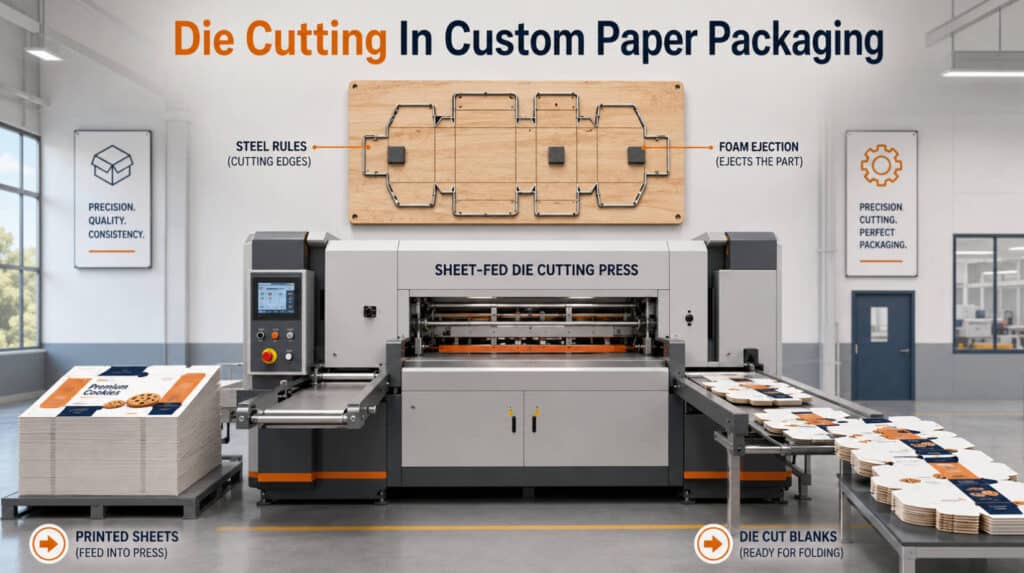
Die cutting is a precision manufacturing process that uses a custom die—a shaped steel tool mounted on a press—to cut and crease packaging materials into specific box layouts. In folding carton and corrugated packaging, it is the step that turns printed sheets into ready‑to‑fold blanks with cut lines, fold lines, perforations, and access holes. [packblog]
From a manufacturer’s perspective, a die is like a powerful, industrial cookie cutter: paperboard sheets go into the press, the die presses down, and perfectly shaped box blanks come out ready for stripping, folding, and gluing. This combination of accuracy and repeatability is what makes die‑cut custom packaging scalable for brands of all sizes. [youtube]
Why Die Cutting Matters for Custom Paper Packaging
Die cutting is foundational for custom paper packaging because it links design intent with real‑world production. When properly engineered, a die ensures that artwork, creases, and structural features align precisely on every box in the run. [johnsbyrne]
Key advantages from a buyer’s point of view include:
– Consistent structural integrity across thousands of units. [kylinmachines]
– Efficient high‑volume production with minimal material waste. [packblog]
– True customization: windows, handles, ventilation holes, and unique shapes are all feasible. [youtube]
For brands working with manufacturers like Bonito Packaging, mastering die cutting basics helps you make smarter decisions about dielines, materials, and finishing. [gentlever]
What Is a Die? Tools, Reuse, and Investment
A die is a specialized tool that combines steel rules, creasing elements, and sometimes perforation or embossing components mounted to a die board. [youtube]
– Cutting rules form the outer shape of the box and internal cut‑outs. [kylinmachines]
– Creasing rules create fold lines that make carton assembly fast and repeatable. [packaging-warehouse]
– Perforation rules create easy‑tear sections or access points. [youtube]
Can the Same Die Be Used More Than Once?
Yes—and in professional manufacturing it should be. Building a die is a significant upfront cost, but it is a one‑time investment that can be reused for multiple product SKUs that share the same structure. [gentlever]
For example, if you have three products using the same folding carton structure but different artwork, one well‑engineered die can produce thousands of boxes across all SKUs. This is why experienced buyers focus on standardizing structures where possible: it drives down total cost of ownership over time. [gentlever]
From Dieline to Die: How Manufacturers Engineer Your Packaging
Before any steel is cut or mounted, we start with dieline engineering. [johnsbyrne]
Step 1: Dieline Creation (CAD)
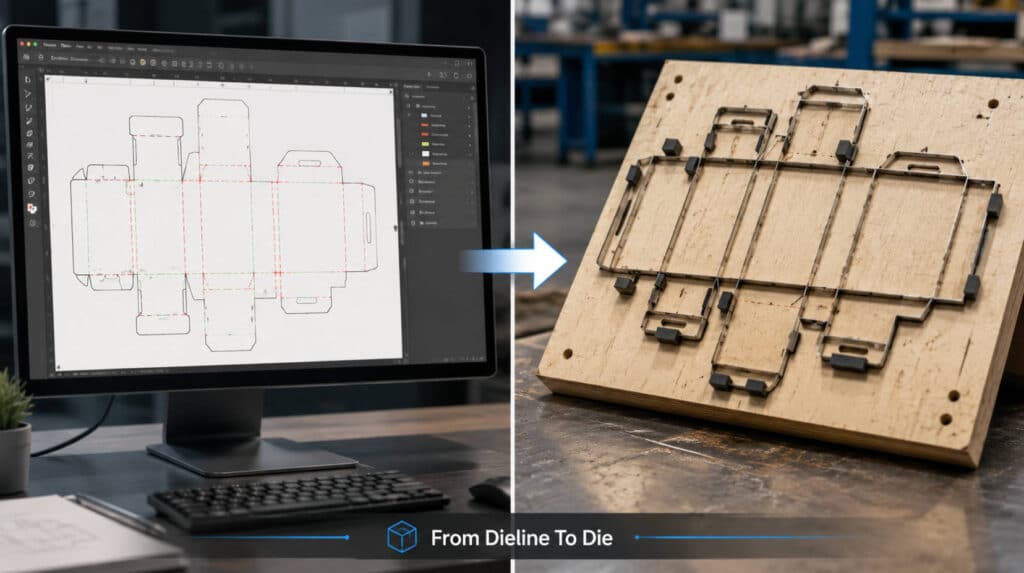
Packaging engineers use Computer‑Aided Design (CAD) to create a 2D dieline that represents the flat version of your 3D carton. This dieline maps: [johnsbyrne]
– Cut lines (outer shape, internal cut‑outs). [kylinmachines]
– Fold/crease lines (panels, flaps, closure mechanisms). [packaging-warehouse]
– Bleed areas and safe zones for artwork. [johnsbyrne]
For reliable production, it is critical to finalize the dieline before die manufacturing begins—last‑minute changes can impact tolerances, tooling cost, and lead time. [gentlever]
Step 2: Transferring Dieline to Die Board
Modern die shops use laser cutters to burn the dieline pattern into a wooden die board with extremely high precision. The steel rules are then bent and hammered into the board along the laser‑cut channels, with foam and rubber pieces added to help the die “bounce off” corrugated or thicker materials during production. [packblog]
This laser‑guided preparation dramatically improves accuracy compared to traditional manual scribing and reduces the risk of misaligned cuts or creases. [packblog]
The Die Cutting Process: Step‑By‑Step on the Production Floor
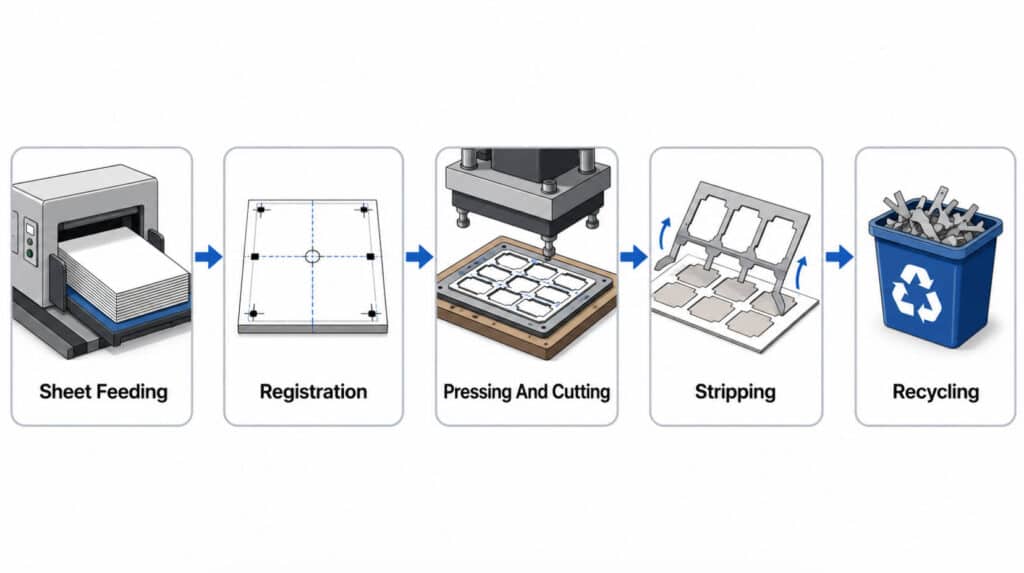
On the press line, die cutting follows a clear sequence designed to maximize speed, accuracy, and safety. [kylinmachines]
1. Sheet feeding: Paperboard or corrugated sheets are fed into the die‑cutting machine in register. [youtube]
2. Registration: Alignment systems ensure each sheet is positioned correctly relative to the die. [youtube]
3. Pressing and cutting: The press applies controlled pressure, driving the die into the material and performing cutting, creasing, scoring, and perforating in one pass. [youtube]
4. Stripping: Waste matrix and excess material are removed, often automatically, leaving only finished blanks. [youtube]
5. Recycling: Remaining stripped material is collected and recycled where possible. [johnsbyrne]
For buyers, the most important takeaway is that die cutting is a multi‑function operation: you don’t just get the outer shape, you also get all critical structural features in one efficient pass. [packblog]
Core Die Cutting Functions in Custom Packaging
Although “cutting” is in the name, industrial die cutting performs several distinct functions. Understanding these helps you specify exactly what you need in your design brief. [gentlever]
– Through cutting: Cuts cleanly through the material to define the outer shape or windows. [kylinmachines]
– Scoring: Creates shallow impressions or partial cuts that guide folds without fully severing the material. [packblog]
– Creasing: Forms defined fold lines, especially important for corrugated and rigid structures that must fold reliably. [packaging-warehouse]
– Perforating: Adds a line of small cuts for easy tearing, ventilation, or access panels. [youtube]
Each function can be tuned to material thickness, grain direction, and end‑use, which is why collaboration between design and manufacturing teams is so important. [gentlever]
Die Cutting Methods: Structural Possibilities for Paper Packaging
Different die cutting methods unlock different structural possibilities and performance characteristics. [gentlever]
| Método | What It Does | Caso típico |
|---|---|---|
| Blanking | Clips flat material from the outer edge to achieve flatness. kylinmachines | Flat carton blanks for efficient stacking. packblog |
| Drawing | Pulls material to a predetermined length. kylinmachines | Long, lean packaging formats or inserts. gentlever |
| Forming | Shapes material on a curved surface. kylinmachines | Rounded or cylindrical paper packaging. gentlever |
| Coining | Creates precise circular holes using pressurized force. kylinmachines | Ventilation, cable pass‑throughs, hang holes. youtube |
| Broaching | Uses multiple rows of cutting teeth for hard or thick materials. kylinmachines | Heavy‑duty industrial or specialty substrates. packblog |
For brands, this range of methods means you are not limited to standard rectangular cartons. With thoughtful engineering, your packaging can integrate functional features like handles, locking mechanisms, and structural reinforcement without sacrificing speed or cost‑effectiveness. [gentlever]
Finishing Techniques That Complement Die Cutting
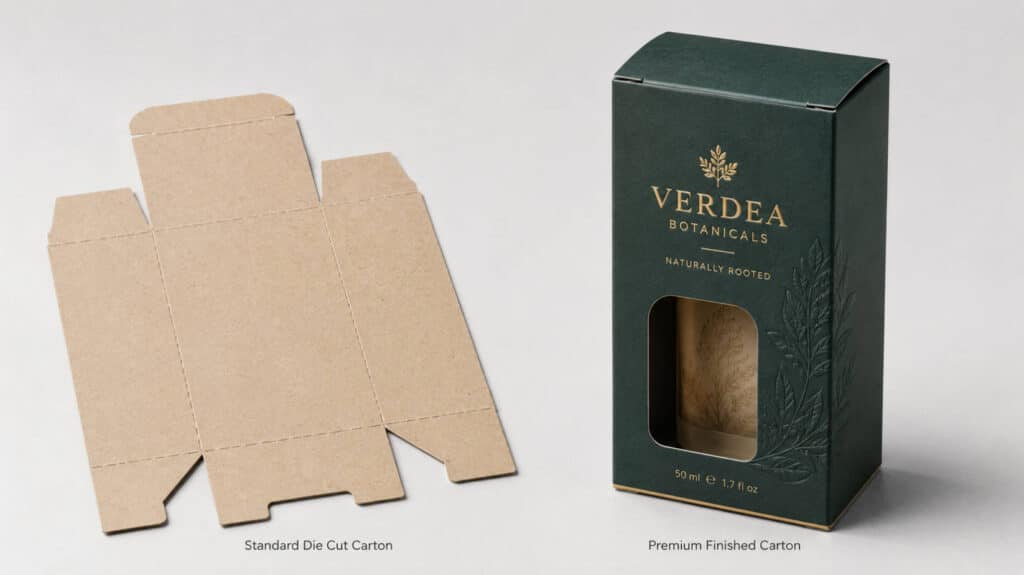
Once die cutting is complete, finishing techniques bring your packaging’s visual and tactile experience to life. For high‑end custom paper packaging, manufacturers often combine die cutting with: [johnsbyrne]
– Estampado/grabado en relieve to raise or recess key design elements like logos. [kylinmachines]
– Estampación for metallic accents that signal premium positioning. [johnsbyrne]
– UV printing or coatings to create gloss, matte, or textured surfaces. [kylinmachines]
The die‑cut structure must support these finishes: for example, deep embossing on a thin carton panel without proper creasing can lead to cracking or warp. Working closely with a manufacturer that understands both structure and aesthetics is essential. [fonzy]
Cost, Efficiency, and Reusability: A Practical Buyer’s View
From a procurement perspective, die cutting’s economics hinge on run size, die complexity, and reuse potential. [gentlever]
– Initial die fabrication is a capital expense, but spread over thousands of units, it sharply reduces per‑box cost. [gentlever]
– Standardizing carton structures across product lines maximizes die reuse and simplifies inventory. [gentlever]
– Advanced die cutting equipment improves changeover speed, making short and medium runs more viable than they were a decade ago. [indexbox]
Industry analyses forecast continued growth in die cutting equipment driven by e‑commerce packaging demand through 2035, which means more automation, better precision, and improved waste control for buyers. [indexbox]
Common Mistakes Buyers Make With Die Cutting
From years working with B2B brands, three recurring issues often undermine die‑cut packaging projects: [gentlever]
1. Late dieline changes: Adjusting structure after tooling wastes time and can introduce fit issues on automated packing lines. [gentlever]
2. Ignoring material behavior: Choosing artwork or finishes without considering fiber direction, thickness, and crease performance leads to cracking or weak corners. [johnsbyrne]
3. Under‑specifying functional features: Leaving out perforations, access holes, or locking details can force expensive retrofits. [youtube]
By involving your manufacturer early—at the concept stage rather than post‑design—you leverage their experience with die cutting tolerances, press capabilities, and finishing interactions. [gushwork]
How Custom Paper Packaging Manufacturers Add Value
Manufacturers like Bonito Packaging do more than simply “run the press.” At a process level, we help you: [respectmanufacturing]
– Translate brand and UX requirements into production‑ready dielines. [gentlever]
– Match material grade and thickness to structural demands and shipping conditions. [packblog]
– Optimize die design for efficient layout on the sheet, reducing waste and cost. [packblog]
– Integrate finishing (foil, emboss, coatings) in a way that works with die‑cut structure. [kylinmachines]
This holistic view ensures your custom paper packaging performs in three contexts: on the shelf, in transit, and on the packing line. [gentlever]
Call to Action: Partner With a Die Cutting Expert
If your brand is planning a new custom paper packaging project or re‑engineering existing cartons for better performance, partnering with a manufacturer experienced in die cutting and finishing is critical. [gushwork]
At Bonito Packaging, we help you move from concept to optimized production by aligning dieline design, material selection, and finishing with your brand’s goals and budget. Whether you need high‑volume folding carton runs or complex die‑cut structures with premium finishes, our team can guide you through every step. [kerkarmedia]
Talk to our packaging specialists today to review your current dielines, identify cost‑saving opportunities, and plan a more efficient die‑cut production run for your next launch. [fonzy]
Preguntas frecuentes
1. How long does it take to create a new die for custom paper packaging?
Lead time for a new die typically ranges from several days to a couple of weeks, depending on dieline complexity, material type, and the die maker’s workload. Complex structures with multiple perforations, windows, or locking mechanisms will take longer than simple folding cartons. [gentlever]
2. Can I reuse an existing die if I change my artwork?
Yes, as long as the structural layout remains unchanged, you can reuse the same die with updated artwork, colors, or branding elements. This is a common strategy for families of products that share a standard carton form factor, minimizing tooling cost across SKUs. [gentlever]
3. What materials work best with die cutting for custom paper packaging?
Die cutting works well with folding carton paperboard, corrugated board, and many specialty coated or laminated paper substrates. The optimal material depends on product weight, protection needs, and desired visual finish, so work with your manufacturer to test samples before finalizing specifications. [packblog]
4. How does die cutting affect packaging cost for short runs?
For very short runs, the upfront cost of tooling can be a higher percentage of total spend, but modern equipment and reusable dies still make custom structures viable. Brands often standardize structures and vary artwork to spread tooling cost across multiple campaigns or SKUs. [youtube]
5. What information should I provide my manufacturer to ensure a successful die‑cut packaging project?
Provide a clear dieline (or at least structural concept), product dimensions and weight, artwork files or brand guidelines, expected run size, and any functional requirements such as windows, tamper evidence, or machine packing. This allows your manufacturer to engineer appropriate die cutting functions, materials, and finishing options from the start. [fonzy]
References
1. Pakfactory Blog – “The Die Cutting Process in Packaging” (original article and process overview). [page:1]
2. PackBlog – “Die Cutting: What Is It and How Does It Work?” (corrugated packaging process explanation). [Link]
3. JohnsByrne – “The Folding Carton Manufacturing Process” (manufacturing stages and die cutting role). [Link]
4. Gentlever – “What Is Die Cutting in Packaging? A Guide to Die Cut Boxes” (benefits of die‑cut boxes). [Link]
5. Gentlever – “Folding Carton Manufacturing Process Guide” (buyer‑oriented carton process and best practices). [Link]
6. IndexBox – “Die Cutters Market Analysis 2026‑2035” (market growth and e‑commerce demand). [Link]
7. YouTube – “Box Plant Basics – Die Cutters” (technical overview of die cutter operation). [Link]
8. YouTube – “Rotary Die Cutting for Folding Cartons and Packaging” (operational overview of sheet‑fed die cutting). [Link]
9. YouTube – “Die Cutting: How Folding Carton Boxes Are Made” (visual explanation of cookie‑cutter analogy). [Link]
Hot Tags: Custom Packaging, Manufacturers, Customized, Custom, Suppliers, Buy, Cheap, Quality, Advanced, Durable, in Stock, Made in China, Price, Quotation, Free Sample
 English
  Spanish
  French
  German
  Russian
  Japanese
  Portuguese
  Arabic