
Content Menu
● What Is a Corrugated Flute and Why It Matters
● The Role of Corrugated Flutes in Modern Packaging
● Overview of Common Flute Profiles (A, B, C, E, F and Combinations)
>> Typical Single Flute Profiles
● Flute Combinations: EB, BC and High‑Performance Boards
● Single‑Wall, Double‑Wall and Triple‑Wall Boards
● E Flute vs B Flute: When Print Quality Beats Thickness
● Practical Checklist: How to Choose the Right Flute for Your Product
● Printing Options and UX Considerations on Different Flutes
● 2026 Industry Trends: What Smart Buyers Are Doing Now
● Where to Use Each Flute: Typical Applications
● Actionable CTA: Get Expert Flute Selection Support
>> FAQ 1: What is the best corrugated flute for general e‑commerce shipping?
>> FAQ 2: When should I use BC flute instead of B flute?
>> FAQ 3: Is EB flute overkill for small, lightweight products?
>> FAQ 4: Which flute is best for premium cosmetic or skincare packaging?
>> FAQ 5: How do I make my corrugated packaging more sustainable without losing strength?
As a packaging manufacturer working daily with global B2B brands, I’ve seen perfectly designed products fail in the market simply because the corrugated flute was wrong. Choosing the right flute profile is no longer a basic technical decision—it directly affects shipping damage rates, customer experience, sustainability scores, and total packaging cost. In this guide, I’ll walk you through corrugated flutes from a practical, expert perspective, using real-world manufacturing insights and up‑to‑date industry data. [towardspackaging]
What Is a Corrugated Flute and Why It Matters
In corrugated packaging, the flute is the wavy, arched layer of paper sandwiched between two flat linerboards. That simple “wave” is what gives your box stacking strength, cushioning, and rigidity. [propacmaterials]
A typical corrugated board consists of:
– Outer liner (print surface)
– Inner liner (inside face)
– Fluted medium (the “wave” in between) [towardspackaging]
Those flutes:
– Create vertical compression strength for stacking.
– Provide cushioning against drops, vibration, and impact.
– Influence print quality and die‑cutting performance. [propacmaterials]
From a manufacturer’s lens, when we discuss “which flute is best,” we are really discussing:
– How much protection your product needs.
– How your box will be shipped and stored.
– How premium your branding and printing must look.
– How much you can afford in unit cost and freight. [towardspackaging]
The Role of Corrugated Flutes in Modern Packaging
The global corrugated packaging market exceeded USD 220 billion in 2025 and continues to grow, driven by e‑commerce and last‑mile delivery. This boom means more shipments, more stacking, and more pressure on your packaging to perform. [gminsights]
Key flute functions in 2026 B2B packaging:
– Strength & stacking: Larger flutes support vertical loads in warehouses and 3PL networks. [propacmaterials]
– Cushioning & product safety: Flutes absorb shock and resist puncture, reducing damage claims and returns. [towardspackaging]
– Print & branding: Smaller flutes give a flatter surface for high‑quality graphics, vital for retail and D2C brands. [packccp]
– Cost & sustainability: Thinner, high‑performance flutes can reduce material consumption, shipping weight, and waste. [propacmaterials]
From my experience working with industrial and e‑commerce brands, most packaging failures happen not because the box “isn’t strong,” but because the flute choice ignores:
– Real stacking height.
– Transport distance and handling.
– Product footprint and fragility. [paperindex]
Overview of Common Flute Profiles (A, B, C, E, F and Combinations)
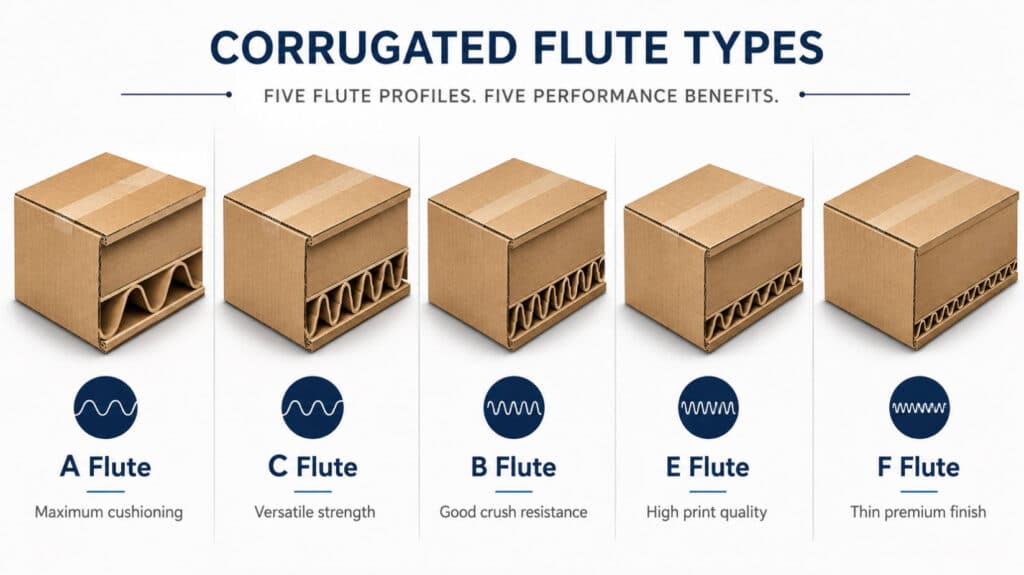
Different flute profiles are defined by their height and number of flutes per foot (or per meter). Larger flutes usually mean more cushioning; smaller flutes usually mean better printing. [packccp]
Typical Single Flute Profiles
| Flute type | Approx. thickness | Flutes per foot | Core strengths | Best use cases |
|---|---|---|---|---|
| A flute | ~1/4 in (≈4.8 mm) youtube | ~33 propacmaterials | Maximum cushioning, strong vertical strength | Fragile/heavy items, industrial, some export |
| C flute | ~3/16 in (≈3.5–4.0 mm) youtube | ~39 propacmaterials | All‑purpose shipping, good stacking | Standard shipping cartons, e‑commerce shipping |
| B flute | ~1/8 in (≈2.4–3.2 mm) youtube | ~47 propacmaterials | Flat surface, good crush resistance | Mailers, canned goods, displays, partitions |
| E flute | ~1/16 in (≈1.2–2.0 mm) youtube | ~90 propacmaterials | Excellent printing, compact profile | Cosmetics, gifts, small e‑commerce items |
| F flute | ~1/32 in (≈0.8–1.0 mm) towardspackaging | ~125 propacmaterials | Microflute, very smooth surface | Retail packs, clamshells, lightweight goods |
These figures can vary slightly by region and mill, but the performance characteristics remain consistent. [packccp]
Flute Combinations: EB, BC and High‑Performance Boards
Double‑wall boards combine two flute profiles to balance protection and print performance. [youtube]
EB Flute (E + B)
EB flute laminates an E flute (for print) with a B flute (for strength), giving a board around 4.5–5.5 mm thick and roughly 35% stronger than B flute alone. [youtube]
Benefits:
– High durability for shipping and storage.
– Smooth outer surface for branding and flood printing.
– Good choice for mid‑to‑premium subscription boxes or heavier D2C products. [youtube]
Trade‑offs:
– Higher material usage and carbon footprint (up to ~40% higher than single B flute). [towardspackaging]
– Over‑engineered for small, light products (unnecessary cost). [towardspackaging]
BC Flute (B + C)
BC flute combines a B and a C flute to create a “twin‑cushion” structure with 7.0–8.0 mm thickness and very high stacking strength. [youtube]
Benefits:
– Maximum protection for bulky, heavy, or fragile goods.
– Excellent for export, pallet stacking, and long‑distance transport. [youtube]
– Ideal alternative to wooden crates for some industrial applications. [youtube]
Trade‑offs:
– Less ideal for high‑end print compared to EB or E flute. [youtube]
– Higher board caliper increases shipping cube. [towardspackaging]
From a factory perspective, BC flute is often the safest option when your priority is “zero damage,” not “best print.”
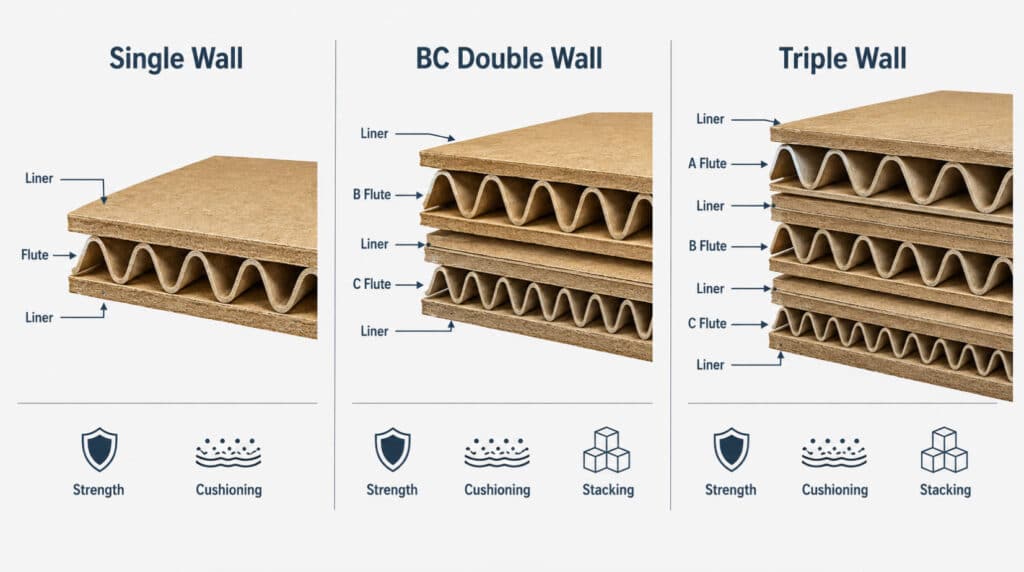
Single‑Wall, Double‑Wall and Triple‑Wall Boards
Flute profile is only one part of the decision. You also need to select the board construction. [hlunpack]
– Single‑face: One liner + one flute; used as internal protection (wrap) rather than as shipping cartons. [youtube]
– Single‑wall: Two liners + one flute layer; standard for most e‑commerce and retail boxes. [hlunpack]
– Double‑wall: Three liners + two flute layers (e.g., BC, EB, EC, FE); suitable for heavy industrial, machinery, and export. [hlunpack]
– Triple‑wall: Four liners + three flute layers; often replaces wooden crates for very heavy or hazardous goods. [hlunpack]
As a manufacturer, when a client sends only “product weight,” we always ask for:
– Stacking height (how high pallets will be stacked).
– Warehouse storage time.
– Transport mode (air, sea, road).
– Product footprint (small fragile vs. large robust). [paperindex]
Those inputs matter as much as the flute type.
E Flute vs B Flute: When Print Quality Beats Thickness
Many buyers confuse E flute with B flute because both are widely used in e‑commerce. The core difference is the number of flutes per meter and the resulting surface characteristics. [propacmaterials]
E flute:
– Thinner profile, more flutes per foot. [propacmaterials]
– Superior print quality and smoother die‑cutting.
– Folds easily, great for smaller boxes and cosmetic packaging. [youtube]
B flute:
– Thicker profile, fewer but taller flutes. [propacmaterials]
– Better cushioning and protection for heavier items.
– Still offers a relatively smooth print surface and is widely used for shipping boxes. [packccp]
In practice:
– If your box is a brand experience (unboxing, retail shelf), E flute or EB flute is usually the smarter choice.
– If your box is a workhorse shipper for heavier goods, B flute or BC flute is safer. [packccp]
Practical Checklist: How to Choose the Right Flute for Your Product
From the perspective of a source‑manufacturer like Bonito Packaging, this is the 5‑step checklist we use with B2B clients:
1. Define product risk
– Is the product fragile (glass, electronics) or robust (textiles, metal parts)?
– What’s the damage tolerance (returns are acceptable vs. near‑zero allowed)? [paperindex]
2. Map logistics reality
– Domestic vs. export; courier vs. palletized freight.
– Typical stacking height in warehouse or containers. [gminsights]
3. Set branding requirements
– Is premium printing essential (beauty, gifting, luxury)?
– Is the box mostly unseen (internal industrial packaging)? [youtube]
4. Choose flute profile and board
– Light, branded goods: E or F fluteo EB double‑wall for heavier D2C. [towardspackaging]
– General e‑commerce and retail shipping: C or B flute single‑wall. [hlunpack]
– Heavy/industrial/export: BC double‑wall or triple‑wall for extreme loads. [youtube]
5. Optimize cost and sustainability
– Use thinner, high‑performance flutes where protection allows to reduce weight and material. [gminsights]
– Avoid over‑engineering (e.g., BC flute for small cosmetics) to minimize cost and CO₂. [towardspackaging]
Example scenario:
A brand shipping 2–3 kg coffee equipment via e‑commerce might choose EB flute mailer boxes: E flute for beautiful branding, B flute for strength, avoiding damage on stacked pallets. A manufacturer shipping 50 kg machinery parts globally would move to BC double‑wall or triple‑wall crates with reinforced corners. [youtube]
Printing Options and UX Considerations on Different Flutes
Modern corrugated packaging is part of the customer experience, not just a container. [towardspackaging]
Common print methods:
– Flexographic printing: Fast, cost‑effective, ideal for large runs; works well on B, C, and BC flutes. [towardspackaging]
– Lithographic (offset) printing: High‑resolution graphics mounted to corrugated; best with E, F, and EB for premium retail packs. [hlunpack]
– Impresión digital: Flexible, plate‑free, efficient for small batches and personalization; performs best on smoother flutes like E and F. [hlunpack]
For UX:
– If the unboxing experience drives reviews and repeat purchases, prioritize smaller flutes (E, F, EB) for cleaner graphics and crisp edges.
– For industrial buyers, a clean, informative one‑color flexo print on B or C flute can still communicate safety, handling instructions, and branding effectively. [hlunpack]
2026 Industry Trends: What Smart Buyers Are Doing Now
Based on recent industry reports and our own client conversations, several trends are reshaping flute selection. [gminsights]
Key trends:
– E‑commerce growth: More mixed SKUs per box, more returns, and higher expectations for damage‑free delivery. [gminsights]
– Sustainability pressure: Brands push for lighter, recyclable boards and microflutes (E, F) that reduce fiber use. [gminsights]
– Engineering‑driven specs: Leading buyers use structured checklists (weight, footprint, stacking, burst strength) instead of “standard box” assumptions. [paperindex]
– Premium D2C branding: Small flutes (E, F, EB) increasingly dominate beauty, electronics, and lifestyle categories because print quality is non‑negotiable. [packccp]
For a manufacturer like Bonito Packaging, the competitive edge comes from helping buyers translate these trends into concrete flute and board choices rather than just quoting a price per box.
Where to Use Each Flute: Typical Applications
To make decisions faster, here is a simple visual matrix you can share with your operations and purchasing teams:
| Use case | Recommended flute | Board type | Rationale |
|---|---|---|---|
| Cosmetics, skincare, small gifts | E or F, sometimes EB | Single- or double‑wall | Premium print, light weight, compact size. towardspackaging |
| Subscription boxes (mid‑weight) | B or EB | Single or double‑wall | Balance between strength and branding. towardspackaging |
| Standard e‑commerce shippers (2–10 kg) | C or B | Single‑wall | All‑purpose shipping, good stacking. propacmaterials |
| Heavy industrial & machinery | BC | Double‑ or triple‑wall | Max protection and stacking strength. towardspackaging |
| Food & beverage trays | B | Single‑wall | Crush and puncture resistance, display‑friendly. propacmaterials |
| Retail micro‑packs, clamshells | F | Single‑wall | Very smooth surface, lower fiber content. towardspackaging |
Actionable CTA: Get Expert Flute Selection Support
If you’re still unsure whether E, B, EB, or BC is the best flute for your product, you shouldn’t rely on guesswork or generic “standard carton” specs. A single wrong choice can lead to breakage, negative reviews, and increased logistics cost.
En Bonito Packaging, we work as a technical partner, not just a box supplier. Share:
– Product type and weight.
– Shipping destinations and stacking height.
– Branding requirements and budget range.
Our packaging engineers will propose a data‑backed flute and board specification tailored to your business, and we can prototype and test before mass production.
PREGUNTAS FRECUENTES
FAQ 1: What is the best corrugated flute for general e‑commerce shipping?
For most general e‑commerce shipping cartons, C flute is considered the best all‑round choice because it balances stacking strength, crush resistance, cushioning, and cost. Around 80% of corrugated containers are made with C flute board globally. [propacmaterials]
FAQ 2: When should I use BC flute instead of B flute?
Utilice BC flute when your product is heavy, fragile, or stacked high on pallets, especially for export or long‑distance transport. BC double‑wall offers significantly higher cushioning and stacking strength than single B flute and is often preferred in machinery and industrial sectors. [youtube]
FAQ 3: Is EB flute overkill for small, lightweight products?
In many cases, yes. EB flute adds strength and improves print quality, but it uses more material and has a higher carbon footprint than single‑wall B or E flute. For light products where damage risk is low, E or F flute with good board quality can be a more cost‑effective and sustainable choice. [propacmaterials]
FAQ 4: Which flute is best for premium cosmetic or skincare packaging?
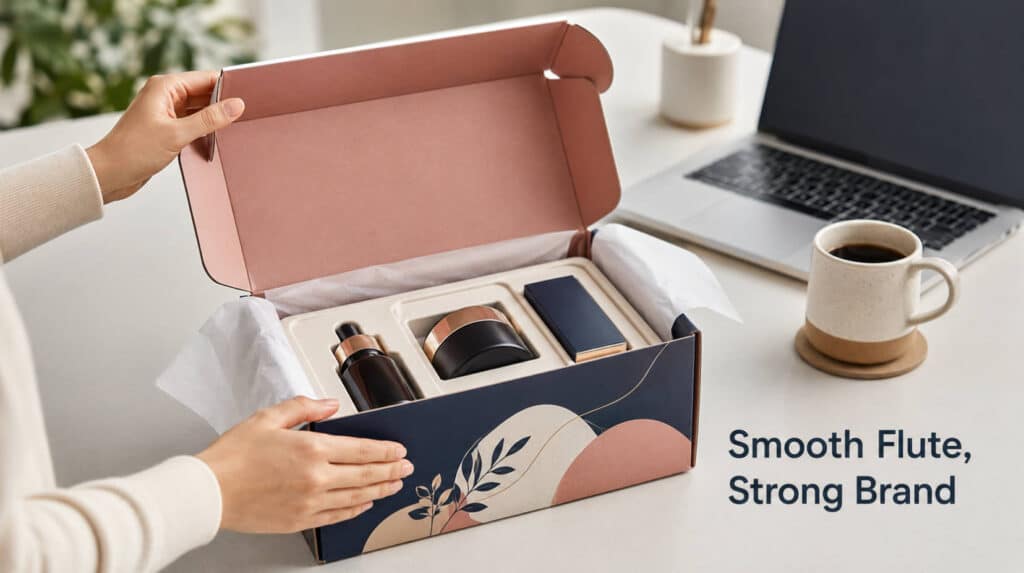
Premium cosmetic and skincare brands typically use E flute or F flute, sometimes combined in EB flute boards for heavier sets. These microflutes provide a smooth surface for high‑resolution printing and compact, elegant box dimensions that enhance the unboxing experience. [youtube]
FAQ 5: How do I make my corrugated packaging more sustainable without losing strength?
You can:
– Shift to smaller flutes (E or F) with engineered papers to reduce fiber usage. [propacmaterials]
– Optimize board grade using verified performance data (edge crush, burst, compression) instead of overspecifying. [paperindex]
– Use double‑wall only where necessary (heavy or stacked products), avoiding over‑engineering across your full SKU range. [gminsights]
References
1. OXO Packaging, “Flute Selection 101: Decoding the Best Corrugated Flute for Your Product.” [towardspackaging]
2. Pro Pac Materials, “Understanding Corrugated Flutes – Packaging Materials.” [propacmaterials]
3. HLunPACK, “Corrugated Box 101: Types, Flute Grades, Testing & How to Choose the Right Shipping Box.” [hlunpack]
4. PackCCP, “Flute Types in Corrugated Boxes: A, B, C, E & F Comparison Guide.” [packccp]
5. PaperIndex Academy, “Matching Corrugated Box Flute Profiles to Product Weight: A Technical Checklist for E-commerce.” [paperindex]
6. GMI Insights, “Corrugated Packaging Market Size, Share, Trends, Report 2035.” [gminsights]
7. Towards Packaging, “Shaped Corrugated Packaging Market Size & Trends 2026–2035.” [towardspackaging]
8. Lumi, “Choosing the Right Corrugated Flute” (YouTube video transcript). [youtube]
9. GUKA Packaging, “B2B Packaging Guide: Choosing the Right Corrugated Flute for Your Product Boxes” (YouTube video transcript). [youtube]
Hot Tags: Corrugated Boxes, Manufacturers, Customized, Custom, Suppliers, Buy, Cheap, Quality, Advanced, Durable, in Stock, Made in China, Price, Quotation, Free Sample
 English
  Spanish
  French
  German
  Russian
  Japanese
  Portuguese
  Arabic