
Content Menu
● Why Custom Packaging Matters More Than Ever
● Retail Packaging vs. Ecommerce Packaging (And Why It Changes Your Strategy)
>> Different channel, different job
● Branding‑First Ecommerce Packaging Ideas
>> 1. Fully branded boxes that fuel unboxing content
>> 2. Custom tape and labels as a low‑lift brand upgrade
>> 3. Custom stickers and tissue for a “gift‑like” unboxing
● Sustainable Ecommerce Packaging That Customers Expect
>> 4. Compostable and biodegradable mailers and cushioning
>> 5. Reusable and repurposable packaging designs
>> 6. Recycled materials and eco‑friendly void fill
● Designing For Customer Experience and Loyalty
>> 7. Inserts, samples and small gifts that feel personal
>> 8. Seasonal and limited‑edition packaging that drives urgency
● Budget‑Friendly Packaging for Growing Ecommerce Brands
>> 9. Personalized notes and custom stamps
>> 10. Shipping box alternatives and structural choices
● How to Choose the Right Custom Packaging for Your Brand
● Practical Implementation Checklist for Ecommerce Teams
● Call to Action: Turn Your Packaging Into a Profit Center
>> よくあるご質問
>> 1. How do I know if my ecommerce brand is ready for fully custom packaging?
>> 2. Is sustainable packaging always more expensive?
>> 3. What is the quickest way to improve my unboxing experience on a small budget?
>> 4. How can I measure the impact of new packaging?
>> 5. How do I choose between rigid boxes and folding cartons for ecommerce?
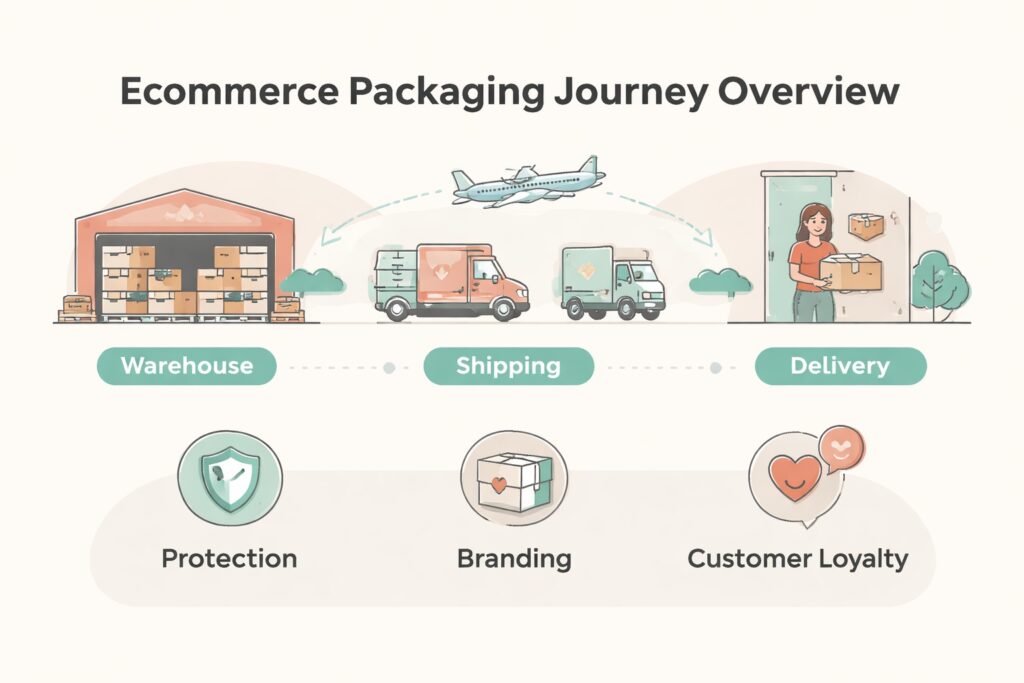
As someone who has spent years helping ecommerce brands turn “plain boxes” into high‑converting brand assets, I’ve seen one simple truth: カスタムパッケージング is often your most underused sales channel. When a package lands at your customer’s door, it is the only physical touchpoint in an otherwise digital journey—waste it, and you lose a powerful moment to build trust, loyalty and referrals. [pakfactory]
Why Custom Packaging Matters More Than Ever
The global custom packaging market was worth around 43–45 billion USD in 2023 and is forecast to grow steadily through 2030 and beyond. That growth is powered by DTC and ecommerce brands who understand that packaging is not just protection—it is brand, marketing and retention in one. [finance.yahoo]
From our vantage point as a custom packaging manufacturer at Bonito Packaging, working with hundreds of ecommerce brands globally, we consistently see three business outcomes from well‑designed custom packaging: [bonitopack]
– Higher repeat‑purchase rates and subscription retention.
– More organic social shares and UGC from unboxing.
– Lower damage rates and fewer returns when structure is engineered properly. [pakfactory]
And customers clearly care. In one widely cited study, 72% of Americans say their purchase decisions are influenced by packaging design, 50% would recommend a product if it arrived in gift‑like or branded packaging, and 40% would share images of unique packaging. When you treat the unboxing as a campaign, not an afterthought, the ROI compounds across your whole funnel. [pakfactory]
Retail Packaging vs. Ecommerce Packaging (And Why It Changes Your Strategy)
Different channel, different job
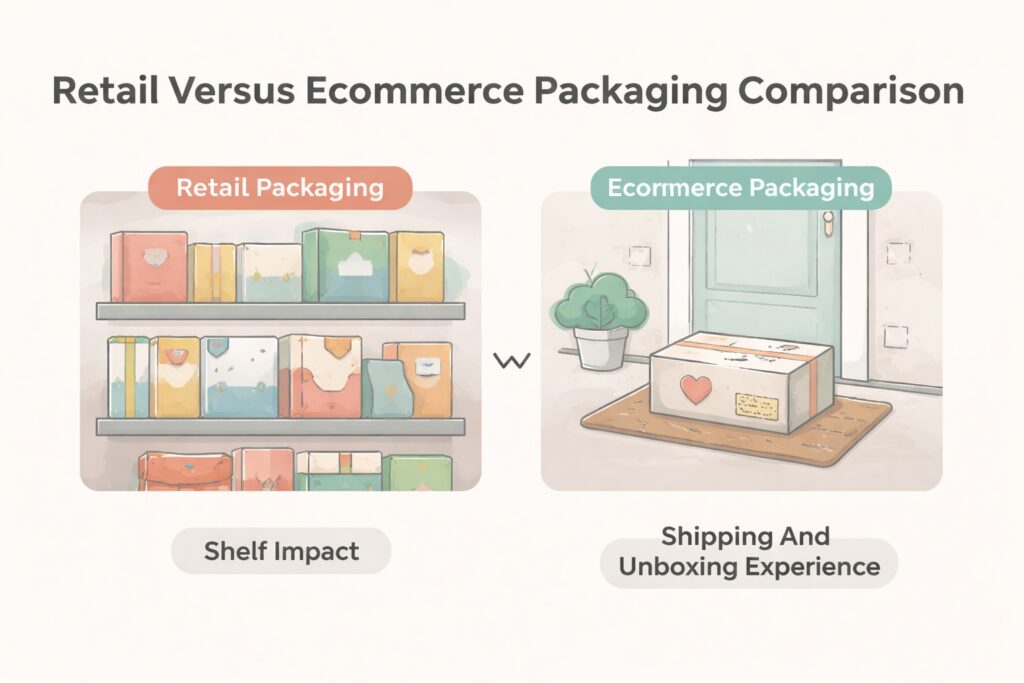
Retail‑ready packaging is built to win attention on a shelf. It leans on detailed graphics, finishes and storytelling because the competition is literally sitting right beside it. It does not need to survive multi‑leg shipping; it just needs to stand out, stack well, and meet retailer requirements. [pakfactory]
Ecommerce‑ready packaging has a different first job: arrive safely, every time. It must handle conveyors, drops, weather, and long‑distance transport. That means: [pakfactory]
– Stronger board grades and structures.
– Smarter internal protection and fit.
– Materials optimized for carriers and fulfillment workflows.
But “functional” does not mean “ugly.” Leading brands now design around “experiential unboxing”—deliberately engineering that first opening moment to feel like a gift, not a shipment. Think of a birthday present: the suspense, the reveal, the tactile layers. That feeling is what you want customers to associate with your brand every single time they open a box. [pakfactory]
Branding‑First Ecommerce Packaging Ideas
1. Fully branded boxes that fuel unboxing content
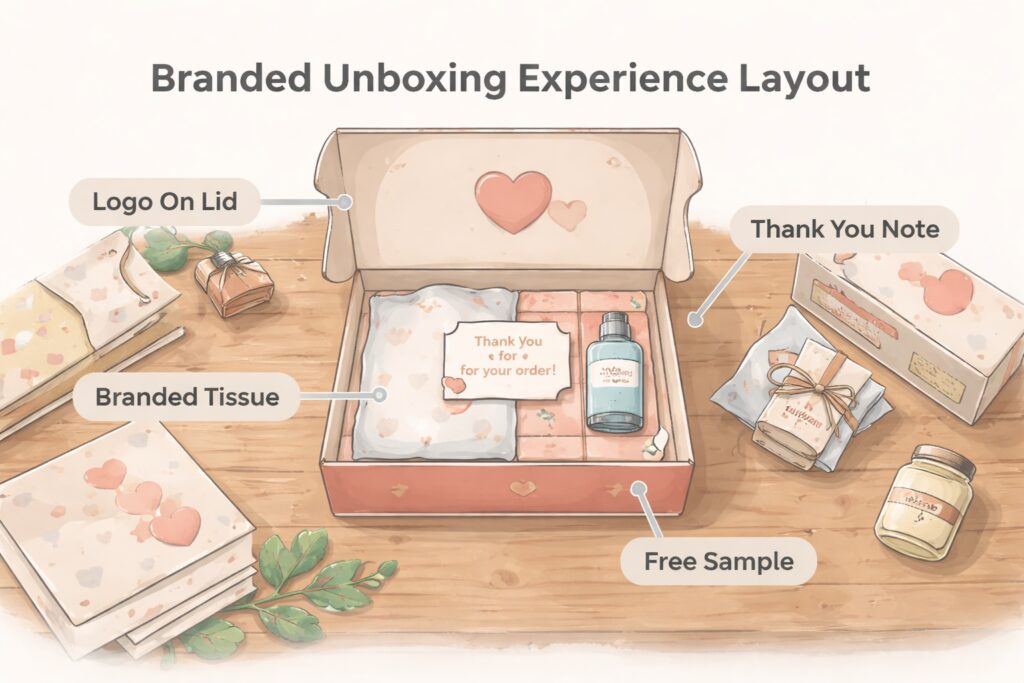
A fully branded box does far more than display your logo—it creates a cohesive, immersive brand story from the outer print to the interior panels. We routinely see brands unlock three wins with this approach: [pakfactory]
– Memorable first impression: Color, typography and messaging are instantly recognizable.
– Built‑in marketing: Branded interiors, hashtags and QR codes turn every box into a shareable moment.
– Higher perceived value: Customers infer quality from thoughtful presentation, not just from the product itself. [pakfactory]
Unboxing videos have made this even more powerful. About 35% of American consumers report watching unboxing videos, and more than half of them say those videos have convinced them to purchase. When your packaging is visually distinct, you increase the odds that creators and customers will feature you in this content—for free. [pakfactory]
Pro tip from the factory: Place your strongest brand elements on the inside lid and first visible layer. That’s what cameras and customers focus on in the first two seconds of an unboxing shot.
2. Custom tape and labels as a low‑lift brand upgrade
If you are not ready for fully custom boxes, custom tape and labels provide a cost‑effective bridge. [pakfactory]
– Brand impact: Your logo or tagline runs across every seal; even plain mailers look more intentional.
– Security: Tamper‑evident tape makes it obvious if a shipment has been opened. [pakfactory]
– Operations: Labels can carry handling instructions (“Fragile”, “This side up”), return info or QR codes for tracking and support.
For growing brands, we often recommend starting with white or kraft mailer boxes plus branded paper tape; you get a clean, premium look without committing to large‑volume custom print runs.
3. Custom stickers and tissue for a “gift‑like” unboxing
Interior branding is where you can deliver a surprisingly premium experience for relatively low cost. [pakfactory]
– Wrap products in branded tissue and seal with a logo sticker.
– Add extra stickers as a small, fun collectible customers can use on laptops, water bottles or luggage. [pakfactory]
– Use interior stickers to communicate care instructions, values (e.g., “Plastic‑free inside”) or micro‑copy that reinforces your brand voice.
Because people associate tissue wrapping with gifts, this simple layer instantly reframes your shipment as a present, not just a delivery. It is especially effective for beauty, fashion, accessories and gifting‑oriented brands. [pakfactory]
Sustainable Ecommerce Packaging That Customers Expect
Sustainability has shifted from “nice‑to‑have” to baseline expectation in many categories. Younger customers in particular are quick to call out excessive plastic and non‑recyclable packaging, and they often choose brands that align with their environmental values. [refinepackaging]
4. Compostable and biodegradable mailers and cushioning
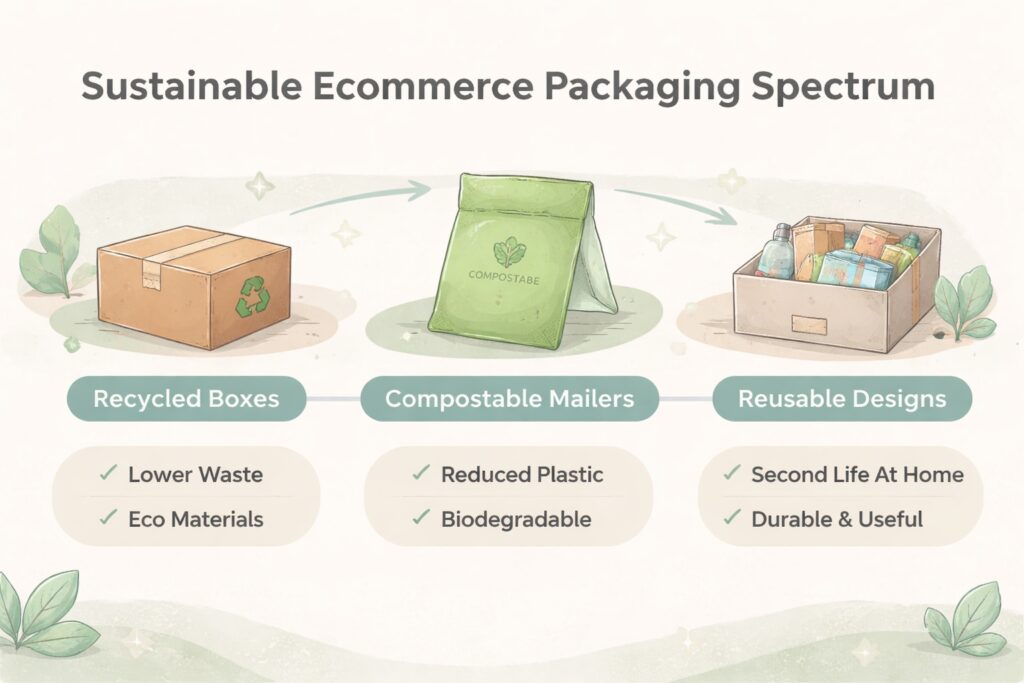
Traditional poly mailers can take hundreds of years to break down and release harmful chemicals as they do. Compostable and biodegradable options—often made from materials like corn starch or agricultural waste—are designed to decompose in months under the right conditions, not centuries. [pakfactory]
Alongside the mailer itself, you can now use:
– Compostable labels and adhesives.
– Biodegradable bubble wrap and packing peanuts. [pakfactory]
This lets you align your packaging with your sustainability messaging, instead of undermining it at the doorstep.
5. Reusable and repurposable packaging designs
One of the most powerful levers you have is to design packaging that does not end its life in the bin.
– Resealable mailers: Allow returns or re‑use by the customer, reducing single‑use waste. [pakfactory]
– Secondary use designs: For example, Monday’s Child in the UK ships children’s clothing in boxes that transform into dollhouses, intentionally creating a second life as a toy. [pakfactory]
At Bonito, we’ve helped brands design boxes that convert into storage organizers, display stands or even simple games. This does three things at once: reduces waste, reinforces your creativity, and keeps your brand literally visible in a customer’s home.
6. Recycled materials and eco‑friendly void fill
Using recycled board and paper is now a mainstream, scalable path to sustainability.
– Kraft mailers made from 100% recycled paper are lightweight, affordable and naturally biodegradable. [pakfactory]
– Air pillows made from recycled content reduce material usage but still protect fragile goods, and they can be reused and recycled. [pakfactory]
– Recycled paper tape replaces plastic tape, keeping more of the packaging stream paper‑based and easy to process. [pakfactory]
From a manufacturing standpoint, specifying recycled content and water‑based inks is one of the easiest ways to reduce the footprint of your packaging without redesigning your whole structure.
Designing For Customer Experience and Loyalty
7. Inserts, samples and small gifts that feel personal
Thoughtful inserts can transform a routine order into a memorable, relationship‑building experience. [pakfactory]
High‑performing examples include:
– Hand‑signed thank‑you notes for first orders or high‑value customers.
– Non‑promotional small gifts (keychains, magnets, art cards) that reflect your brand world. [pakfactory]
– Samples of complementary products to encourage trial and cross‑sell.
– Coupon cards for the next purchase or for gifting to a friend. [pakfactory]
We’ve seen brands lift repeat‑purchase rates significantly simply by adding personalized notes and targeted samples based on order history, even before investing in more complex packaging changes.
8. Seasonal and limited‑edition packaging that drives urgency
Seasonal or limited‑edition packaging leverages scarcity and collectability—two powerful psychological triggers. [prowpak]
– Rotate colors and motifs by season (e.g., “Spring Edition”, “Holiday Edit”) while keeping key brand elements consistent.
– Create limited runs for milestones, collaborations or product launches.
– Encourage customers to share and tag their limited‑edition boxes on social media.
A key detail is to keep language and visuals broad enough (“Winter Collection”, “Spring Edition”) so the designs feel relevant beyond a single holiday. That extends the life of your inventory while still feeling fresh and special. [pakfactory]
Budget‑Friendly Packaging for Growing Ecommerce Brands
You do not need a huge budget to deliver thoughtful, on‑brand packaging. The goal is to invest where customers notice most.
9. Personalized notes and custom stamps
When budgets are tight, handwritten or printed notes and custom stamps offer high emotional impact for minimal cost. [pakfactory]
– Use notes to welcome new customers, share your brand story, or thank them for their specific purchase.
– Apply rubber or pre‑inked custom stamps on plain kraft boxes or mailers to add logo marks, slogans or icons. [pakfactory]
These tactics work especially well for early‑stage brands where a more “human,” artisanal feel actually reinforces the brand positioning.
10. Shipping box alternatives and structural choices
Luxury rigid boxes are beautiful, but they are also expensive, slow to produce and less flexible for smaller brands. In many cases, folding carton boxes achieve a better balance: [pakfactory]
– Lower unit cost and faster production.
– Plenty of structural and print options.
– Often more eco‑friendly than rigid boxes due to material efficiency. [pakfactory]
We often recommend starting with well‑engineered mailer boxes or folding cartons, then layering in branding over time as volumes grow.
How to Choose the Right Custom Packaging for Your Brand
Drawing from dozens of ecommerce projects, we typically guide brands through this simple decision framework:
1. Clarify your primary objective.
Is packaging mainly for protection, premium branding, sustainability signaling, or social content? You can’t maximize everything at once.
2. Map packaging to product and price.
High‑ticket products usually justify richer structural design and interior layers, while lower‑value items may focus on cost control and branded tape or labels.
3. Define your sustainability baseline.
Decide early whether recycled content, plastic reduction or compostability is a must‑have, then engineer from there rather than treating it as an add‑on.
4. Pilot before you scale.
Test 2–3 packaging concepts with small batches and track damage rate, unboxing‑related UGC, customer comments and fulfillment efficiency.
5. Partner with a packaging manufacturer early.
An experienced factory can advise on material specs, structural performance and print constraints long before you lock in designs, saving both time and rework. [bonitopack]
At Bonito Packaging, we typically run structural sampling and small pre‑production runs so ecommerce teams can A/B test designs in the real world before committing to full‑scale orders. [bonitopack]
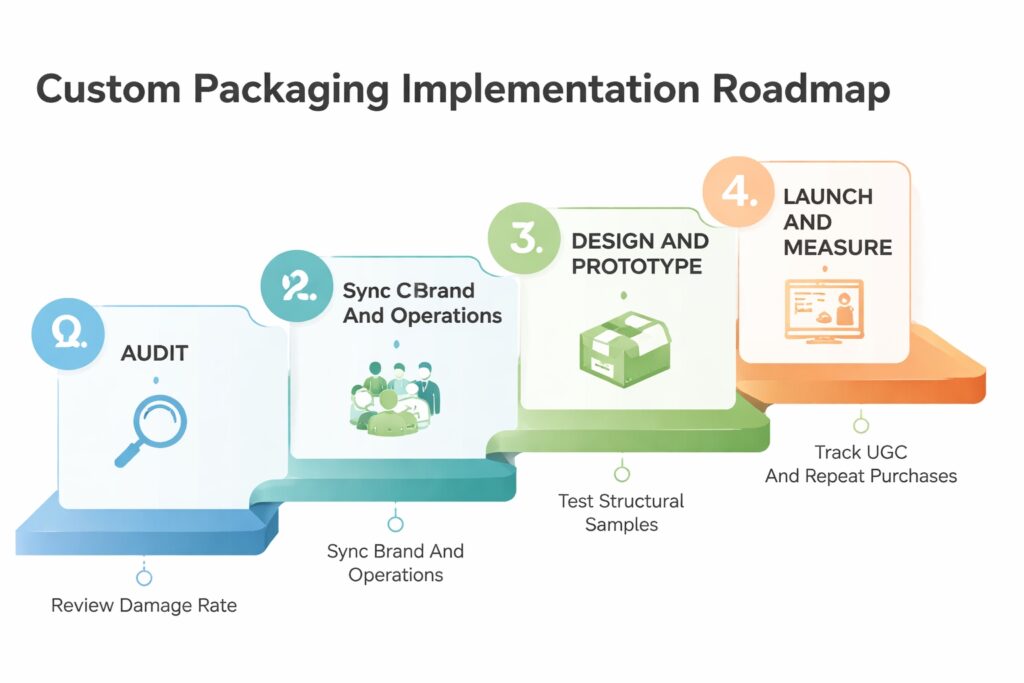
Practical Implementation Checklist for Ecommerce Teams
When you are ready to roll out or upgrade custom packaging, use this checklist to stay organized:
1. Audit your current packaging
– Damage rate, return reasons, customer comments about packaging.
– Total packaging cost per order, including materials, labor and DIM weight.
2. Align stakeholders
– Brand/marketing defines visual and experiential goals.
– Operations and fulfillment validate packing time, storage and shipping constraints.
– Finance agrees on acceptable cost per order.
3. Design and prototype
– Create dielines and artwork for at least two structural options.
– Request samples from your packaging partner and perform drop and crush tests.
– Check compatibility with your current fulfillment line.
4. Launch and measure
– Encourage customers to share unboxing experiences with specific hashtags.
– Track NPS, repeat rate and UGC volume before and after the change.
– Iterate based on real data, not just internal opinions.
This process aligns tightly with Google’s E‑E‑A‑T expectations: you are implementing changes based on real‑world experience, data and expert guidance, not just theory. [refinepackaging]
Call to Action: Turn Your Packaging Into a Profit Center
If your current packaging is “just a box,” you are leaving money, loyalty and brand equity on the table. Thoughtfully engineered custom packaging can lower damage rates, increase repeat purchases, and generate free social exposure—often within a single reorder cycle. [refinepackaging]
If you are ready to:
– Audit your current packaging performance.
– Explore sustainable, on‑brand structures and materials.
– Prototype ecommerce‑ready boxes tailored to your products and fulfillment flow.
Get in touch with a specialized custom packaging manufacturer like Bonito Packaging to review your options and develop a packaging system that supports your next stage of growth. [bonitopack]
Contact us to get more information!
よくあるご質問
1. How do I know if my ecommerce brand is ready for fully custom packaging?
You are usually ready when you have stable order volumes, a clear brand identity, and consistent feedback that your packaging feels generic, underwhelming or wasteful. At that point, even modest investments in branded boxes or interiors can significantly lift perceived value and loyalty. [pakfactory]
2. Is sustainable packaging always more expensive?
Not necessarily. While some compostable materials carry a premium, options like recycled kraft mailers, right‑sized cartons and paper‑based void fill can reduce total packaging and shipping costs by cutting waste and dimensional weight. [refinepackaging]
3. What is the quickest way to improve my unboxing experience on a small budget?
Start with custom tape or stickers and simple interior tissue, plus a short thank‑you note. These changes are inexpensive, easy to implement, and instantly make your shipments feel more thoughtful and branded. [pakfactory]
4. How can I measure the impact of new packaging?
Track metrics such as damage and return rates, customer support tickets mentioning packaging, repeat‑purchase rate, and social mentions or UGC that feature your packaging. Running before‑and‑after comparisons over a few months will show you whether the new design is paying off. [refinepackaging]
5. How do I choose between rigid boxes and folding cartons for ecommerce?
Use rigid boxes when you are selling high‑ticket or giftable items where unboxing is part of the value proposition and margins are high. Use well‑designed folding cartons or mailers when you need a balance of protection, branding and cost efficiency, especially for everyday or subscription products. [pakfactory]
References
1. PakFactory Blog – “10 Creative Ways to Use Custom Packaging for Ecommerce Businesses.”
https://pakfactory.com/blog/10-creative-ways-to-use-custom-packaging-for-ecommerce-businesses/ [pakfactory]
2. Refine Packaging – “10 Critical Packaging & Printing Statistics You Need to Know (2025).”
https://refinepackaging.com/blog/packaging-printing-statistics/ [refinepackaging]
3. Towards Packaging / Precedence Research – “Customized Packaging Market Growth, Trends, Key Segments.”
https://finance.yahoo.com/news/customized-packaging-market-growth-trends-160000454.html [finance.yahoo]
4. Bonito Packaging – Official Site.
https://bonitopack.com and https://bonito-packaging.com [bonito-packaging]
5. ProWPak – “Top 10 Creative Ecommerce Packaging Ideas to WOW Your Customers.”
https://prowpak.com/blogs/top-10-creative-ecommerce-packaging-ideas-to-wow-your-customers/ [prowpak]
Hot Tags: Packaging Design for Ecommerce, Manufacturers, Customized, Custom, Suppliers, Buy, Cheap, Quality, Advanced, Durable, in Stock, Made in China, Price, Quotation, Free Sample
 English
  Spanish
  French
  German
  Russian
  Japanese
  Portuguese
  Arabic