
Content Menu
● Why Subscription Box Packaging Matters for Retention
>> Build the Unboxing Sequence, Not Just the Box
● Choose the Right Custom Subscription Box Style
>> Custom Mailer Boxes: The Default Choice for Many Brands
>> When a Shipping Box Is Better
● Size Subscription Boxes for Products, Protection, and Freight
>> Use This Simple Sizing Method
>> Design Around Your Monthly Product Variations
● Create Subscription Box Packaging Design That Prints Reliably
>> Start With a Production-Ready Dieline
>> Select Print Methods Based on Order Volume
● Protect Products Through Real Shipping Conditions
>> Match the Protection Method to the Product
>> Run a Pre-Production Transit Test
● Make Sustainable Packaging Claims Specific and Verifiable
● A Factory-Ready Subscription Packaging Checklist
● Build Your Next Custom Subscription Box With Bonito Packaging
>> 1. What is the best box type for a subscription box?
>> 2. How do I calculate the right subscription box size?
>> 3. Can folding cartons be used for subscription box packaging?
>> 4. How can I make a subscription box feel premium on a budget?
>> 5. Should subscription box packaging be tested before mass production?
>> 6. What should I ask a custom subscription box supplier?
Subscription box packaging is not simply a shipping container. It is the first physical brand touchpoint your customer sees each month—and it has to perform under real shipping pressure. The right custom subscription box should protect the products, control fulfillment costs, communicate your brand clearly, and create an unboxing experience worth remembering.
For growing subscription businesses, the challenge is balancing presentation with repeatable operations. A beautiful box that arrives crushed, wastes space, or changes size every month can quickly turn into unnecessary cost and customer frustration. At Упаковка Bonito, we approach custom paper packaging as a system: structure, material, print, protection, assembly, and logistics must work together.
This guide explains how to choose, design, test, and source subscription box packaging that supports both your customer experience and your margin.
Why Subscription Box Packaging Matters for Retention
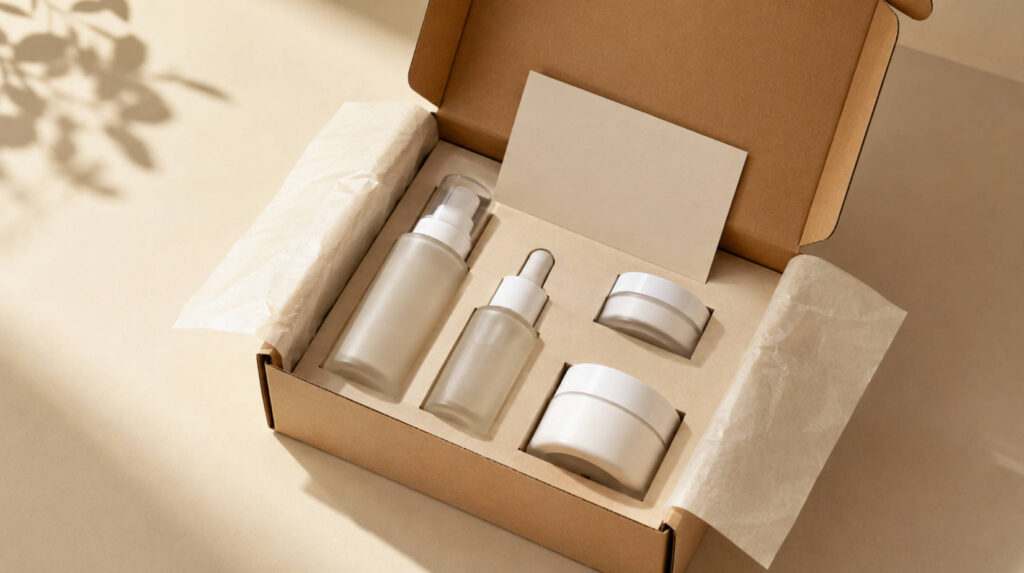
A subscriber has already made the purchase decision. Packaging now influences the moment that confirms—or weakens—that decision. A well-designed subscription box makes the delivery feel intentional, organized, and consistent with the price point of the service.
From a packaging-production perspective, the strongest subscription programs usually achieve three things:
– Защита: Products arrive intact, clean, and correctly positioned.
– Recognition: Customers can identify the brand before opening the box.
– Repeatability: The packaging can be packed efficiently for every recurring shipment.
The experience does not need to be overly elaborate. In fact, a simple corrugated mailer box with a confident logo, a clean interior message, and correctly fitted tissue can feel more premium than a heavily printed box with products shifting inside.
Build the Unboxing Sequence, Not Just the Box
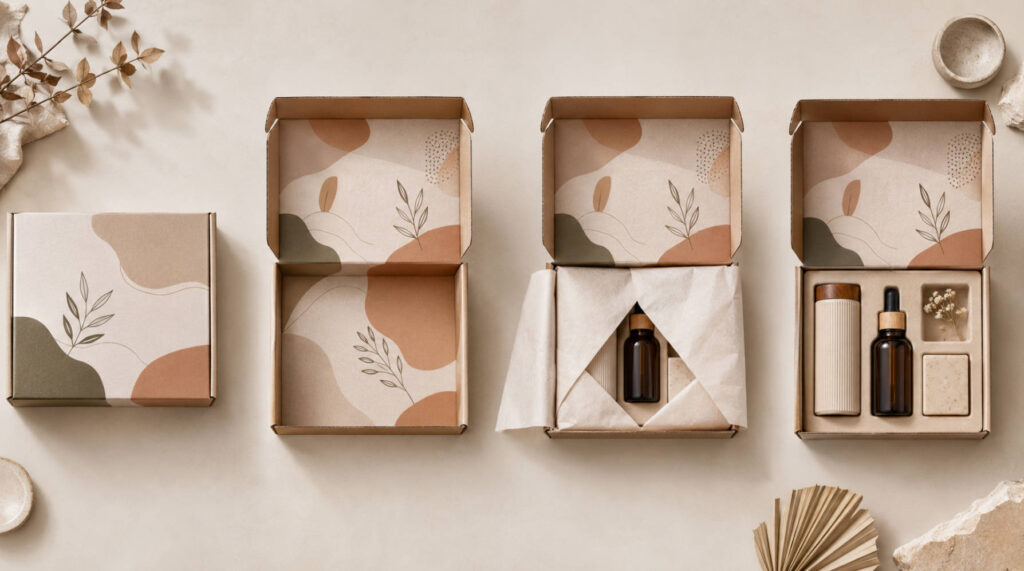
Think of unboxing as a sequence of reveals. The customer should not immediately see loose, disorganized products. Instead, guide their attention in a deliberate order:
1. Exterior: Brand recognition, shipping-ready structure, and a clean first impression.
2. Opening moment: A lid message, pattern, or short welcome statement.
3. Protective layer: Tissue paper, paper fill, or a branded card that conceals the contents.
4. Product reveal: Products presented securely and in a logical order.
5. Next action: A QR code, referral message, product-use guide, or renewal prompt.
This sequence should reflect the subscription category. A skincare subscription may need calm, clinical cues and product education. A gourmet snack box may prioritize discovery, flavor notes, and gift-ready presentation. A B2B sample kit should emphasize precision, specifications, and easy product identification.
Choose the Right Custom Subscription Box Style
The best subscription packaging format depends on product weight, fragility, packing method, shipping channel, and brand positioning. Do not select a style only because it looks attractive in a product photo.
| Box style | Best use | Main advantage | Key consideration |
|---|---|---|---|
| Custom corrugated mailer box | Most direct-to-consumer subscription boxes | Strong, self-locking, brandable inside and out | Confirm board grade and insert needs for fragile products |
| Corrugated shipping box | Heavy, oversized, or multi-product shipments | High compression and transit protection | Usually needs an inner branded layer for a premium reveal |
| Folding carton | Retail-ready individual products or inner boxes | Lightweight and strong shelf presentation | Often needs an outer mailer for parcel shipping |
| Rigid gift box | Luxury, high-value, influencer, or seasonal boxes | Premium tactile experience | Higher unit cost, storage volume, and packing complexity |
| Paper mailer or padded mailer | Apparel, soft goods, low-risk items | Low material use and compact storage | Limited protection and less structured unboxing experience |
Custom Mailer Boxes: The Default Choice for Many Brands
For most recurring subscription shipments, a corrugated mailer box is the most balanced option. Its built-in locking tabs speed up packing, its rigid structure protects products, and its printable surfaces make the interior as useful as the exterior.
However, “corrugated” is not one universal specification. Before approving production, discuss the required flute type, board strength, box orientation, product weight, and whether your shipment will be stacked, dropped, or exposed to long-distance parcel handling. A box that works for two jars may fail when the monthly assortment changes to glass bottles, metal accessories, or heavy refills.
When a Shipping Box Is Better
Use a standard corrugated shipping box when protection is the priority and the contents are heavy, unusually shaped, or packed in several layers. You can still create a branded experience with an inner folding carton, printed tissue, a welcome card, or a custom corrugated insert.
This two-layer approach is often smarter than forcing a decorative mailer to do the work of a high-strength transport carton.
Size Subscription Boxes for Products, Protection, and Freight
Incorrect dimensions are one of the most expensive packaging mistakes. A box that is too small can crush products or make packing slow. A box that is too large can increase void fill, product movement, material use, warehouse space, and shipping charges.
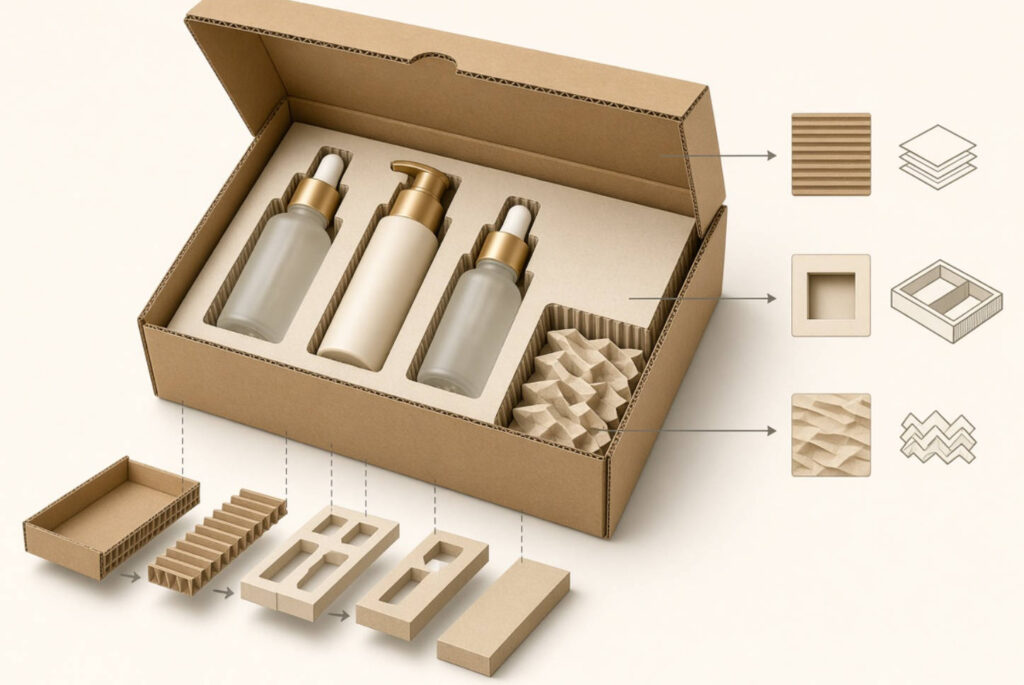
Start with the fully packed product set—not the products alone. Measure the final arrangement including bottles, caps, protective sleeves, inserts, tissue, dividers, and any promotional card.
Use This Simple Sizing Method
1. Arrange the actual products in their intended shipping layout.
2. Add the protection required on every side, including top clearance.
3. Measure the packed arrangement as length × width × height.
4. Add realistic production tolerances instead of designing an excessively tight fit.
5. Make a physical sample and pack it at normal fulfillment speed.
6. Test the packed sample before committing to mass production.
A useful rule is to reduce empty space without making the packout difficult. If warehouse staff must force the lid closed or repeatedly adjust products, the design is not operationally ready.
For U.S. postal shipments, large lightweight parcels may be charged using dimensional weight. USPS states that for packages larger than one cubic foot, DIM weight is calculated from length × width × height divided by 139; if the resulting DIM weight is higher than actual weight, that higher figure determines pricing. This makes right-sizing a financial decision, not merely a design preference.
Design Around Your Monthly Product Variations
Subscription brands often make a critical error: they size packaging around the launch-month assortment. Six months later, the products vary, the fill level changes, and the box is either underfilled or overloaded.
Create a “packaging envelope” before finalizing dimensions:
– Define the smallest and largest expected monthly product configurations.
– Identify the heaviest possible assortment.
– Reserve space for seasonal inserts, cards, and promotional samples.
– Specify which products require dividers, sleeves, or protective pads.
– Establish a maximum acceptable void-fill level.
If your assortment varies greatly, consider two standardized box sizes rather than one oversized “universal” box. This can improve presentation and reduce freight inefficiency.
> Visual suggestion: Insert a simple sizing diagram with “product footprint,” “protective clearance,” “void-fill zone,” and “internal box dimensions” labels.
Create Subscription Box Packaging Design That Prints Reliably
Good packaging design is not only about color and graphics. It must also account for manufacturing tolerances, fold lines, glue areas, print limitations, and the actual direction in which customers open the box.
Start With a Production-Ready Dieline
A dieline is the flat technical template that shows cut lines, creases, glue tabs, and print panels. Your designer should work from the manufacturer’s approved dieline—not a generic template found online.
Before sending artwork to production, check these points:
– Keep essential text and logos away from cut lines and folds.
– Do not place fine text across deep score lines or closing flaps.
– Extend background artwork into bleed areas.
– Confirm the opening direction before placing lid graphics.
– Use high-resolution images and vector files for logos and line art.
– Convert critical brand colors to the agreed printing specification.
– Review the final 3D mockup and physical sample, not only a digital rendering.
Select Print Methods Based on Order Volume
Digital printing is flexible for prototypes, lower quantities, seasonal designs, and frequent artwork changes. Flexographic printing can be more efficient for higher-volume programs with simpler color requirements, while litho-laminated packaging can support detailed, premium graphic reproduction.
The correct method depends on your artwork, order quantity, timeline, target unit cost, and finish expectations. Rather than asking only, “What is the cheapest printing option?”, ask, “Which process delivers the required visual quality at our forecast volume?”
A practical sourcing brief should include box style, internal dimensions, board preference, print coverage, colors, finish, quantity, packing method, delivery destination, and expected reorder frequency. This enables more comparable supplier quotations.
Protect Products Through Real Shipping Conditions
A subscription box must survive more than a short trip from your warehouse to a photo studio. It can face vibration, compression, drops, repeated handling, and changes in shipping orientation.
The International Safe Transit Association’s ISTA 3A procedure is designed for individually packaged products of 150 lb/70 kg or less shipped through parcel delivery systems, including standard, small, flat, and elongated packages distributed by air or ground. It offers a useful benchmark when evaluating an e-commerce packaging system.
Match the Protection Method to the Product
| Product risk | Recommended protection approach |
|---|---|
| Glass bottles and jars | Custom corrugated insert, molded pulp tray, paper wrap, controlled headspace |
| Cosmetics and small accessories | Paperboard divider, die-cut insert, tissue wrap, snug product positioning |
| Apparel and soft goods | Tissue paper, belly band, compact mailer, minimal void fill |
| Food gift assortments | Food-contact-appropriate inner packaging, dividers, product labels, crush protection |
| Heavy mixed products | Double-wall or stronger corrugated shipping carton, layered packing, reinforced base |
| Premium fragile kits | Rigid presentation box inside a protective outer corrugated shipper |
Do not assume that more void fill always means better protection. Loose filler can allow products to move. The goal is controlled movement: products should be cushioned where necessary and held in a stable position.
Run a Pre-Production Transit Test
Before approving a large run, build several packed samples with actual products and simulate the fulfillment process. At a minimum, check:
– Can one person pack the box quickly and consistently?
– Does the lid close without stress or distortion?
– Do products shift when the box is turned upside down?
– Are printed surfaces scuffed after handling?
– Are fragile items protected at corners and edges?
– Does the experience still look premium after transit testing?
For high-value, fragile, or marketplace-bound products, discuss formal testing with your packaging supplier or a qualified testing partner. Test the whole system—product, insert, inner packaging, and outer box—not the empty box alone.
Make Sustainable Packaging Claims Specific and Verifiable
Sustainable subscription packaging should reduce unnecessary material while remaining fit for purpose. A damaged shipment that must be replaced creates additional materials, transport, and customer-service cost, so sustainability and protection must be designed together.
The strongest approach is to make a precise claim that can be supported by documentation. Avoid broad statements such as “100% eco-friendly” unless you can define and substantiate exactly what the claim means.
Consider these practical improvements:
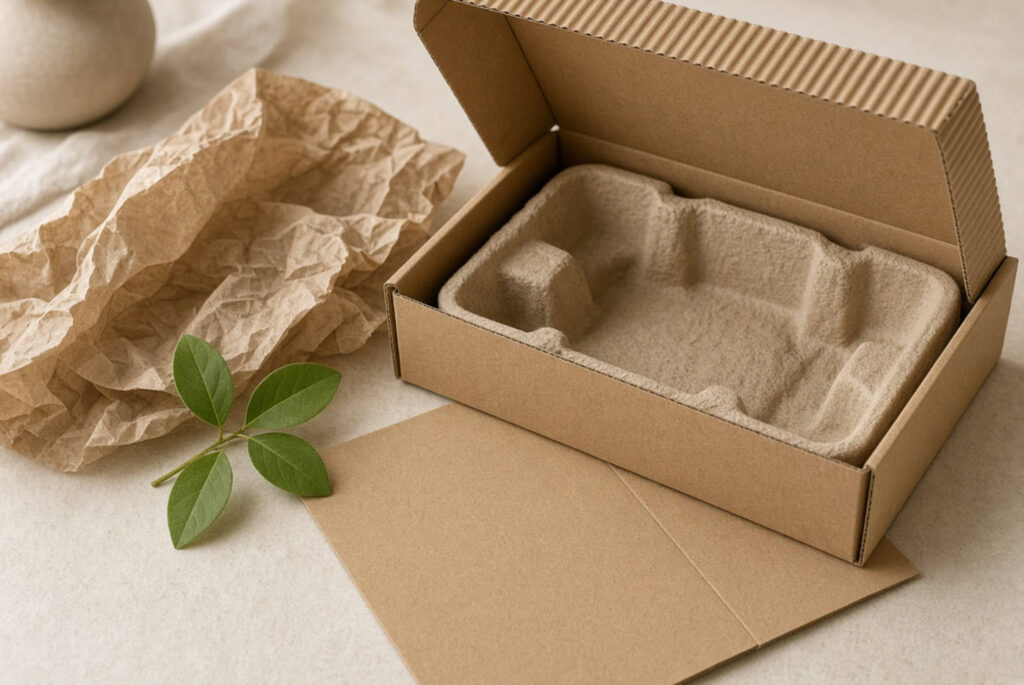
– Right-size the box to reduce unused volume.
– Use paper-based inserts instead of unnecessary mixed-material components where feasible.
– Reduce plastic laminations and difficult-to-separate decorations.
– Specify recycled content only when documentation confirms the percentage.
– Use forest-certification labels only through an eligible, properly certified supply chain.
– Tell customers clearly which components they can recycle locally and which require separate disposal.
The FTC advises that recycled-content claims should clarify whether they apply to the product or the package and state the amount when the item is not entirely recycled. It also notes that a recyclable claim does not guarantee local recyclability for every consumer.
A Factory-Ready Subscription Packaging Checklist
Before requesting a quotation or approving a production sample, prepare the following information:
– Product list, dimensions, weights, and fragility level
– Monthly assortment range and future product-change expectations
– Target internal box dimensions and preferred box style
– Required insert, divider, tissue, card, or sealing solution
– Brand artwork, logo files, colors, and print coverage
– Required material, board strength, and finish
– Target order quantity and annual reorder forecast
– Packout process, fulfillment location, and shipping destinations
– Testing requirements and acceptance criteria
– Sustainability documentation or labeling requirements
– Target delivery date and packaging budget
A professional packaging supplier should ask detailed questions before recommending a structure. If the conversation begins and ends with “box size and quantity,” the solution may not account for the actual product, production, or shipping risks.
Build Your Next Custom Subscription Box With Bonito Packaging
The best subscription box packaging combines a memorable first impression with disciplined engineering. It should fit the monthly product range, protect goods through transit, print consistently, support efficient fulfillment, and make environmental claims responsibly.
Bonito Packaging helps brands develop custom subscription boxes, corrugated mailer boxes, folding cartons, inserts, and premium paper packaging from concept through production. Share your product dimensions, packing requirements, artwork, target quantity, and shipping markets with our team.
Request a custom packaging consultation and quotation from Bonito Packaging to turn your subscription box into a reliable brand experience.
ЧАСТО ЗАДАВАЕМЫЕ ВОПРОСЫ
1. What is the best box type for a subscription box?
For many direct-to-consumer programs, a custom corrugated mailer box offers the best balance of protection, branding space, fast packing, and shipping readiness. Heavy or fragile assortments may need a stronger shipping carton or a protective outer box.
2. How do I calculate the right subscription box size?
Arrange the complete product set in its intended layout, add inserts and protective clearance, then measure the fully packed configuration. Test samples with real products before finalizing internal dimensions.
3. Can folding cartons be used for subscription box packaging?
Yes, but folding cartons are usually better as retail-facing inner packaging. If the shipment will travel through parcel networks, they often need a corrugated outer mailer or shipping box for protection.
4. How can I make a subscription box feel premium on a budget?
Focus on structural fit and a coherent reveal sequence. A well-sized mailer, printed interior message, branded tissue, and clear insert card can create a premium experience without expensive finishes or excessive materials.
5. Should subscription box packaging be tested before mass production?
Yes. At minimum, test packed samples with actual products for product movement, lid closure, scuffing, packing speed, and visual presentation. Fragile or high-value products may require more formal parcel-shipment testing.
6. What should I ask a custom subscription box supplier?
Ask about recommended structure, board grade, printing method, dieline requirements, sample process, production lead time, minimum order quantity, insert options, quality-control process, delivery terms, and sustainability documentation.
References
1. Packlane. “The Complete Guide to Subscription Box Packaging Design.” Originally published August 29, 2019. [Read the original guide].
2. United States Postal Service. “USPS Ground Advantage.” Guidance on dimensional-weight pricing for packages larger than one cubic foot. [Read USPS dimensional-weight guidance].
3. International Safe Transit Association. “Test Procedure Training: ISTA 3A—Parcel Delivery System Shipments 150 lb (70 kg) or Less.” [Read ISTA 3A information].
4. U.S. Federal Trade Commission. “Eco-Friendly and Green Marketing Claims.” Guidance on recycled content and recyclable claims. [Read FTC guidance].
5. Forest Stewardship Council. “FSC Claim, Labels, and Logo.” Explanation of FSC 100%, FSC Recycled, and FSC Mix claims. [Read FSC label guidance].
Hot Tags: Subscription Box Packaging, Manufacturers, Customized, Custom, Suppliers, Buy, Cheap, Quality, Advanced, Durable, in Stock, Made in China, Price, Quotation, Free Sample
 English
  Spanish
  French
  German
  Russian
  Japanese
  Portuguese
  Arabic