
Content Menu
● Understand the Real Lead Time
● Lead Time vs. Production Speed
● Freeze the Structural Design
>> Confirm Fit Before Decoration
● Reduce Rework With Quality Control
>> 1. What is the usual rigid box lead time?
>> 2. Can a rigid box order be expedited?
>> 3. Which features increase lead time most?
>> 4. Does a physical sample always matter?
>> 5. How can I shorten approval time?
>> 6. Is shipping included in manufacturing lead time?
>> 7. Can repeat rigid box orders be faster?
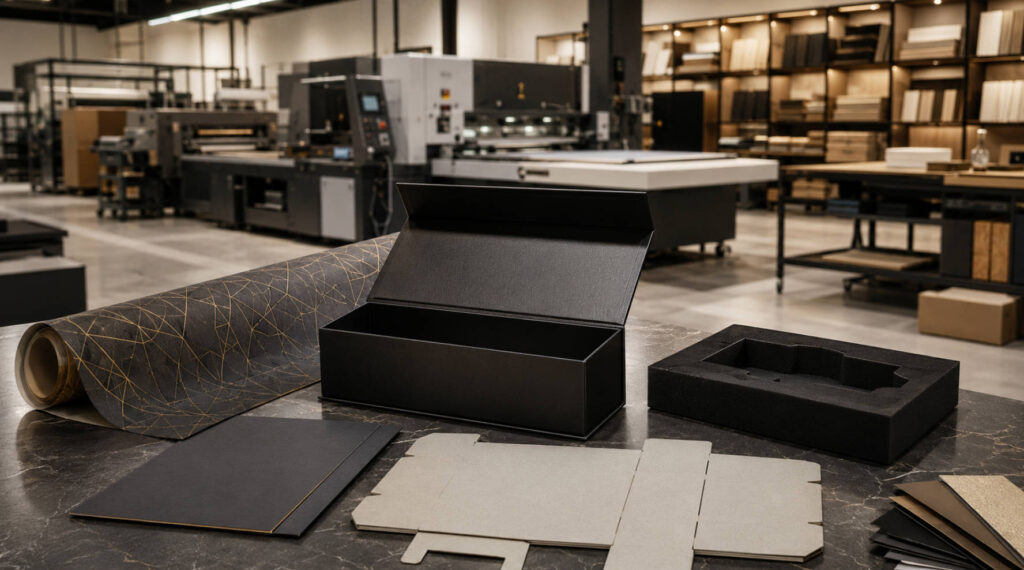
Custom rigid box production is not simply a printing job. It is a coordinated manufacturing process involving structural engineering, material sourcing, prepress, printing, finishing, hand assembly, inspection, and export packing.
For premium brands, a long lead time can delay a product launch, create inventory pressure, or force costly air freight. For packaging buyers, the goal is not merely to receive нестандартные жесткие коробки faster. The real goal is to achieve a shorter, more predictable, and quality-controlled production cycle.
На сайте Упаковка Bonito, we see that the largest causes of delay often appear before mass production starts. Incomplete specifications, repeated artwork revisions, late material decisions, and unapproved samples can stop a project before the factory even begins printing.
This guide explains how to reduce lead times for custom rigid box production without sacrificing appearance, structural strength, or brand consistency.
Understand the Real Lead Time
A custom rigid box is a high-end paper packaging product made from rigid greyboard or chipboard, wrapped with printed paper, specialty paper, fabric, or other decorative materials. Compared with folding cartons, rigid boxes generally require more manual operations and more process coordination.
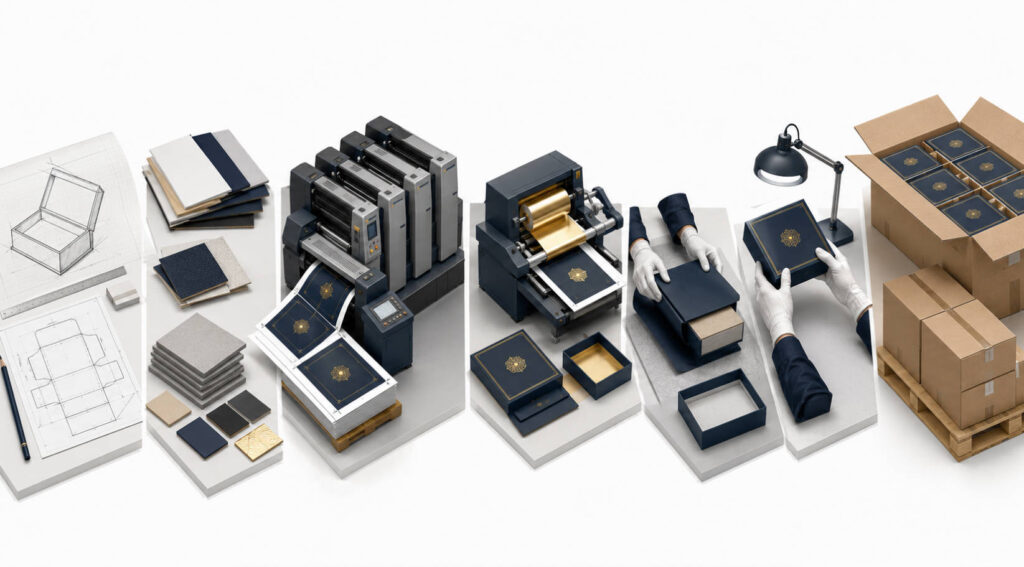
A typical custom rigid box production lead time includes:
– Packaging structure development
– Dieline confirmation
– Artwork prepress and proofing
– Material sourcing and inspection
– Printing and surface finishing
– Die-cutting and board wrapping
– Hand assembly and accessory installation
– Quality control and export packing
– Shipping preparation
The production lead time should also be separated from shipping time. A factory may finish production in 15 working days, while sea freight, customs clearance, or destination delivery can add several weeks.
Key principle: A fast factory cannot fully compensate for an unprepared packaging brief.
Lead Time vs. Production Speed
Buyers often use “lead time” and “production speed” as if they mean the same thing. They do not.
| Фактор | Время выполнения | Скорость производства |
|---|---|---|
| Definition | Total time from confirmed order to goods ready for shipment | Time required to manufacture the boxes after production begins |
| Includes approvals | Да | Usually no |
| Includes material preparation | Да | Иногда |
| Includes sampling | Often | Нет |
| Main risk | Delays across multiple departments or suppliers | Bottlenecks on the production line |
| Buyer focus | Predictable launch planning | Faster output once specifications are locked |
| Best improvement method | Better planning and earlier decisions | Better capacity allocation and workflow efficiency |
A project can have fast production but still suffer from a long overall lead time. For example, a factory may complete printing and assembly in seven days, but the total project may take four weeks if artwork approval, foil stamping dies, or specialty paper selection are delayed.
For this reason, reducing custom rigid box lead times requires a complete supply-chain view. It is not only about asking a manufacturer to “produce faster.”
Start With a Complete Brief
The fastest way to reduce rigid box production lead time is to submit a complete and production-ready packaging brief at the beginning.
An incomplete brief creates a chain reaction. The engineering team cannot finalize the structure. The purchasing team cannot confirm materials. The printing department cannot prepare plates or color proofs. The production planner cannot reserve capacity accurately.
Before requesting a quotation or sample, prepare the following information:
– Box style, such as lid-and-base, magnetic closure, drawer box, book-style box, or shoulder box
– Internal and external box dimensions
– Product weight and product protection requirements
– Quantity by SKU, color, and size
– Board thickness and desired box strength
– Wrap material, including art paper, textured paper, specialty paper, or fabric
– Printing colors, Pantone references, and brand color standards
– Finishing requirements, such as foil stamping, embossing, debossing, spot UV, lamination, or soft-touch film
– Insert requirements, including EVA foam, paperboard, molded pulp, satin, or flocked trays
– Required sample type and approval standard
– Delivery country, target date, and shipping method
Practical tip: Confirm the internal dimensions based on the actual product, not only the product’s nominal dimensions. Allow space for inserts, protective tissue, product tolerances, and easy removal.
Freeze the Structural Design
Structural changes are among the most expensive causes of delay in custom rigid box manufacturing.
A rigid box may look simple from the outside, but its structure affects board cutting, wrap-paper layout, magnetic positioning, insert fit, and assembly instructions. If the box size changes after sampling, many of these steps must be repeated.
Confirm Fit Before Decoration
Do not finalize expensive decorative processes before the product fit is approved. A luxury rigid box can include magnetic closures, ribbon pulls, foam inserts, windows, and multiple components. These details should be tested in a plain or simplified structural sample first.
A practical approval sequence is:
1. Approve the box structure and product fit.
2. Approve the insert protection and opening experience.
3. Confirm paper, board, and finish selections.
4. Approve color and decorative details.
5. Release the final production sample.
This approach prevents brands from approving a visually attractive box that does not fit the product correctly.
Standardize Where Possible
Customization does not require reinventing every component.
Brands can reduce lead time by standardizing selected elements across different SKUs, including:
– Base box styles
– Board thicknesses
– Insert formats
– Magnetic sizes
– Ribbon materials
– Paper families
– Carton packing configurations
For example, a skincare brand may use the same magnetic rigid box structure for three product sets while changing only the artwork, product insert, and foil color. This keeps the luxury presentation while reducing engineering and setup time.
Make Artwork Print-Ready
Artwork problems can delay a rigid box order before production starts. Missing bleed, incorrect dielines, low-resolution images, unclear spot-color instructions, and editable fonts can all create extra prepress rounds.
For custom printed rigid boxes, buyers should provide a final production file rather than a design concept alone.
A print-ready artwork package should include:
– Final dieline supplied or approved by the manufacturer
– High-resolution PDF artwork
– CMYK and Pantone color specifications
– Clearly marked foil, embossing, debossing, and spot UV areas
– Fonts converted to outlines or supplied with licenses
– Images at suitable print resolution
– Bleed and safe-area allowances
– Separate artwork files for each SKU or language version
Important: Do not place critical text, logos, barcode elements, or fine borders too close to trim, fold, or wrap edges. Rigid boxes involve wrapping and positioning tolerances that differ from a flat printed sheet.
Use One Approval Owner
Multiple stakeholders can improve a packaging project, but too many approvers can create delays. Marketing may focus on appearance, procurement may focus on cost, and operations may focus on delivery timing.
Assign one person to consolidate feedback and issue final approval. This avoids receiving conflicting revision requests from different teams.
A clear approval owner can reduce unnecessary email cycles and make production scheduling more reliable.
Choose Materials Early
Specialty materials can create premium packaging, but they can also create procurement risk.
Standard coated paper and common greyboard may be readily available. In contrast, imported textured paper, custom-colored paper, unusual fabric, premium metallic paper, or special foam inserts may require longer sourcing time.
To shorten custom rigid box lead times, confirm materials as early as possible.
| Material Choice | Lead-Time Impact | Recommended Approach |
|---|---|---|
| Standard art paper | Usually lower risk | Suitable for repeatable branded packaging |
| Common greyboard thickness | Usually lower risk | Confirm strength requirements early |
| Specialty textured paper | Medium to high risk | Request availability before design approval |
| Custom-dyed paper | Higher risk | Order or reserve material early |
| Imported fabric or leatherette | Higher risk | Build buffer time into the project |
| Custom EVA foam | Medium to high risk | Approve product dimensions before tooling |
| Foil stamping film | Medium risk | Confirm color and width before production |
| Custom hardware or metal parts | High risk | Treat as a separate procurement project |
At Bonito Packaging, a practical planning approach is to identify long-lead components during quotation, not after order confirmation. This allows the buyer to decide whether to use an alternative in-stock material, reserve stock, or extend the launch schedule.
Simplify Premium Finishes
Luxury finishes add value, but every additional process creates another production dependency.
Foil stamping may require a custom die. Embossing and debossing require precise alignment. Spot UV needs additional screening and curing steps. Magnetic closures require accurate placement and controlled assembly. These features are worthwhile when they support the brand story, but they should be selected deliberately.
A faster design is not necessarily a less premium design.
Instead of combining five decorative treatments, consider one or two signature finishes. For example:
– Soft-touch lamination with a single gold foil logo
– Textured specialty paper with blind embossing
– Matte lamination with a debossed brand mark
– Premium uncoated paper with one-color printing and a ribbon pull
This design discipline can shorten setup time, reduce quality risk, and create a more refined appearance.
Expert view: Premium packaging often looks more expensive when the design has a clear focal point rather than too many competing effects.
Plan Sampling Strategically
Sampling is essential for high-value custom rigid boxes. However, sampling should answer specific questions. A sample process becomes slow when buyers request repeated changes without defining what needs approval.
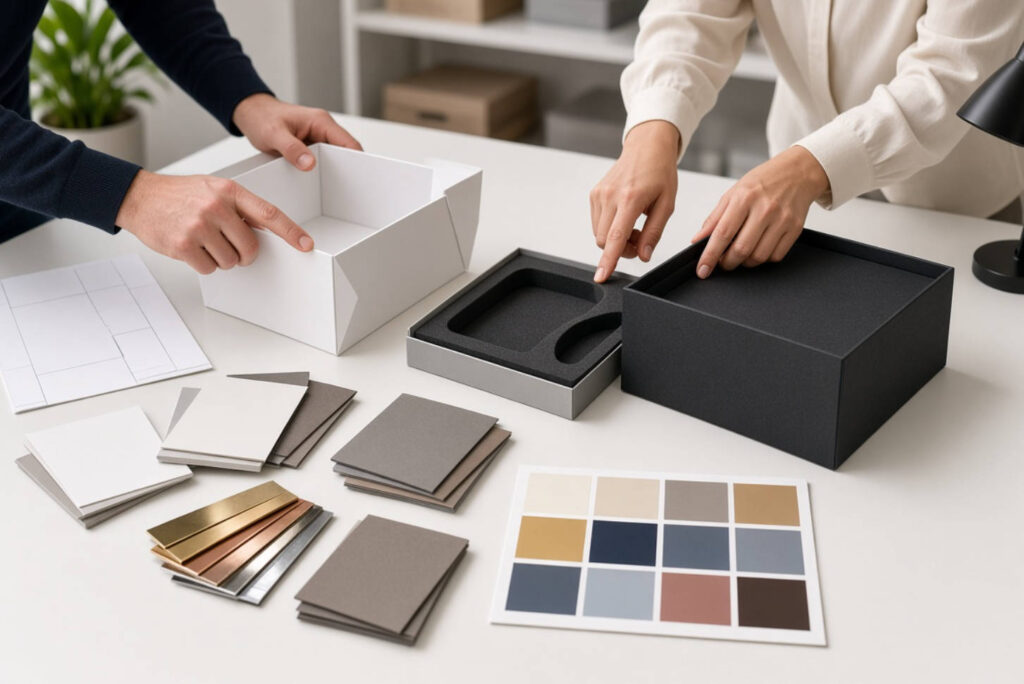
Use different sample types for different decisions.
| Sample Type | Лучше всего подходит для | Lead-Time Benefit |
|---|---|---|
| Digital mockup | Reviewing layout and basic visual direction | Fast early feedback |
| White sample | Checking dimensions, structure, and product fit | Prevents structural rework |
| Material swatch | Selecting paper, board, fabric, and foil | Confirms appearance before production |
| Pre-production sample | Approving final color, finish, and assembly | Reduces mass-production uncertainty |
| Golden sample | Creating the final quality benchmark | Improves inspection consistency |
A “golden sample” is especially important for repeat orders. It gives the buyer and manufacturer a shared visual and functional reference for color, wrapping quality, corners, adhesive cleanliness, magnetic alignment, and insert fit.
For urgent projects, avoid changing structure, artwork, and materials at the same time. Change one major variable per sampling round whenever possible.
Reserve Capacity Early
Lead time is also a capacity-planning issue.
Factories manage multiple projects, production lines, hand-assembly teams, printing schedules, and material deliveries. A buyer who confirms an order late may enter the queue behind already scheduled work.
To improve delivery reliability:
– Share your expected launch date during the quotation stage
– Provide a realistic forecast for repeat packaging programs
– Confirm quantities as early as possible
– Ask the manufacturer to identify busy production periods
– Reserve production capacity for seasonal campaigns
– Approve final artwork before the scheduled production slot
– Avoid last-minute quantity changes after material preparation
For holiday launches, beauty promotions, retail events, and product releases, it is wise to work backward from the required delivery date. Include time for production, inspection, shipping, customs, warehousing, and distribution to retailers.
Planning rule: The earlier a packaging manufacturer can schedule materials and labor, the more likely it can protect your delivery date.
Use a Critical Path
A critical-path plan identifies the activities that directly determine whether the packaging project can finish on time.
For custom rigid box production, the critical path often includes:
1. Product dimensions and box structure approval
2. Dieline and artwork approval
3. Long-lead material availability
4. Sample approval
5. Printing and finishing setup
6. Hand assembly and insert installation
7. Final inspection and export packing
Not every task has the same urgency. For instance, the shipping carton artwork may be less critical than the final wrap-paper artwork. A production manager should focus first on the steps that can stop all downstream work.
Example Timeline
A premium magnetic rigid box project may follow this simplified timeline:
| Stage | Typical Focus | Buyer Action |
|---|---|---|
| Days 1–3 | Brief review and structural confirmation | Provide complete specifications |
| Days 4–7 | Dieline and white sample | Test product fit quickly |
| Days 8–10 | Artwork finalization and material confirmation | Approve one consolidated revision |
| Days 11–14 | Pre-production sample or proof | Confirm color and finishes |
| Days 15–25 | Printing, finishing, wrapping, and assembly | Avoid scope changes |
| Days 26–28 | Final QC and packing | Confirm shipping documents |
This is an illustrative planning framework, not a universal guarantee. Actual lead time depends on order quantity, box complexity, finishing processes, material availability, factory capacity, and approval speed.
Reduce Rework With Quality Control
Reducing lead time should never mean skipping quality control. In premium packaging, a rushed shipment with color issues, exposed greyboard, poor corner wrapping, weak magnets, or incorrect inserts can cost more than a longer production cycle.
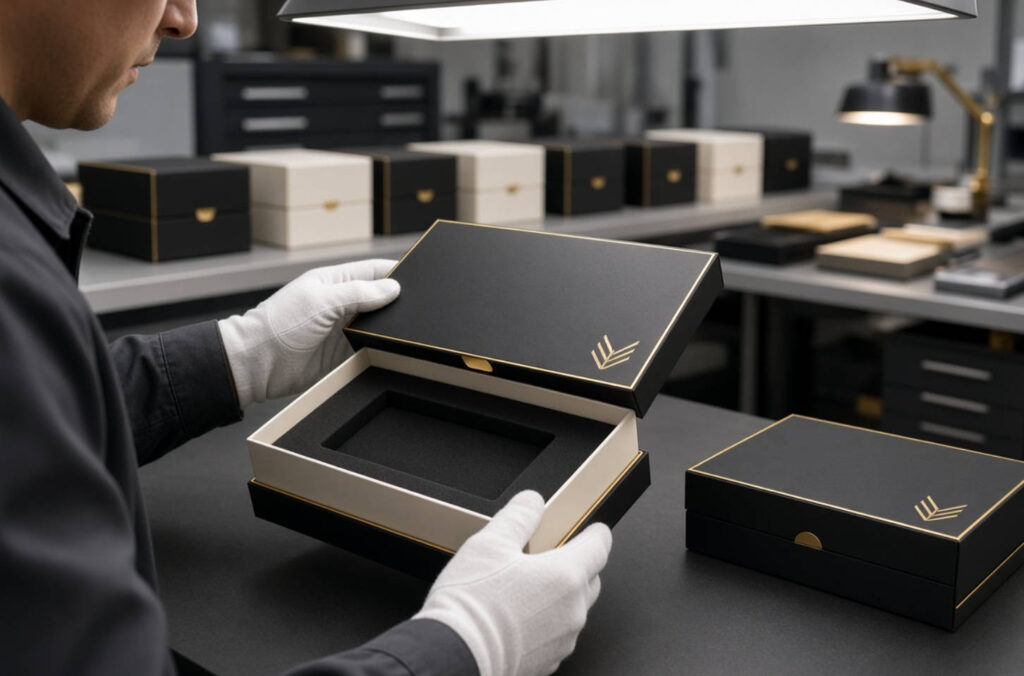
The right approach is to build quality checks into the process rather than relying only on final inspection.
Useful in-process controls include:
– Incoming inspection for board, paper, and accessories
– Color approval before full printing
– First-piece inspection at each major process
– Checks for foil, embossing, and spot UV alignment
– Monitoring of glue application and wrap tension
– Verification of box dimensions and lid fit
– Magnetic closure alignment checks
– Insert fit testing with the real product
– Final random inspection before export packing
A reliable manufacturer should document standards for acceptable color variation, corner quality, surface cleanliness, glue marks, and packaging protection.
Fast and controlled is better than fast and uncertain.
Build a Repeat-Order System
The best opportunity to reduce lead times often appears after the first successful production run.
Once the structure, material, artwork, and quality standard are stable, Bonito Packaging can help buyers create a repeat-order system. This can include approved dielines, archived artwork files, material specifications, color references, golden samples, and packing instructions.
For repeat programs, brands can also consider:
– Keeping approved raw materials available
– Using forecast-based production planning
– Pre-booking capacity for major seasons
– Maintaining a safety-stock level for fast-moving products
– Standardizing inserts across product families
– Creating a controlled artwork version-management process
This converts packaging from a one-off purchasing task into a managed supply program.
Work With Bonito Packaging
Reducing lead times for custom rigid box production begins with earlier decisions, clearer approvals, and stronger coordination between your brand and packaging manufacturer.
Bonito Packaging is a source manufacturer of premium custom paper packaging, including rigid boxes, magnetic gift boxes, drawer boxes, lid-and-base boxes, and customized paper inserts. Our team can support your project from structural development and material selection to sampling, mass production, quality control, and export packing.
If you are preparing a product launch or need a more dependable rigid box supply plan, send us your box dimensions, quantity, artwork status, finishing requirements, and delivery target. We will help you identify lead-time risks before they become production delays.
Вопросы и ответы
1. What is the usual rigid box lead time?
Custom rigid box production commonly requires several weeks after final specifications and samples are approved. The exact timeline depends on box structure, order quantity, finishes, material availability, and the complexity of inserts or accessories.
2. Can a rigid box order be expedited?
Yes, some projects can be expedited when the artwork is final, materials are available, and production capacity is open. However, urgent production should not remove structural testing or quality-control requirements.
3. Which features increase lead time most?
Custom specialty papers, complex inserts, magnetic closures, foil stamping, embossing, debossing, spot UV, multiple SKUs, and repeated artwork changes can all extend the production schedule.
4. Does a physical sample always matter?
For premium, high-value, fragile, or unusually shaped products, a physical sample is strongly recommended. It confirms product fit, opening experience, insert performance, and the visual quality of materials and finishes.
5. How can I shorten approval time?
Prepare a complete brief, assign one final decision-maker, consolidate feedback, and approve structural fit before reviewing decorative details. Avoid submitting multiple unrelated changes in one revision round.
6. Is shipping included in manufacturing lead time?
Usually, no. Manufacturing lead time normally ends when goods are inspected, packed, and ready for shipment. Sea freight, air freight, customs clearance, and final delivery should be planned separately.
7. Can repeat rigid box orders be faster?
Yes. Repeat orders can move faster when the dieline, artwork, materials, color standards, quality requirements, and packing instructions have already been approved and documented.
References
1. Box Agency. “Custom Rigid Packaging Production: Workflow, Capacity & Lead Time.” Covers the stages of rigid packaging production and indicative production ranges. [Read the source] [boxagency]
2. INNORHINO. “Custom Packaging Design and Manufacturing Guide.” Outlines the stages from packaging strategy and prototyping through printing, finishing, assembly, QC, and shipping preparation. [Read the source] [innorhino]
3. Goldsmiths, University of London Print Services. “How to Create a Print-Ready PDF.” Provides practical print-artwork guidance, including the use of 3 mm bleed. [Read the source] [gold.ac]
4. Printed.com. “Your Ultimate Guide to Creating Perfect Print-Ready Artwork.” Explains print-ready artwork principles, including bleed and production-file preparation. [Read the source] [printed]
5. Originality Packaging. “How Long Does Custom Packaging Take? Real Production Timeline.” Provides indicative timelines and explains how sampling, complexity, finishes, and shipping affect total project duration. [Read the source] [originalitypack]
6. NSF. “ISO 9001: Quality Management Systems Certification.” Background reference for process-based quality management principles relevant to controlled manufacturing workflows. [Read the source] [nsf]
Hot Tags: Custom Rigid Box, Manufacturers, Customized, Custom, Suppliers, Buy, Cheap, Quality, Advanced, Durable, in Stock, Made in China, Price, Quotation, Free Sample
 English
  Spanish
  French
  German
  Russian
  Japanese
  Portuguese
  Arabic