
Content Menu
● Why Holiday Packaging Matters for Modern Brands
● What the Original Holiday Packaging Guide Misses
● 15 Holiday Packaging Ideas for Custom Paper Packaging
>> 1. Use Seasonal Colors Without Abandoning Your Brand Identity
>> 2. Create a Limited-Edition Holiday Sleeve
>> 3. Build Gift Sets With Custom Rigid Boxes
>> 4. Add Foil Stamping for a Premium Seasonal Detail
>> 5. Use Embossing or Debossing for Tactile Brand Recognition
>> 6. Design a Holiday Pattern That Works Beyond December
>> 7. Choose Kraft Packaging for a Warm, Natural Look
>> 8. Make the Inside of the Box Part of the Experience
>> 9. Use Custom Inserts to Protect and Present Products
>> 10. Offer Gift-Ready Packaging for E-Commerce Orders
>> 11. Add Ribbons, Tags, and Seals With Purpose
>> 12. Use Monochrome Design to Stand Out From Holiday Clutter
>> 13. Add Personalized Elements for Corporate Gifting
>> 14. Use Recyclable Paper-Based Designs Where Possible
>> 15. Plan Production Earlier Than You Think
● How to Choose the Right Holiday Packaging Style
● Why Work With Bonito Packaging for Holiday Projects
>> 1. What is holiday packaging?
>> 2. What type of box is best for holiday gift packaging?
>> 3. How can I make my packaging look more premium?
>> 4. Can holiday packaging be sustainable?
>> 5. When should I start planning custom holiday packaging?
>> 6. Can I use the same holiday packaging design for retail and e-commerce?
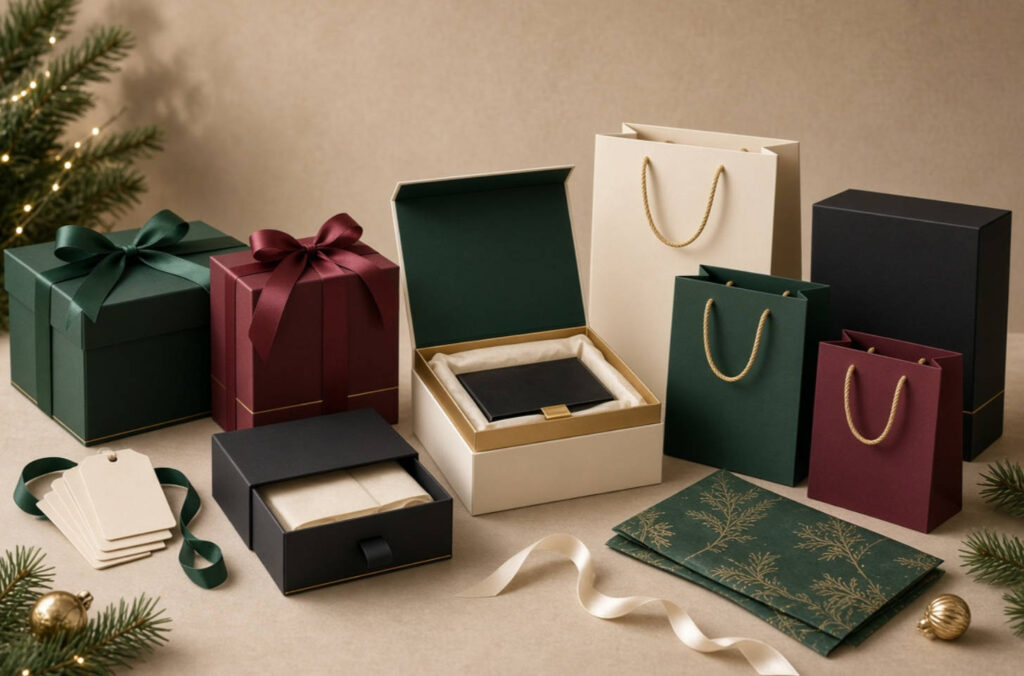
Holiday packaging is no longer just a protective layer around a product. For brands competing during the busiest gifting season, custom holiday packaging can turn an ordinary delivery into a memorable gift, reinforce brand value, and help products stand out in crowded retail and e-commerce channels.
Em Embalagem de Bonito, we manufacture premium custom paper packaging for brands that need more than a standard box. From rigid gift boxes and folding cartons to custom inserts, tissue paper, sleeves, ribbons, and branded mailer boxes, the right seasonal packaging can make every touchpoint feel intentional—from the first online impression to the final unboxing moment.
Why Holiday Packaging Matters for Modern Brands
The holiday season creates a high-pressure environment for retailers, DTC brands, subscription companies, and corporate gifting programs. Consumers compare more products, evaluate value more closely, and often buy items specifically to give to someone else.
That means packaging has a different job during the holiday season. It must protect the product, communicate the brand, create a gift-ready presentation, and support an enjoyable unboxing experience.
For a customer, a well-designed holiday package can signal:
– Higher perceived value before the product is even opened
– Better gift readiness, reducing the need for extra wrapping
– More confidence in a premium or limited-edition purchase
– A more shareable, memorable brand experience
– Greater attention to visual detail and product quality
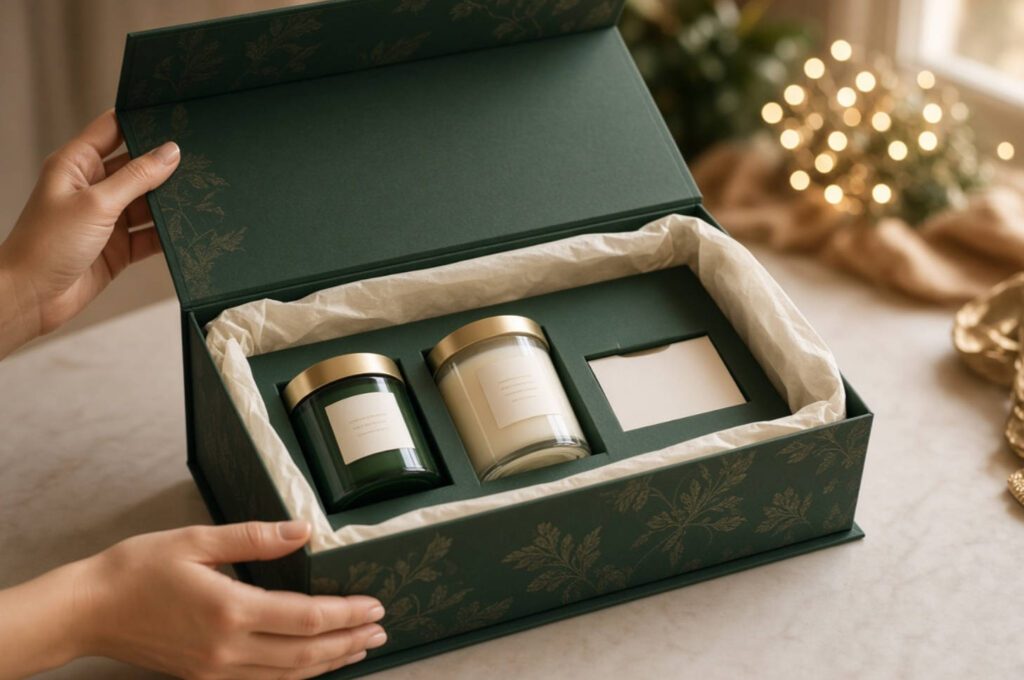
For brands, seasonal packaging is also a practical commercial tool. It can differentiate an existing SKU without requiring a completely new product line. A skincare brand may use the same jars and formulas but introduce a holiday rigid box. A candle company can add a festive sleeve, foil logo, and molded insert. A gourmet food brand can convert multiple products into a giftable set with a custom presentation box.
This matters especially in e-commerce. A 2025 Ryder survey reported that 61% of respondents considered sustainable packaging when assessing e-commerce’s environmental impact, while 16% said sustainable packaging was among the factors most likely to make them shop with a brand again. The message is clear: customers notice packaging, and they increasingly connect it with their perception of the brand.
What the Original Holiday Packaging Guide Misses
Many holiday packaging articles focus almost entirely on visual trends: red and green colors, festive patterns, ribbons, embossing, and tissue paper. These are useful starting points, but they do not fully address what brand owners, purchasing managers, and packaging teams need to decide before production.
A stronger holiday packaging strategy should answer five operational questions:
1. What does the customer need the package to do?
Is it a shelf-ready retail carton, a shipping-safe e-commerce box, a luxury gift box, or a corporate gifting kit?
2. How will the product be protected during fulfillment and transit?
A beautiful package that arrives crushed, scuffed, or damaged does not create a premium experience.
3. What packaging features genuinely support the brand position?
Not every product needs gold foil, magnetic closures, or multiple layers of wrapping. The structure and finish should match the price point and buyer expectation.
4. Can the packaging be produced within the holiday timeline?
Seasonal packaging requires earlier planning than many brands expect because structural design, sampling, material sourcing, printing, finishing, assembly, and shipping all take time.
5. Is the sustainability message credible and practical?
A package should not make vague “eco-friendly” claims if its materials, coatings, components, or disposal instructions do not support that claim.
The best holiday packaging is not simply decorative. It is commercially purposeful, structurally functional, and emotionally engaging.
15 Holiday Packaging Ideas for Custom Paper Packaging
1. Use Seasonal Colors Without Abandoning Your Brand Identity
Traditional red, green, gold, silver, white, and deep navy remain popular holiday colors. However, a brand does not need to copy a conventional Christmas palette to look festive.
Instead, adapt your existing brand colors with a seasonal accent. For example:
– A minimalist skincare brand can use ivory, soft sage, and gold foil.
– A luxury chocolate brand can use matte black, burgundy, and metallic copper.
– A children’s brand can use bright red, cobalt blue, and playful illustrated characters.
– A wellness brand can use kraft paper, forest green, and natural cotton ribbon.
The goal is to make the package feel seasonal while remaining unmistakably yours. Brand consistency is often more valuable than following a short-lived color trend.
2. Create a Limited-Edition Holiday Sleeve
A custom printed sleeve is one of the most flexible ways to launch seasonal packaging without redesigning the entire primary box.
A sleeve can wrap around a standard folding carton, rigid box, candle box, skincare carton, or mailer. It gives brands space for holiday artwork, limited-edition messaging, campaign slogans, QR codes, or gift-set information.
This solution works particularly well when:
– You already have inventory of existing packaging
– You want a lower-risk seasonal test
– You have multiple products with a shared holiday campaign
– You need a more economical alternative to a fully customized box
A holiday sleeve can also make a standard product feel like a special edition. This approach is ideal for cosmetics, candles, tea, coffee, confectionery, apparel accessories, and subscription boxes.
3. Build Gift Sets With Custom Rigid Boxes
Rigid boxes are one of the strongest choices for premium holiday gift packaging. Their sturdy construction, clean edges, and substantial feel make them suitable for products that need to feel valuable before they are revealed.
Popular structures include:
– Two-piece lift-off lid rigid boxes
– Magnetic closure boxes
– Drawer-style rigid boxes
– Shoulder-neck rigid boxes
– Book-style presentation boxes
– Rigid boxes with removable inserts
A well-designed custom rigid box can hold several products in a gift set while keeping each item organized and protected. It is especially effective for beauty kits, wine accessories, luxury food gifts, jewelry, electronics, premium stationery, and VIP corporate gifts.
Expert recommendation: If your product has a high average order value or is frequently purchased as a gift, prioritize structural quality before adding decorative finishes. A weak box with expensive foil stamping still feels weak.
4. Add Foil Stamping for a Premium Seasonal Detail
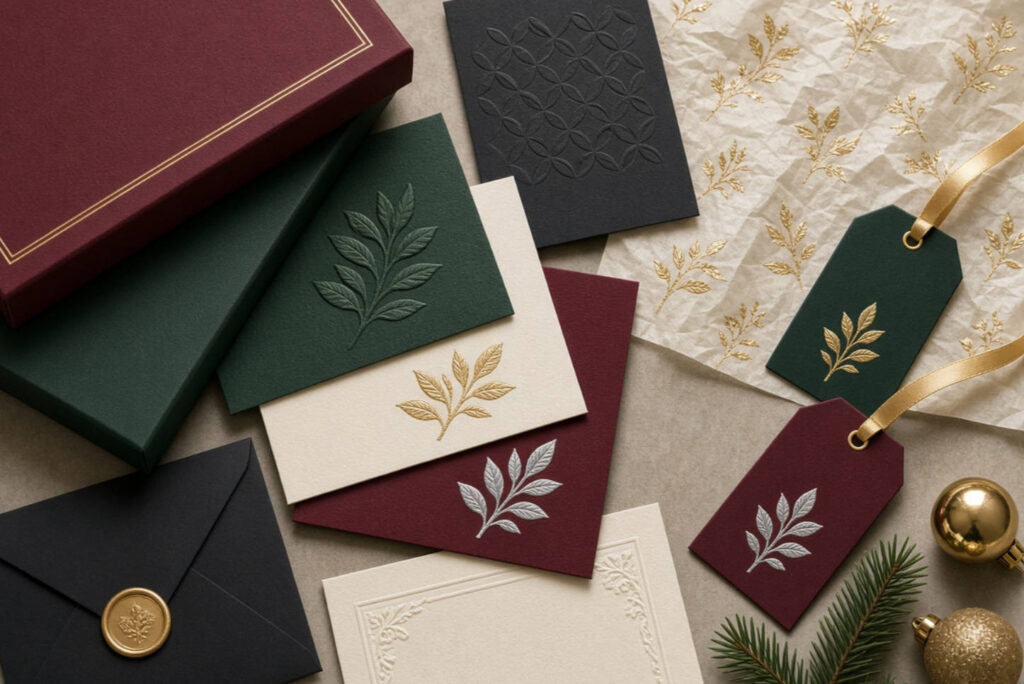
Foil stamping creates a reflective metallic finish that can elevate a box without requiring a complex illustration. Gold, silver, rose gold, holographic, red, green, and custom metallic foils can all support a holiday campaign.
Use foil selectively on:
– Brand names and logos
– Holiday messages
– Borders and decorative frames
– Snowflakes, stars, ornaments, or botanical motifs
– Limited-edition collection names
– Product icons or monograms
Foil works best when paired with a simple design. If every element is metallic, the package can feel visually crowded. A restrained combination—such as a matte dark-green rigid box with a small gold foil logo—usually looks more refined than an over-decorated surface.
5. Use Embossing or Debossing for Tactile Brand Recognition
Holiday packaging should be experienced with the hands as well as the eyes. Embossing raises a design above the paper surface, while debossing presses it into the material.
These details are particularly effective for:
– Luxury logos
– Monograms
– Repeating patterns
– Snowflake motifs
– Brand seals
– Minimalist gift packaging
An embossed logo on textured paper can communicate quality without relying on heavy graphics. It also gives customers a tactile moment that can make the unboxing experience more memorable.
For a refined look, combine blind embossing with uncoated, textured, or soft-touch paper. For stronger visual contrast, combine embossing with foil stamping.
6. Design a Holiday Pattern That Works Beyond December
A seasonal pattern should feel festive, but it should not become unusable the moment the holiday passes. Rather than relying only on obvious holiday graphics, consider adaptable motifs such as:
– Winter botanicals
– Stars and constellations
– Geometric gift-wrap patterns
– Abstract snow-inspired linework
– Elegant tartan or plaid
– Hand-drawn ornaments
– Repeating brand icons
– Botanical illustrations
This approach can help brands use packaging across a broader winter campaign or extend the design into New Year, Lunar New Year, corporate gifting, and winter promotions.
A reusable design system also improves consistency across boxes, tissue paper, labels, ribbons, cards, and e-commerce mailers.
7. Choose Kraft Packaging for a Warm, Natural Look
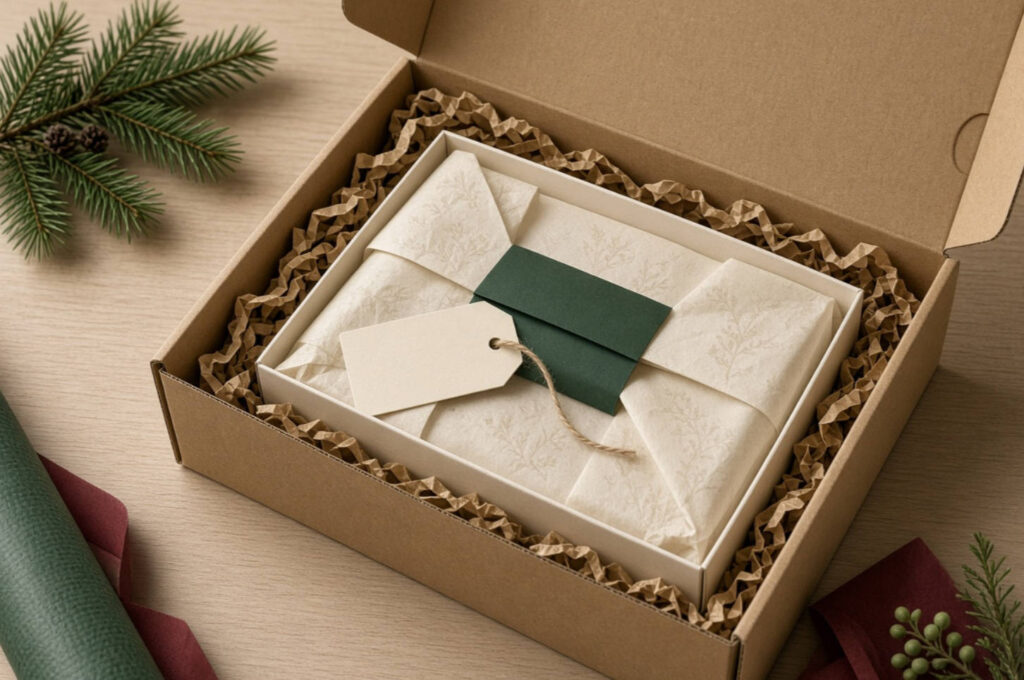
Kraft paper packaging remains a strong option for brands that want a natural, handmade, rustic, or environmentally conscious visual identity. It can work beautifully for food, candles, handmade goods, apparel, wellness products, and artisan gift sets.
To make kraft holiday packaging feel elevated, add one or two premium components:
– Custom printed paper tape
– One-color or two-color artwork
– White ink printing
– Dark green or burgundy ribbon
– Custom gift tags
– Metallic foil logo accents
– Branded tissue paper
– Natural twine with a printed tag
Kraft does not automatically make a package sustainable, and brands should avoid unsupported environmental claims. However, a paper-based design that uses fewer mixed materials, avoids unnecessary layers, and provides clear disposal guidance can make recycling simpler for customers. How2Recycle notes that its labeling system helps communicate whether packaging is widely recyclable, locally recyclable, store drop-off, or not yet recyclable.
8. Make the Inside of the Box Part of the Experience
Customers often remember what happens after the lid opens. The interior is where anticipation turns into product discovery.
Consider adding:
– Printed interior panels
– Patterned tissue paper
– Branded stickers or seals
– Thank-you cards
– Gift messages
– Product story cards
– QR codes leading to tutorials, gift guides, or brand videos
– Custom paperboard inserts
– Compartments for multiple products
For example, a premium skincare set might include a rigid box with a gold foil exterior logo, a printed interior message, color-matched tissue paper, a custom insert, and a card explaining how to use the products. The package becomes a guided experience rather than a container.
9. Use Custom Inserts to Protect and Present Products
A custom insert has two jobs: secure the product and improve presentation. During the holiday season, this is especially important because customers may purchase fragile or premium items as gifts.
Paperboard inserts are often a versatile option for custom paper packaging because they can be printed, die-cut, and designed to hold items in a deliberate arrangement.
Choose inserts based on product needs:
| Tipo de produto | Recommended Insert Approach | Key Priority |
|---|---|---|
| Cosmetics and skincare | Die-cut paperboard insert | Organized product display |
| Candles and glass jars | Reinforced insert or divider | Impact protection |
| Jewelry and accessories | Wrapped insert with recess | Premium presentation |
| Food and confectionery | Food-safe divider or tray | Product separation |
| Eletrônicos | Protective fitted insert | Stability and shock resistance |
| Corporate gift sets | Multi-compartment insert | Clear product hierarchy |
Before approving production, test the package with the actual product weight, shape, and shipping method. Stord’s 2025 mystery-shopping report found that 94% of packages arrived intact, but 6% were damaged—an important reminder that even attractive retail packaging needs transit planning.
10. Offer Gift-Ready Packaging for E-Commerce Orders
A product that is purchased online may arrive directly at the recipient’s home. If the customer still needs to wrap it, remove price information, or replace damaged packaging, the gifting experience loses momentum.
Gift-ready e-commerce packaging can include:
– A branded shipping box with discreet exterior branding
– A premium inner gift box
– Protective paper fill or corrugated inserts
– A gift message option
– A no-price packing slip
– A branded return card
– A tamper-evident seal
– A reusable or recyclable outer mailer
The best approach is often a two-layer system: a protective shipping carton outside and a presentation-quality retail box inside. This protects the gift while preserving the intended unboxing experience.
11. Add Ribbons, Tags, and Seals With Purpose
Ribbons, gift tags, stickers, belly bands, and seals can make holiday packaging feel more personal. However, they should support the package rather than create unnecessary complexity.
Use add-ons to solve a specific experience problem:
– A ribbon can create a gift-like reveal.
– A seal can hold tissue paper neatly in place.
– A tag can carry a handwritten message.
– A belly band can introduce a limited-edition campaign.
– A sticker can communicate a seasonal offer or product benefit.
For high-volume fulfillment, consider whether the add-on can be pre-applied at the factory or assembled efficiently by your fulfillment team. A beautiful package that takes too long to pack can create seasonal operational bottlenecks.
12. Use Monochrome Design to Stand Out From Holiday Clutter
Not every holiday package needs red, green, glitter, or illustrated characters. A monochrome design can look striking when competitors use highly saturated color palettes.
Examples include:
– White box with blind embossing and silver foil
– Black box with a red foil logo
– Deep navy box with white line illustrations
– Cream box with dark-green typography
– Burgundy box with tonal matte and gloss contrast
Minimalism works best when the box construction, paper choice, and print quality are strong. In other words, simplicity raises the importance of every detail.
13. Add Personalized Elements for Corporate Gifting
Corporate gifting often increases during the holiday period, but a generic gift box can feel impersonal. Custom packaging gives companies a way to personalize at scale.
Options include:
– Printed recipient name areas
– Custom company logos
– Seasonal greeting cards
– Department-specific message inserts
– Co-branded packaging
– Variable-data labels
– Customized product bundles
– Event-specific gift box sleeves
For agencies, HR teams, real estate companies, technology firms, and event organizers, a premium custom gift box can turn a standard product bundle into a more meaningful client or employee experience.
14. Use Recyclable Paper-Based Designs Where Possible
Sustainability should be planned at the structural stage, not added as a marketing statement at the end. Start by asking whether the package can use fewer materials, fewer mixed substrates, and more easily separated components.
Practical ways to simplify a holiday package include:
– Use paperboard or corrugated inserts instead of difficult-to-recycle foam where appropriate.
– Avoid unnecessary plastic windows.
– Minimize nonessential lamination and mixed-material decorations.
– Use one main material family where possible.
– Make ribbons, inserts, and sleeves removable.
– Print clear disposal instructions when relevant.
– Right-size the package to reduce material use and shipping volume.
Sustainable Packaging Coalition principles emphasize materials that remain healthy throughout their lifecycle, responsible manufacturing, efficient transportation, and recovery or recycling through biological or industrial cycles.
The goal is not to claim that every package is “green.” The goal is to make informed, transparent design choices that fit the product, market, and available recovery systems.
15. Plan Production Earlier Than You Think
A successful seasonal packaging launch depends on planning, approvals, and testing—not just artwork. Custom holiday packaging may involve structural engineering, dielines, material selection, printing, finishing, sampling, insert development, assembly, and freight coordination.
Use this holiday packaging planning checklist:
1. Define your campaign goal, target customer, product assortment, and budget.
2. Choose the box style, dimensions, materials, and required protection level.
3. Confirm the desired print method and finishes, such as foil, embossing, spot UV, or matte lamination.
4. Create artwork that follows the approved dieline and includes safe areas for critical elements.
5. Order a structural or pre-production sample before committing to volume production.
6. Test fit, product protection, opening experience, and fulfillment speed.
7. Approve final production files and establish clear quality standards.
8. Build in time for overseas shipping, customs clearance, warehouse receiving, and fulfillment preparation.
Holiday demand increases pressure throughout the supply chain. Early planning gives brands more design flexibility, reduces expensive rush decisions, and improves the likelihood that the finished package will arrive in time for the selling season.
How to Choose the Right Holiday Packaging Style
The right custom holiday packaging depends on your product category, sales channel, budget, and brand position.
| Business Goal | Best Packaging Option | Por que funciona |
|---|---|---|
| Launch a luxury gift set | Magnetic rigid box with insert | Creates a substantial, premium presentation |
| Upgrade existing products quickly | Custom sleeve or belly band | Adds seasonal impact with less structural change |
| Protect fragile e-commerce products | Corrugated mailer plus fitted inner box | Balances shipping protection and unboxing quality |
| Support a natural brand image | Kraft folding carton with paper-based inserts | Creates a warm, simple, material-led look |
| Sell corporate gifts | Rigid box with co-branded sleeve and message card | Makes personalization and product organization easier |
| Create a limited-edition campaign | Printed folding carton with foil details | Delivers seasonal differentiation at scale |
| Improve perceived value | Rigid box, embossing, tissue, and custom insert | Adds tactile and visual layers to the experience |
A useful rule is this: the higher the product value, gifting intent, and emotional importance of the purchase, the more the packaging experience matters.
Why Work With Bonito Packaging for Holiday Projects
Bonito Packaging is a source manufacturer specializing in high-end custom paper packaging. We help brands translate seasonal ideas into practical packaging systems that are designed for production, protection, and brand impact.
Our custom packaging capabilities can support:
– Custom rigid gift boxes
– Folding cartons
– Corrugated mailer boxes
– Custom paperboard inserts
– Gift box sleeves and belly bands
– Printed tissue paper
– Stickers, labels, and hang tags
– Foil stamping, embossing, debossing, spot UV, and specialty finishes
– Retail-ready and e-commerce-ready packaging solutions
– OEM and ODM packaging development
Our team can help you evaluate the full packaging journey—from product dimensions and box structure to decoration, assembly, sampling, and shipment requirements.
Ready to create holiday packaging that customers want to give, keep, photograph, and remember? Contact Bonito Packaging to discuss your custom holiday gift box, seasonal folding carton, or premium paper packaging project. Start with your product dimensions, target quantity, desired finish, and required delivery date, and our packaging specialists can help you develop the right solution.
Perguntas frequentes
1. What is holiday packaging?
Holiday packaging is custom product packaging designed for seasonal gifting periods, including Christmas, New Year, Lunar New Year, Thanksgiving, Valentine’s Day, and other promotional occasions. It may include festive colors, limited-edition graphics, premium finishes, gift-ready structures, inserts, tissue paper, ribbons, or personalized message cards.
2. What type of box is best for holiday gift packaging?
Rigid boxes are usually best for premium holiday gifts because they offer strong structure and a high-end presentation. Folding cartons are often suitable for lightweight retail products, while corrugated mailer boxes are more appropriate for e-commerce shipping. The best option depends on product weight, fragility, gifting value, and budget.
3. How can I make my packaging look more premium?
To make packaging look more premium, focus first on box structure, paper quality, precise printing, and product fit. Then add selective details such as foil stamping, embossing, soft-touch finishes, printed interiors, custom inserts, tissue paper, or branded seals. Avoid adding too many decorative elements at once.
4. Can holiday packaging be sustainable?
Yes, holiday packaging can be designed with sustainability in mind. Brands can choose paper-based materials, reduce unnecessary packaging layers, use right-sized boxes, avoid difficult-to-separate mixed materials, and provide clear disposal guidance. Sustainability claims should be specific and supported by the actual packaging materials and available recycling systems.
5. When should I start planning custom holiday packaging?
Ideally, begin planning several months before your required delivery date. Custom packaging needs time for structural design, artwork preparation, sampling, testing, production, finishing, quality control, and freight. Brands with complex rigid boxes, custom inserts, multiple finishes, or large-volume programs should allow even more time.
6. Can I use the same holiday packaging design for retail and e-commerce?
You can use a unified visual design, but retail and e-commerce packaging often need different structural solutions. Retail packaging prioritizes shelf appeal and product presentation, while e-commerce packaging must also withstand shipping and handling. Many brands use a premium inner retail box protected by an outer corrugated shipping carton.
References
1. PakFactory. “9 Trendy Holiday Packaging Ideas for This Season.”
[https://pakfactory.com/blog/holiday-packaging-ideas/]
2. Ryder and Packaging Dive. “E-commerce Shoppers Seek Value, Sustainable Packaging.” Survey coverage discussing consumer preferences for sustainable packaging and unboxing experiences.
3. Stord. “2025 Mystery Shopping Report.” Findings on delivery performance, product condition, and package condition in e-commerce orders.
[https://www.stord.com/reports/mystery-shopping-2025]
4. GreenBlue / How2Recycle. “How2Recycle Program Resources.” Guidance on standardized consumer-facing packaging disposal labels in the United States and Canada.
[https://greenblue.org/category/how2recycle/]
5. Global Vision. “A Beginner’s Guide to Sustainable Packaging.” Overview of sustainable packaging principles, material choices, simplification, and quality-control considerations.
[https://www.globalvision.co/blog/a-beginners-guide-to-sustainable-packaging]
6. Bain & Company. “2025 Holiday Shopping Outlook.” Market context and holiday retail sales outlook.
[https://www.bain.com/insights/2025-holiday-shopping-outlook-infographic/]
Hot Tags: Custom Packaging, Manufacturers, Customized, Custom, Suppliers, Buy, Cheap, Quality, Advanced, Durable, in Stock, Made in China, Price, Quotation, Free Sample
 English
  Spanish
  French
  German
  Russian
  Japanese
  Portuguese
  Arabic