
Content Menu
● The Standard Order: Length × Width × Height
>> Why the Measurement Order Matters
● Internal vs. External Box Dimensions
>> Internal Dimensions: The Usable Product Space
>> External Dimensions: The Outside Shipping Footprint
>> The Material-Thickness Factor
● How to Measure a Box in Five Steps
>> 1. Measure the Actual Product
>> 2. Decide How the Product Will Sit Inside the Box
>> 3. Add Clearance for Easy Packing
>> 4. Include Inserts, Tissue, and Protective Materials
>> 5. Confirm the Final Dimensions With a Sample
● Box Dimensions for Popular Custom Packaging Styles
● Box Size, Shipping Cost, and Dimensional Weight
● Common Box Measurement Mistakes to Avoid
>> Measuring Only the Product Body
>> Confusing Internal and External Dimensions
>> Ignoring Packaging Material Thickness
>> Forgetting Inserts and Accessories
>> Using a Box That Is Too Tight
>> Using a Box That Is Too Large
● Expert Checklist Before Ordering Custom Boxes
● Work With Bonito Packaging on Custom Box Dimensions
>> 1. What is the correct order for box dimensions?
>> 2. Should I provide internal or external box dimensions?
>> 3. How much extra space should I add around my product?
>> 4. How do I measure an irregularly shaped product for a custom box?
>> 5. Do thicker box materials change the final dimensions?
>> 6. Why does box size affect shipping cost?
>> 7. Can Bonito Packaging help choose the right box size?
When ordering индивидуальные коробки, accurate box dimensions are not a minor technical detail—they determine product fit, material usage, shipping efficiency, protection, and the final unboxing experience. At Упаковка Bonito, we help brands turn product measurements into high-end custom paper packaging that is practical for production and polished enough for retail presentation.
The standard box-dimension format is Length × Width × Height, commonly written as L × W × H. However, correctly applying this format requires more than measuring three sides. You also need to account for internal clearance, paperboard or corrugated-board thickness, product orientation, inserts, closure style, and the external dimensions used by carriers for dimensional-weight pricing.
This guide explains how to measure box dimensions accurately, avoid costly mistakes, and prepare a clearer packaging specification for your custom box manufacturer.
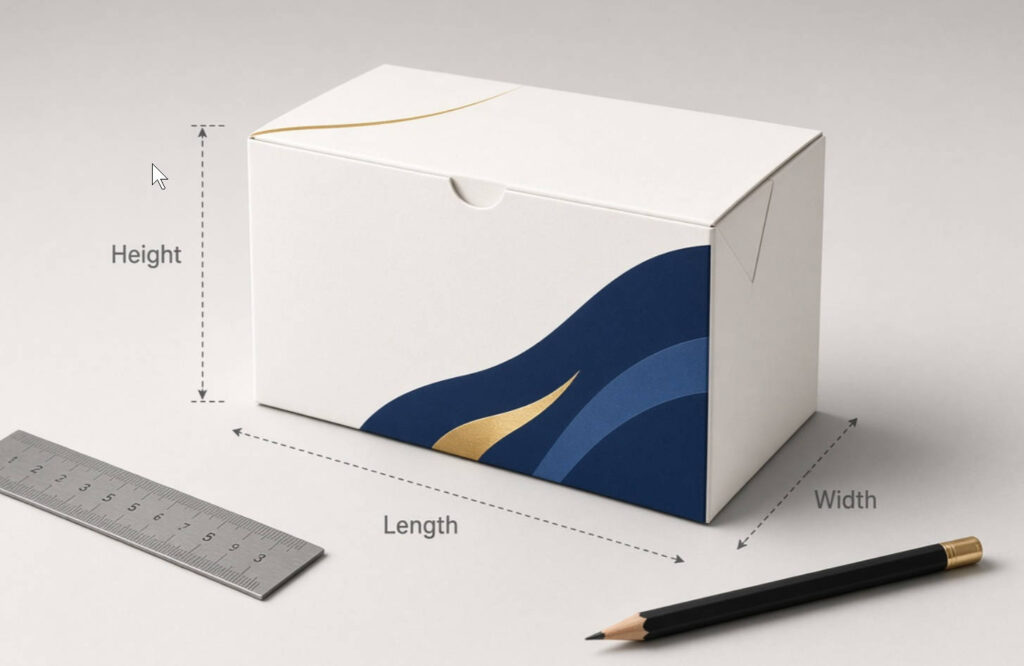
What Are Box Dimensions?
Box dimensions describe the three-dimensional size of a packaging box:
Длина×Ширина×Высота
For example, a rigid gift box listed as 8 × 5 × 3 inches has:
– A length of 8 inches
– A width of 5 inches
– A height of 3 inches
In most packaging specifications, length is the longer opening-side measurement, width is the shorter opening-side measurement, and height is the distance from the bottom panel to the top of the box.
For many standard rectangular custom boxes, this order is expressed as:
L×W×H
However, the physical orientation of a product matters more than blindly labeling the longest side as length. A packaging supplier should understand how the product sits inside the box before finalizing its dimensions.
For instance, a skincare bottle may stand vertically in a folding carton. In that case, the vertical measurement is normally treated as the height, even if it is longer than the front-facing length.
The Standard Order: Length × Width × Height
The widely accepted order for box measurements is:
| Dimension | What It Means | How to Measure It |
|---|---|---|
| Length | The longer side of the box opening | Measure from left to right across the front-facing opening |
| Width | The shorter side of the box opening | Measure from front to back |
| Height | The vertical dimension | Measure from the bottom to the top of the box |
A useful rule is: when looking at an open box from above, measure the longer side first, the shorter side second, and the vertical side last.
For a standard mailer box, shipping carton, folding carton, or rigid setup box, the dimensions may look like this:
– 6 × 4 × 2 inches
– 10 × 8 × 3 inches
– 250 × 180 × 80 mm
The first number is length, the second is width, and the third is height.
Why the Measurement Order Matters
A dimension sequence is not interchangeable. A box specified as 10 × 6 × 4 inches is physically different from a box specified as 6 × 10 × 4 inches if the opening direction, front panel, print layout, and product placement are different.
This distinction becomes especially important for:
– Custom folding cartons with front-facing branding
– Magnetic rigid boxes with a specific opening direction
– Drawer boxes with a sleeve and pull-out tray
– Почтовые ящики designed for e-commerce unboxing
– Коробки для демонстрации продукции with windows, inserts, or hang tabs
– Subscription boxes that must fit a planned product assortment
Clear measurements reduce production questions, prevent artwork-placement errors, and help ensure that the finished box supports the desired customer experience.
Internal vs. External Box Dimensions
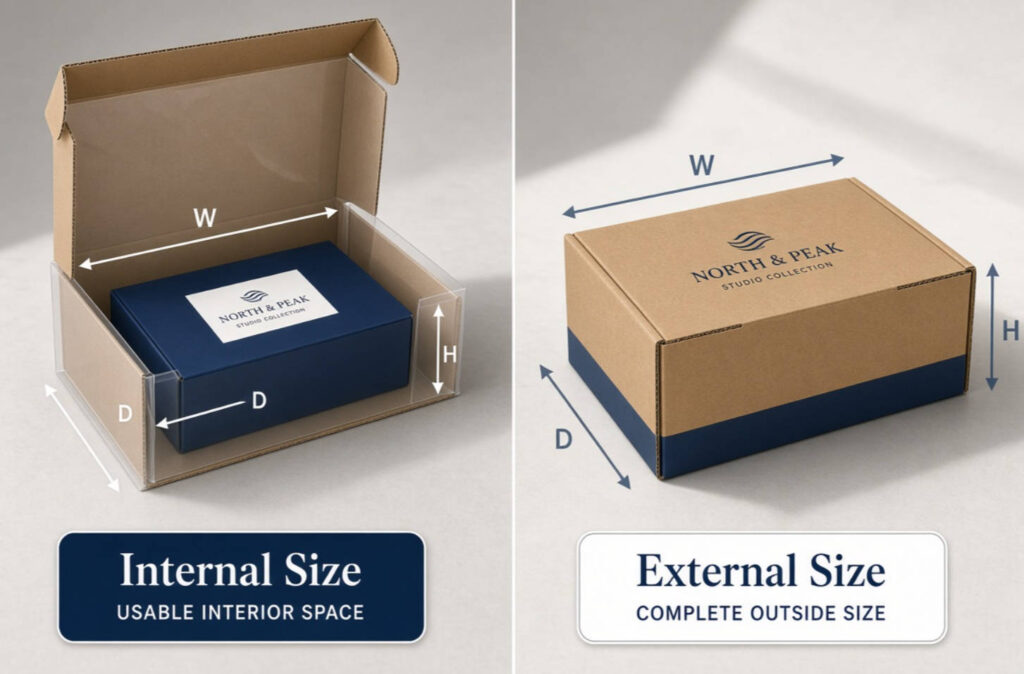
One of the most important decisions in custom packaging is whether you are discussing internal dimensions or external dimensions.
Internal Dimensions: The Usable Product Space
Internal dimensions describe the actual usable space inside the box. These measurements matter most when you need packaging to fit a product precisely.
For example, if a candle jar measures 3.2 × 3.2 × 4.5 inches, you should not simply order a box with the same measurements. The jar needs room for easy insertion, material tolerances, protective padding, and possibly an insert.
A practical internal-size approach may be:
– Product size: 3.2 × 3.2 × 4.5 inches
– Clearance allowance: 0.1–0.25 inch per relevant side
– Proposed internal box size: approximately 3.5 × 3.5 × 4.8 inches
The right allowance depends on the product, packaging style, and whether the box includes an insert.
External Dimensions: The Outside Shipping Footprint
External dimensions measure the complete outside size of the assembled package. They are particularly important for:
– Shipping-rate calculations
– Warehousing and pallet planning
– Retail shelf planning
– Master-carton configuration
– Carrier compliance
– E-commerce fulfillment operations
Shipping providers often calculate pricing based on dimensional weight, which reflects how much space a package occupies rather than its actual weight alone. FedEx, for example, instructs shippers to multiply external length, width, and height in inches, round measurements to whole inches, and divide the cubic size by the applicable dimensional-weight divisor.
The Material-Thickness Factor
The difference between internal and external dimensions is affected by packaging material thickness.
A thin paperboard folding carton may add relatively little to the outside measurement. In contrast, corrugated mailer boxes, shipping cartons, and rigid boxes can add meaningful thickness around the product cavity.
Typical corrugated flute thicknesses vary by board construction. E-flute is commonly around 1–1.5 mm thick, while B-flute is often around 3 mm thick; thicker or double-wall structures require more allowance.
That means a box designed with a 10 × 8 × 4 inch internal cavity may have noticeably larger external measurements once board thickness, folded edges, and assembly tolerances are included.
How to Measure a Box in Five Steps
Whether you are redesigning existing packaging or requesting a new custom box, follow this process before submitting your specification.
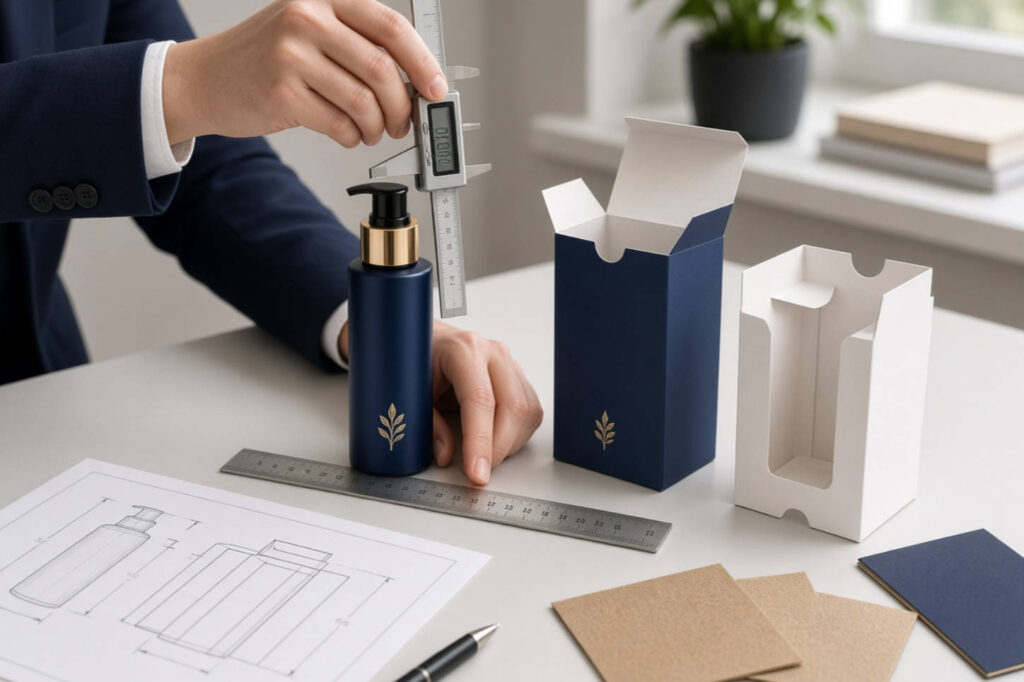
1. Measure the Actual Product
Use a reliable ruler, caliper, or measuring tape. Measure the product at its widest, longest, and tallest points.
Do not measure only the primary body if the product has features that extend beyond it, such as:
– Bottle caps
– Pump dispensers
– Handles
– Cords
– Lids
– Product labels
– Protruding buttons
– Uneven corners
– Decorative accessories
For soft goods, measure the product in the folded or packed state—not when it is laid flat.
2. Decide How the Product Will Sit Inside the Box
A product can often be positioned in more than one direction. The orientation you choose affects box dimensions, printing layout, customer perception, and shipping efficiency.
Ask these questions:
– Will the product stand upright or lie flat?
– Which panel should show the brand logo first?
– Does the product need to be removed from the top, side, or front?
– Will the customer reuse the box?
– Does the opening experience need to feel premium?
– Is the product fragile, heavy, or unusually shaped?
For a premium cosmetic product, a vertical folding carton may reinforce shelf presence. For apparel, a shallow rigid box or mailer may create a cleaner unboxing experience. For electronic accessories, a compact drawer box with a custom insert may provide better organization and protection.
3. Add Clearance for Easy Packing
A product should fit securely, but it should not be so tight that the production team struggles to pack it or the customer struggles to remove it.
The appropriate clearance depends on the packaging design:
| Packaging Situation | Recommended Approach |
|---|---|
| Lightweight product without insert | Add modest clearance for smooth insertion |
| Glass, ceramic, or fragile item | Add space for cushioning or protective inserts |
| Premium retail product | Use a close fit with a custom paperboard or foam insert |
| Multi-piece gift set | Measure the full set and allocate space between components |
| Apparel or fabric item | Allow for variation in folding thickness |
| Heavy product | Consider structural reinforcement and controlled movement |
A close fit can look premium, but precision must be balanced with real manufacturing tolerances. This is where an experienced packaging manufacturer can help translate product dimensions into a production-ready dieline.
4. Include Inserts, Tissue, and Protective Materials
Many packaging projects fail at the measurement stage because buyers measure only the product and forget the internal packaging components.
Make room for any of the following:
– Paperboard inserts
– Corrugated inserts
– EVA foam
– Molded pulp trays
– Tissue paper
– Bubble wrap
– Divider partitions
– Instruction manuals
– Thank-you cards
– Accessories
– Samples
– Warranty cards
For example, a 6 × 4 × 2 inch product may require a 7 × 5 × 3 inch custom box after a folded insert, tissue wrap, product card, and clearance are included.
5. Confirm the Final Dimensions With a Sample
Before placing a large production order, request a plain structural sample or a fully printed pre-production sample when the project is complex.
A physical sample helps verify:
– Product fit
– Opening and closing performance
– Insert alignment
– Print direction
– Logo placement
– Shipping durability
– Shelf appearance
– Customer unboxing experience
For high-value products, subscription packaging, gift boxes, and retail launches, sampling is not an unnecessary extra step. It is a practical quality-control measure that can prevent expensive remakes or shipping failures.
Box Dimensions for Popular Custom Packaging Styles
Different box styles require different measurement logic. The same product may need different dimensions depending on the structural design.
Folding Carton Dimensions
Folding cartons are commonly used for cosmetics, supplements, tea, candles, food products, electronics, and retail goods. They are usually made from paperboard and ship flat before assembly.
When measuring a folding carton, focus on the internal product cavity, closure style, and any insert requirements. If the carton includes a tuck top, auto-bottom, reverse tuck end, or crash-lock base, the structural design can affect production allowances.
Best for:
– Retail-ready product packaging
– Cosmetics and skincare
– Food and beverage products
– Supplements
– Small electronics
– Lightweight consumer goods
Mailer Box Dimensions
Mailer boxes are popular for e-commerce brands, subscription services, influencer kits, apparel, and gift sets. They typically use corrugated board and feature interlocking flaps.
Because mailer boxes have thicker walls than folding cartons, external dimensions may be noticeably larger than internal dimensions. This matters for dimensional-weight shipping calculations.
Best for:
– Subscription boxes
– Apparel and accessories
– E-commerce orders
– DTC brand packaging
– Promotional kits
– Small gift sets
Rigid Box Dimensions
Rigid boxes, also called setup boxes, are premium paper packaging structures that do not collapse flat. They are frequently used for jewelry, fragrances, luxury cosmetics, electronics, wine accessories, and high-end gifts.
Rigid boxes require especially careful dimension planning because wrapped board thickness, lid fit, shoulder depth, and insert construction all affect the final result.
Best for:
– Luxury products
– High-value gifts
– Premium cosmetics
– Electronics
– Jewelry
– Corporate presentation boxes
Shipping Box Dimensions
Shipping cartons must protect products through handling, stacking, and transit. Their dimensions should account for the product, inner packaging, void fill, and shipping rules.
For carrier pricing, the external carton dimensions are essential. FedEx states that dimensional weight is calculated from external package dimensions, and the charge may be based on either dimensional weight or actual weight, depending on which is greater.
Box Size, Shipping Cost, and Dimensional Weight
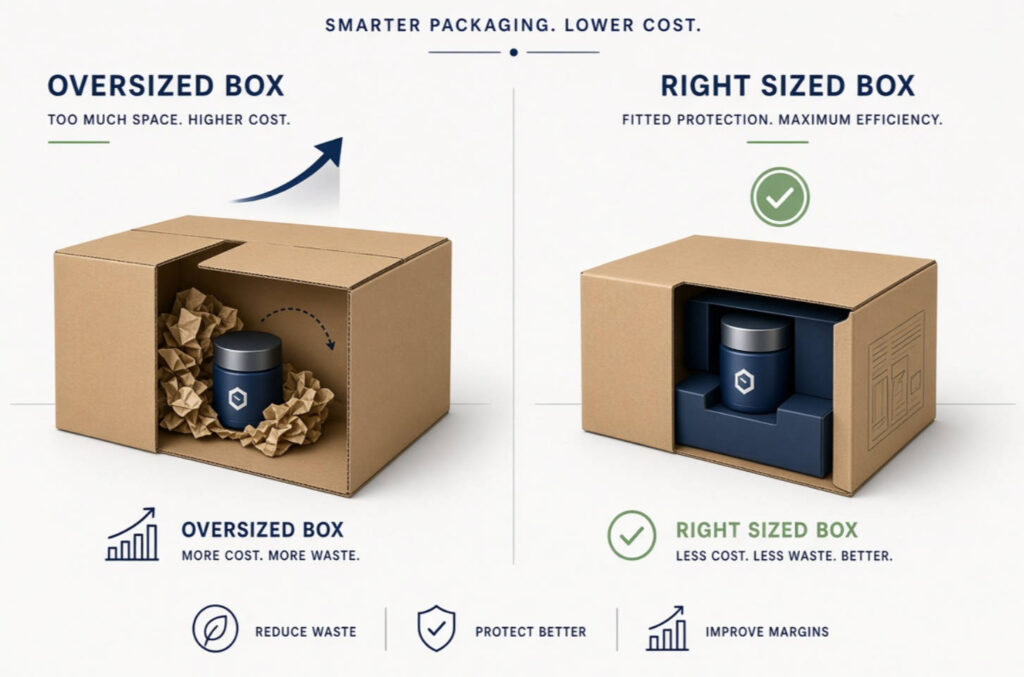
A common packaging mistake is selecting an oversized box because it feels safer. Extra empty space can create several problems:
– Higher dimensional-weight charges
– More void-fill material
– Greater product movement during transit
– Increased damage risk
– More warehouse space required
– Less efficient pallet utilization
– A weaker unboxing presentation
For many U.S., Puerto Rico, and international FedEx shipments, the dimensional-weight calculation uses:
Dimensional Weight=(L×W×H)/139
Measurements are taken in inches and rounded according to carrier rules.
Here is a simple example:
| Package | External Dimensions | Cubic Size | Dimensional Weight |
|---|---|---|---|
| Compact mailer | 12 × 8 × 4 in | 384 cubic in | 2.76 lb |
| Oversized mailer | 14 × 10 × 6 in | 840 cubic in | 6.04 lb |
Even if both packages contain the same lightweight product, the larger box can create a significantly higher billable shipping weight.
This is why packaging design should not focus only on aesthetics. The most effective custom packaging balances brand impact, product protection, material efficiency, and shipping economics.
USPS also uses dimensional-weight rules for eligible parcels and instructs shippers to measure package dimensions at their extreme points. Its published guidance states that the applicable price is based on actual weight or dimensional weight, whichever is greater.
Common Box Measurement Mistakes to Avoid
Even experienced product teams can make mistakes when converting product sizes into box dimensions. Avoid these common errors.
Measuring Only the Product Body
Always include caps, lids, handles, cords, labels, and any other protruding components. Measuring the product body alone can lead to a box that does not close correctly.
Confusing Internal and External Dimensions
If you provide only “10 × 8 × 3 inches,” a packaging manufacturer may need clarification. State whether the measurement refers to the inside usable space or the outside assembled box.
Ignoring Packaging Material Thickness
Corrugated mailers, rigid boxes, and multi-layer structures take up more space than thin folding cartons. Material selection directly affects final dimensions and shipping footprint.
Forgetting Inserts and Accessories
A product box may need to hold more than the product. Consider cards, manuals, tissue, samples, accessories, dividers, and protective inserts from the beginning.
Using a Box That Is Too Tight
A box that fits with zero tolerance may look efficient on paper but can be difficult to assemble, pack, and open. Slight, intentional clearance improves operational consistency.
Using a Box That Is Too Large
Excess space can increase cost and damage risk. A well-designed insert or right-sized structure is often more effective than simply using a larger box.
Expert Checklist Before Ordering Custom Boxes
Before requesting a quotation from Bonito Packaging or another custom packaging manufacturer, prepare the following information:
1. Product dimensions: Length, width, height, and weight.
2. Product orientation: How the item should sit inside the box.
3. Internal or external dimensions: Clearly identify which measurements you are providing.
4. Packaging style: Folding carton, mailer box, rigid box, drawer box, shipping carton, or another structure.
5. Material preference: Paperboard, corrugated board, rigid board, or a combination.
6. Protection needs: Inserts, dividers, tissue, foam, or void-fill requirements.
7. Printing requirements: Logo, brand colors, finishes, inside printing, and artwork placement.
8. Order quantity: The quantity affects production method, material sourcing, and unit cost.
9. Shipping requirements: Individual shipping, retail display, bulk packing, or export distribution.
10. Sample requirement: Confirm whether you need a structural prototype or printed pre-production sample.
Providing this information early helps your supplier create a better dieline, quote more accurately, and reduce the risk of revisions later.
Work With Bonito Packaging on Custom Box Dimensions
The right custom box dimensions protect your product, control fulfillment costs, strengthen your brand presentation, and create a more satisfying customer experience. A good packaging box should feel intentional from the moment a customer sees it to the moment they remove the product.
Bonito Packaging specializes in high-end custom paper packaging, including custom folding cartons, corrugated mailer boxes, rigid gift boxes, retail packaging, and branded inserts. Share your product size, packaging concept, and target market with our team, and we can help you develop a tailored box structure that fits your product and your brand.
Request a custom packaging quote today and let Bonito Packaging help you turn accurate product measurements into packaging that performs beautifully in retail, e-commerce, and shipping.
Часто задаваемые вопросы
1. What is the correct order for box dimensions?
The standard order is Length × Width × Height, written as L × W × H. Length is typically the longer side of the box opening, width is the shorter side from front to back, and height is measured from the bottom to the top.
2. Should I provide internal or external box dimensions?
For custom product packaging, internal dimensions are usually more important because they determine whether the product fits. For shipping, storage, and carrier pricing, external dimensions are essential. Ideally, provide both when available.
3. How much extra space should I add around my product?
The amount depends on the product, material, box style, and protective needs. Lightweight products may need only modest clearance, while fragile items need additional space for inserts or cushioning. A packaging manufacturer can recommend an appropriate allowance after reviewing the product and box structure.
4. How do I measure an irregularly shaped product for a custom box?
Measure the product at its maximum length, maximum width, and maximum height, including protruding parts. For curved or irregular products, it may also be useful to provide photographs, a technical drawing, or a physical sample.
5. Do thicker box materials change the final dimensions?
Yes. Corrugated board, rigid board, and wrapped box structures add thickness around the internal cavity. Thicker materials can increase the external box size and affect shipping costs.
6. Why does box size affect shipping cost?
Many carriers use dimensional weight, which considers the package’s external cubic volume. A larger but lightweight package can cost more to ship than a smaller package of the same actual weight.
7. Can Bonito Packaging help choose the right box size?
Yes. Bonito Packaging can review your product measurements, product orientation, insert requirements, packaging style, branding needs, and shipping goals to recommend a practical custom box structure and size.
References
1. [Oxo Packaging — 6 Things You Need to Know about a Dimension of Box]
Source used for the original article’s coverage of standard box dimensions, internal versus external measurements, irregular box shapes, and common measurement errors. [oxopackaging]
2. [FedEx — What Is Dimensional Weight?]
Source for FedEx dimensional-weight calculation guidance, including multiplying external dimensions and dividing by 139 for relevant U.S., Puerto Rico, and international shipments. [fedex]
3. [United States Postal Service — Parcel Size, Weight & Fee Standards]
Source for USPS parcel size and weight standards, including maximum size and weight information. [faq.usps]
4. [USPS Postal Explorer — Quick Service Guide 150]
Source for USPS dimensional-weight measurement guidance, extreme-dimension measurement requirements, and actual-versus-dimensional-weight pricing principles. [pe.usps]
5. [GWP Group — Corrugated Board Grades Explained]
Source for general corrugated flute thickness information, including E-flute, B-flute, C-flute, and double-wall corrugated board characteristics. [gwp.co]
6. [FedEx — Boxes for Packing, Shipping & Moving]
Source for examples of shipping-box dimensions and commonly available carrier box formats. [fedex]
Hot Tags: Custom Box, Manufacturers, Customized, Custom, Suppliers, Buy, Cheap, Quality, Advanced, Durable, in Stock, Made in China, Price, Quotation, Free Sample
 English
  Spanish
  French
  German
  Russian
  Japanese
  Portuguese
  Arabic