
Content Menu
● Structural Design vs. Visual Design in Rigid Boxes
● What Structural Design Means in Rigid Box Manufacturing
>> The “inside-out” design principle
● Why Structure Must Come Before Artwork
>> 1. It protects the product and reduces damage risk
>> 2. It controls the unboxing experience
>> 3. It determines manufacturing feasibility
● The Key Structural Design Variables
>> Product dimensions and clearance
>> Board thickness and box strength
● A Practical Rigid Box Design Workflow
>> Step 1: Define the packaging job
>> Step 2: Build a complete product specification
>> Step 3: Select the structural concept
>> Step 4: Prototype before finalizing finishes
>> Step 5: Lock structure, then approve artwork
● Structural Design and Sustainable Luxury Packaging
>> A better sustainability question
● Expert Insight: Structural Design Is a Cost-Control Tool
● Common Structural Design Mistakes
● Partner With a Structural-First Rigid Box Manufacturer
● FAQs
>> 1. What is structural design in rigid box manufacturing?
>> 2. Why should structural design come before rigid box artwork?
>> 3. What is the best board thickness for a custom rigid box?
>> 4. Which rigid box style is best for luxury products?
>> 5. Do rigid boxes need inserts?
>> 6. Can a rigid box be designed with sustainability in mind?
>> 7. How should a rigid box be tested before mass production?
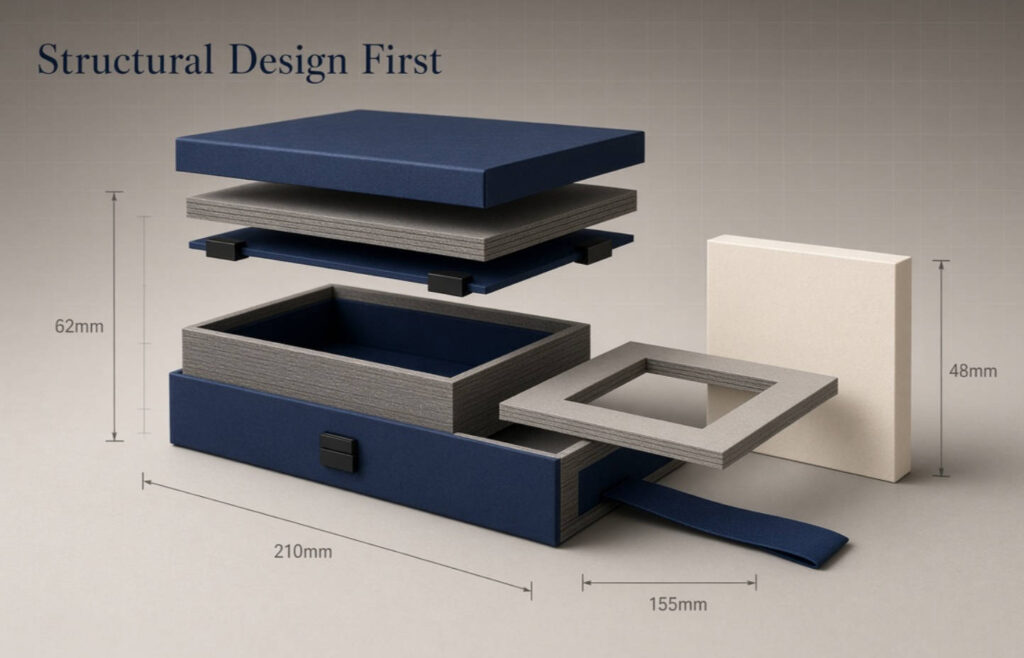
A premium rigid box is not created by adding foil stamping, embossed logos, or luxury paper at the end. It begins with structural design—the engineered relationship between product dimensions, board thickness, opening mechanism, insert, tolerance, and transport conditions.
For brands investing in custom rigid box manufacturing, structural design should come before graphic design and surface finishing. It determines whether the box protects the product, opens smoothly, communicates value, supports scalable production, and delivers the intended unboxing experience. At Bonito Packaging, we view structure as the working foundation of every high-end paper packaging project.
Structural Design vs. Visual Design in Rigid Boxes
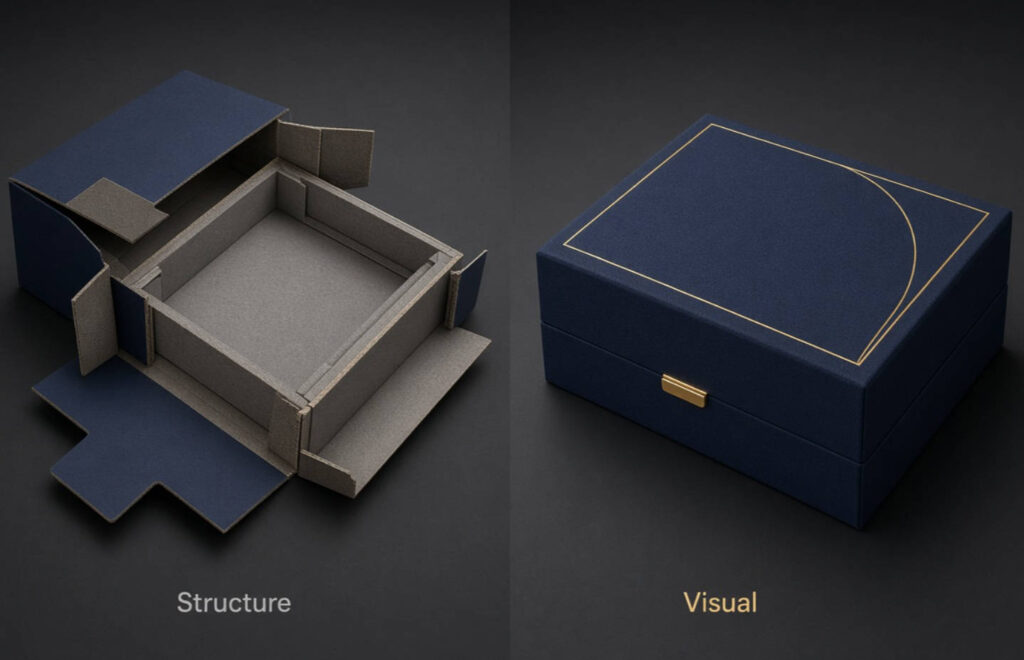
Rigid box projects often begin with a mood board: colors, logos, textures, metallic effects, and references from luxury brands. These elements matter, but they cannot correct an unsuitable box structure.
Structural design defines how the packaging is built and performs. Visual design defines how it looks and communicates.
| Design Area | Structural Design | Visual Design |
|---|---|---|
| Primary purpose | Protect, contain, support, and enable opening | Attract, differentiate, and communicate |
| Main decisions | Box style, dimensions, board thickness, insert, fit, tolerances | Color, artwork, typography, logo placement, finishes |
| Core questions | Will the product fit securely? Can it survive transport? | Does it reflect the brand’s positioning? |
| Production impact | Controls tooling, assembly sequence, material yield, and defect risk | Controls printing process, color consistency, and finishing complexity |
| Customer impact | Determines tactile feel, usability, product reveal, and perceived quality | Shapes first impression, shelf appeal, and brand recognition |
| Risk if ignored | Damaged products, poor fit, hard opening, high rework cost | Weak differentiation or inconsistent branding |
A structural problem remains a problem even when the box looks beautiful. For example, a magnetic closure box may use premium textured paper, elegant debossing, and a high-quality ribbon. But if the magnet placement is inaccurate, the flap may not close flush. If the insert is too loose, the product can move during shipping. If the lid is too tight, the customer may struggle to open it.
Luxury packaging must perform before it persuades.
What Structural Design Means in Rigid Box Manufacturing
Rigid boxes, also called setup boxes, are non-collapsible packages generally made from dense greyboard or chipboard and wrapped with printed or specialty paper. Their rigid construction creates the solid hand-feel associated with cosmetics, jewelry, wine, electronics, fragrances, gifts, and premium retail products.
In practical manufacturing terms, rigid box structural design includes the following decisions:
– Outer box length, width, and height
– Internal usable dimensions
– Product orientation inside the box
– Greyboard thickness and density
– Lid style and opening mechanism
– Base-wall and lid-wall tolerances
– Insert shape, depth, and retention method
– Magnet, ribbon, EVA, foam, paperboard, or molded-pulp component placement
– Wrap-paper folding and corner construction
– Shipping configuration and master-carton compatibility
These choices are connected. A change to one dimension can affect the insert, the wrapping process, magnetic closure alignment, paper consumption, packing density, and shipping performance.
The “inside-out” design principle
The most reliable approach is to design a custom rigid box from the product outward:
1. Measure the actual product, including accessories and protective layers.
2. Define the protection level required during storage, retail handling, and shipping.
3. Select the most suitable rigid box style.
4. Engineer the insert and clearance.
5. Establish external dimensions and board thickness.
6. Confirm wrapping, assembly, and finishing feasibility.
7. Develop the artwork around the approved dieline and structure.
This sequence prevents a common error: designing an attractive exterior first, then forcing the product to fit inside it.
Why Structure Must Come Before Artwork
Artwork can be revised during prepress. A structural error often requires new samples, altered materials, manual rework, or a complete restart of the manufacturing process.
1. It protects the product and reduces damage risk
A rigid box is not merely a branded container. It is part of the product-protection system.
The structural design must account for:
– Product weight and center of gravity
– Fragility of corners, screens, glass, or coated surfaces
– Risk of movement inside the box
– Compression during warehouse stacking
– Shock and vibration during parcel or freight transport
– Temperature and humidity exposure where relevant
The International Safe Transit Association (ISTA) identifies vibration, drop, compression, and environmental conditions as important factors in pre-shipment packaging testing.
For example, a premium skincare bottle may require a close-fitting EVA foam insert, while a lightweight gift set may work better with a folded paperboard insert. Using a high-cost foam insert for every product is not automatically better. The right answer depends on product geometry, fragility, sustainability objectives, and distribution conditions.
2. It controls the unboxing experience
The opening action is a physical brand interaction. A well-designed rigid box creates a controlled reveal: the lid lifts at the right resistance, the product is easy to remove, and the packaging feels intentional rather than over-engineered.
Common rigid box opening styles include:
– Lift-off lid and base boxes
– Shoulder and neck rigid boxes
– Drawer-style rigid boxes
– Magnetic closure rigid boxes
– Book-style presentation boxes
– Hinged lid rigid boxes
– Round or shaped rigid boxes
Each structure creates a different user experience.
A drawer box can create anticipation but needs an accessible pull mechanism. A magnetic box can feel ceremonial, but its flap length, magnet force, and board stiffness must be balanced. A shoulder-and-neck box signals precision and luxury, but dimensional tolerances must be carefully controlled so the lid neither binds nor feels loose.
The experience is engineered, not accidental.
3. It determines manufacturing feasibility
A premium concept may appear simple in a digital mockup but become difficult to manufacture consistently at scale.
In rigid box manufacturing, structural design affects:
– Greyboard cutting and corner construction
– Manual or semi-automatic assembly requirements
– Wrapped-paper allowance at corners
– Glue placement and drying behavior
– Magnet insertion sequence
– Insert assembly time
– Finished-box squareness
– Quality-control checkpoints
– Packing efficiency for export shipments
An experienced manufacturer evaluates these details before mass production. This is especially important for customized rigid boxes with unusual shapes, multiple components, thick inserts, or elaborate opening systems.
At Bonito Packaging, structural feasibility should be reviewed before final artwork is approved. This protects the brand’s launch schedule, quality expectation, and unit economics.
The Key Structural Design Variables
Product dimensions and clearance
The product should never be measured only by its nominal dimensions. Measure the real item, including caps, cables, accessories, protective sleeves, and any variation between production batches.
A practical structural brief should define:
– Product length, width, and height
– Weight
– Fragile points
– Desired product orientation
– Required removal method
– Clearance around the product
– Accessory compartments
– Product-facing presentation angle
Too little clearance can cause friction, scuffing, and difficult removal. Too much clearance can allow movement and create a low-quality impression.
Board thickness and box strength
Rigid boxes commonly use chipboard or greyboard cores. Thickness selection should be based on product weight, box dimensions, style, intended reuse, and transport needs—not only on the desire to make the box feel “more premium.”
Industry guidance commonly places many rigid-box board specifications in the approximate 1.5 mm to 3 mm range, while larger or heavier applications may need thicker board.
However, thicker is not always better. Excessive board thickness can:
– Increase material and freight cost
– Make folds and wrapped corners harder to control
– Add unnecessary weight
– Reduce packing efficiency
– Create an overly bulky product presentation
The best rigid box structure uses the minimum material needed to achieve the required protection and brand experience.
Insert engineering
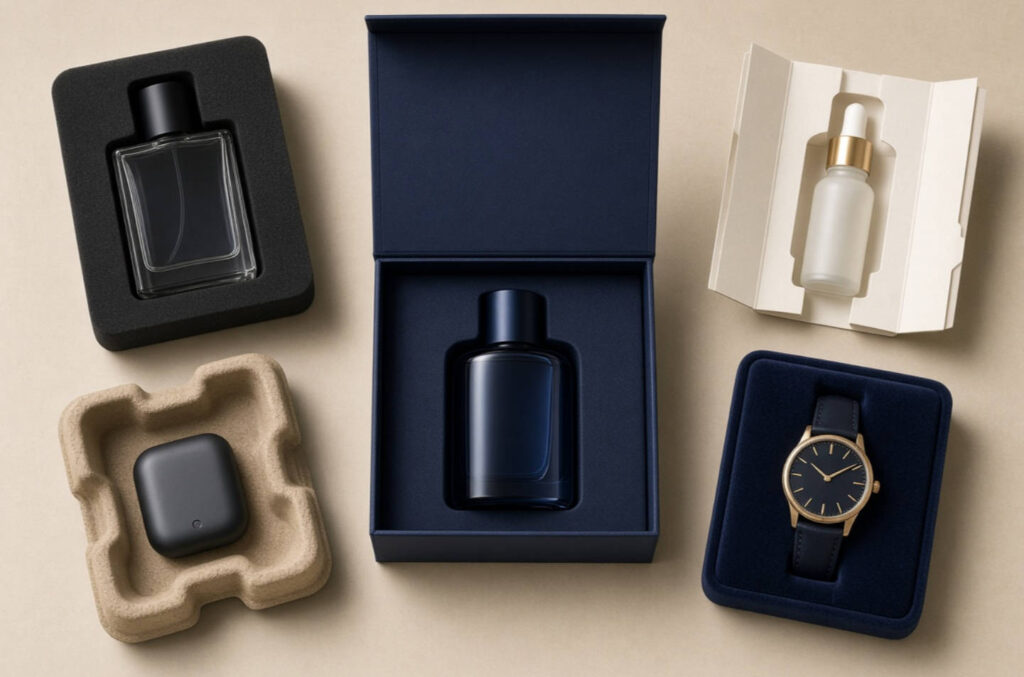
The insert is often the most underestimated part of custom rigid packaging. It keeps the product stable, controls the reveal, separates components, and can reinforce sustainability positioning.
| Insert Type | Best Use | Advantages | Key Consideration |
|---|---|---|---|
| EVA foam | Fragile, premium, high-value products | Precise fit and strong cushioning | Material selection affects recyclability goals |
| Paperboard insert | Cosmetics, gift sets, accessories | Printable, lightweight, paper-forward | Needs accurate folding and retention design |
| Molded pulp | Sustainable consumer products | Protective, fiber-based appearance | Surface finish and fine-detail control vary |
| Sponge or flocked foam | Jewelry and delicate items | Soft presentation and protection | Must fit brand and end-of-life strategy |
| Vacuum-formed tray | Repeatable product geometry | Clean product positioning | Plastic use may conflict with sustainability objectives |
A structural designer should ask: Can the customer remove the product easily without damaging it? Does the insert still perform after repeated opening? Does it support the product during transport? Can it be assembled efficiently?
A Practical Rigid Box Design Workflow
For buyers, a structured development process minimizes surprises and creates better production outcomes.
Step 1: Define the packaging job
Start with function, not decoration.
Clarify:
– Is the box for retail display, gifting, e-commerce, or all three?
– Will it ship directly to the end customer?
– Does it need to support product returns?
– Is the main priority protection, premium presentation, reuse, or cost control?
– Does the brand need a paper-based or certified-material direction?
A box intended for boutique display may need a different structure from one traveling through parcel networks.
Step 2: Build a complete product specification
Provide your packaging manufacturer with physical samples whenever possible. If samples are unavailable, supply accurate technical drawings, 3D files, photographs, and dimensions.
Include:
– Product weight
– Product materials and fragile areas
– Quantity per box
– Accessories
– Required opening direction
– Desired internal presentation
– Target market and distribution method
Step 3: Select the structural concept
Choose a box style that matches both the brand position and the product’s use case.
For instance:
– A luxury watch may suit a shoulder-and-neck rigid box with a velvet or paper-based insert.
– A direct-to-consumer beauty kit may benefit from a magnetic closure box with paperboard dividers.
– A premium tea set may need a lift-off lid box with secure internal partitions.
– A tech accessory bundle may need a drawer box with separate compartments and a pull ribbon.
Step 4: Prototype before finalizing finishes
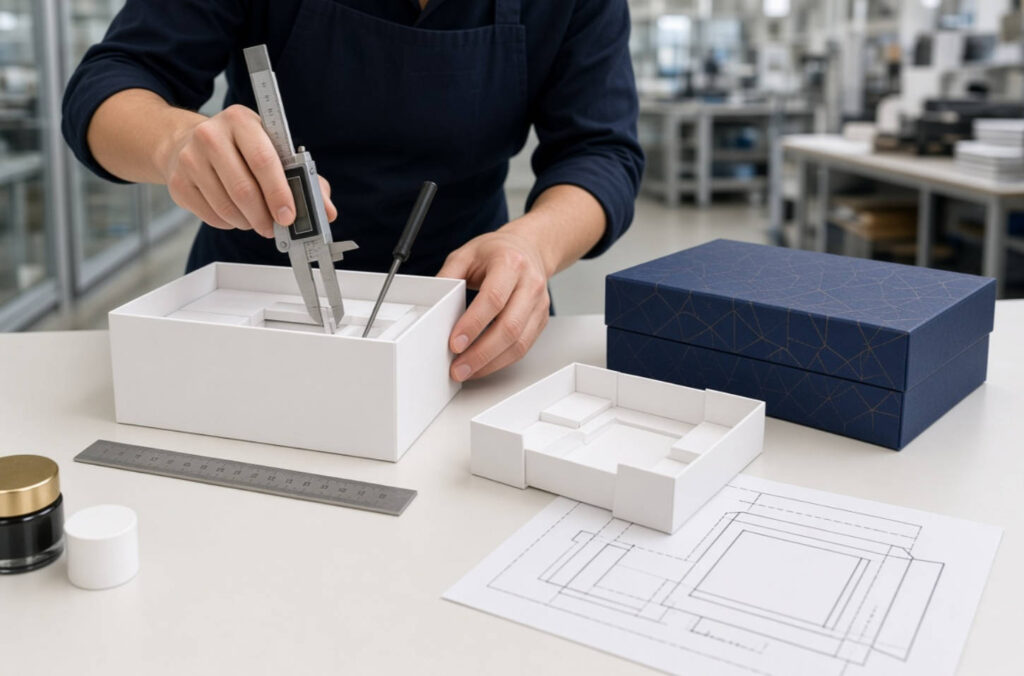
A white sample, structural mockup, or pre-production sample is where the real decisions happen.
Test the following:
1. Product fit and removal.
2. Lid alignment and opening force.
3. Insert stability.
4. Corner quality and box squareness.
5. Magnet or ribbon placement.
6. Clearance for wrapped-paper thickness.
7. Shipping-carton compatibility.
8. User handling after repeated opening.
Do not approve a design only from a rendered image. A digital model cannot fully show tactile resistance, assembly variation, paper behavior, or real-world product fit.
Step 5: Lock structure, then approve artwork
Once the box structure is approved, create final artwork based on the confirmed dieline and wrapping layout.
This reduces the risk of:
– Logos landing too close to wrapped corners
– Fine type being distorted around folds
– Foil elements crossing glue areas
– Artwork misalignment at lid or base seams
– Barcodes becoming hard to scan
– Inconsistent visual registration between components
Structural Design and Sustainable Luxury Packaging
Sustainability should be a design constraint at the beginning, not a label added at the end.
The U.S. Environmental Protection Agency’s waste-management hierarchy prioritizes source reduction and reuse before recycling. In packaging terms, this means avoiding unnecessary material while maintaining the performance required to protect the product.
For a rigid box, structural sustainability can include:
– Right-sizing the outer box around the product
– Avoiding empty space and unnecessary layers
– Choosing paper-based inserts where performance allows
– Designing removable components for easier material separation
– Using reusable structures with lasting value
– Evaluating FSC-certified material options
– Reducing mixed-material elements where they add little functional value
If an FSC claim is used, it should be supported by the appropriate certified supply chain and correct trademark use. FSC chain-of-custody certification is designed to verify FSC-certified material through processing stages.
A better sustainability question
Instead of asking, “Can this rigid box be called eco-friendly?” ask:
“Can we reduce materials, retain protection, improve reuse potential, and make end-of-life handling clearer?”
That question produces more credible packaging decisions.
Expert Insight: Structural Design Is a Cost-Control Tool
Many buyers assume that structural design increases cost. In reality, early structural engineering can reduce expensive late-stage changes.
A well-designed structure can improve:
– Material yield
– Assembly speed
– Product protection
– Rejection rates
– Carton packing density
– Freight efficiency
– Customer satisfaction
– Reusability and brand retention
Consider two magnetic rigid boxes. Both may have the same printed surface, logo treatment, and external dimensions. But one may require excessive manual assembly because of complex inner layers and tight tolerances. The other may use a simplified board construction and a smart insert layout. The second design can deliver a similar luxury result with lower production risk and stronger consistency.
Premium does not mean complicated. Premium means intentional.
Common Structural Design Mistakes
Avoid these frequent errors when developing custom rigid boxes:
– Designing graphics before confirming the box structure
– Using external dimensions instead of usable internal dimensions
– Ignoring the thickness of wrap paper, inserts, and product accessories
– Selecting board thickness based only on appearance
– Adding magnets, ribbons, and layers without a functional purpose
– Treating the insert as an afterthought
– Skipping a physical sample
– Failing to test the box under realistic shipping conditions
– Over-sizing the box and increasing material and freight costs
– Making sustainability claims without verifying materials and certification status
Partner With a Structural-First Rigid Box Manufacturer
A successful rigid box begins with a clear structural brief, an accurate product sample, and a manufacturer capable of translating brand requirements into repeatable production.
Bonito Packaging develops custom rigid boxes from the inside out—starting with product protection, dimensions, opening experience, inserts, materials, and manufacturability before moving into printing and premium finishes. Whether you need a magnetic gift box, drawer box, lift-off lid box, shoulder-and-neck box, or a fully customized luxury presentation package, our team can help turn an initial concept into a production-ready packaging solution.
Send us your product dimensions, target quantity, reference images, and desired box style to begin a structural design review for your next rigid box project.
FAQs
1. What is structural design in rigid box manufacturing?
Structural design is the engineering of a rigid box’s physical form and performance. It includes dimensions, board thickness, opening style, inserts, clearances, material selection, and assembly details.
2. Why should structural design come before rigid box artwork?
Structural design determines the final dieline, folds, wrapped corners, seams, and printable areas. Approving artwork before confirming the structure can cause logo placement, registration, and production problems.
3. What is the best board thickness for a custom rigid box?
There is no universal best thickness. Many rigid boxes use approximately 1.5 mm to 3 mm board, but the ideal specification depends on product weight, box size, structure, insert design, and distribution conditions.
4. Which rigid box style is best for luxury products?
The best style depends on the product and the desired customer experience. Magnetic closure boxes suit premium gifting, drawer boxes create a staged reveal, and shoulder-and-neck boxes offer a precise, elevated presentation.
5. Do rigid boxes need inserts?
Not every rigid box needs an insert, but inserts are valuable when a product needs protection, controlled positioning, accessory separation, or a more refined unboxing experience.
6. Can a rigid box be designed with sustainability in mind?
Yes. Brands can right-size the packaging, reduce unnecessary components, use paper-based inserts where suitable, design for reuse, consider certified paper options, and simplify material separation.
7. How should a rigid box be tested before mass production?
Test a physical sample for fit, opening and closing, insert retention, visual alignment, repeated use, packing into shipping cartons, and relevant drop, vibration, and compression risks associated with its distribution channel.
References
1. [Shopify. “Product Packaging Design: Guide for Ecommerce.”]
2. [International Safe Transit Association. “Getting Started with Design & Testing.”]
3. [International Safe Transit Association. “International Safe Transit Association: Home.”]
4. [U.S. Environmental Protection Agency. “Recycling Basics and Benefits.”]
5. [U.S. Environmental Protection Agency. “Waste Prevention.”]
6. [Forest Stewardship Council UK. “Chain of Custody Certification.”]
7. [Forest Stewardship Council. “Use of the FSC Trademarks by Certificate Holders.”]
8. [Zenpack. “Custom Rigid Boxes: Luxury Packaging Guide & Services.”]
9. [Shop Rigid Boxes. “How Thick Should a Rigid Box Be? A Complete Packaging Guide.”]
Hot Tags: Rigid Box, Manufacturers, Customized, Custom, Suppliers, Buy, Cheap, Quality, Advanced, Durable, in Stock, Made in China, Price, Quotation, Free Sample
 English
  Spanish
  French
  German
  Russian
  Japanese
  Portuguese
  Arabic