
Content Menu
● Custom Box Finishes: Soft Touch Laminate vs Anti-Scratch Film for Rigid Boxes
● What Soft Touch Laminate Really Does on Rigid Boxes
● Key Advantages of Soft Touch Laminate
● What Anti-Scratch Film Really Does on Rigid Boxes
● Key Advantages of Anti-Scratch Film
● Side-by-Side Comparison of Soft Touch Laminate and Anti-Scratch Film
● How Finishes Influence User Experience and Brand Perception
● Technical Performance in Production and Logistics
● Cost and Overall Packaging Value Considerations
● Practical Scenarios for Choosing Each Finish
>> Scenario 1 – High-End Skincare and Fragrance
>> Scenario 2 – Consumer Electronics and Gadgets
>> Scenario 3 – Subscription Boxes and Reusable Gift Sets
>> Scenario 4 – Limited Editions and Collaboration Kits
● Practical Selection Checklist for Brand Owners and Buyers
● Long-Term Brand Effects of Finish Choices
● FAQ – Soft Touch Laminate and Anti-Scratch Film
>> 1. Is soft touch laminate always the more premium option?
>> 2. Can a single brand use both finishes across different product ranges?
>> 3. Does soft touch laminate affect color accuracy or metallic effects?
>> 4. Is anti-scratch film suitable for very minimal, light-toned designs?
>> 5. How should teams test finishes before confirming specifications?
Soft touch laminate and anti-scratch film are two distinct finishes that shape how rigid boxes look, feel, and age in real-world use. Understanding their differences helps brand owners and packaging buyers specify the right finish for each product line and distribution scenario.
Custom Box Finishes: Soft Touch Laminate vs Anti-Scratch Film for Rigid Boxes
Rigid boxes have become a core packaging solution for premium brands across cosmetics, electronics, fashion accessories, and gifting. Their structural strength and three-dimensional presence make them ideal for showcasing a product and protecting it during transport. Yet the true first impression for the customer often comes from the surface finish—the way the box feels to the touch and how the graphics appear under different lighting conditions.
Among the many finishes available for rigid boxes, soft touch laminate and anti-scratch film stand out as two of the most widely adopted options. They might appear similar at a glance because both are clear protective layers applied over printed paper. In reality, they serve different roles, support different brand stories, and perform differently throughout the packaging lifecycle.
What Soft Touch Laminate Really Does on Rigid Boxes
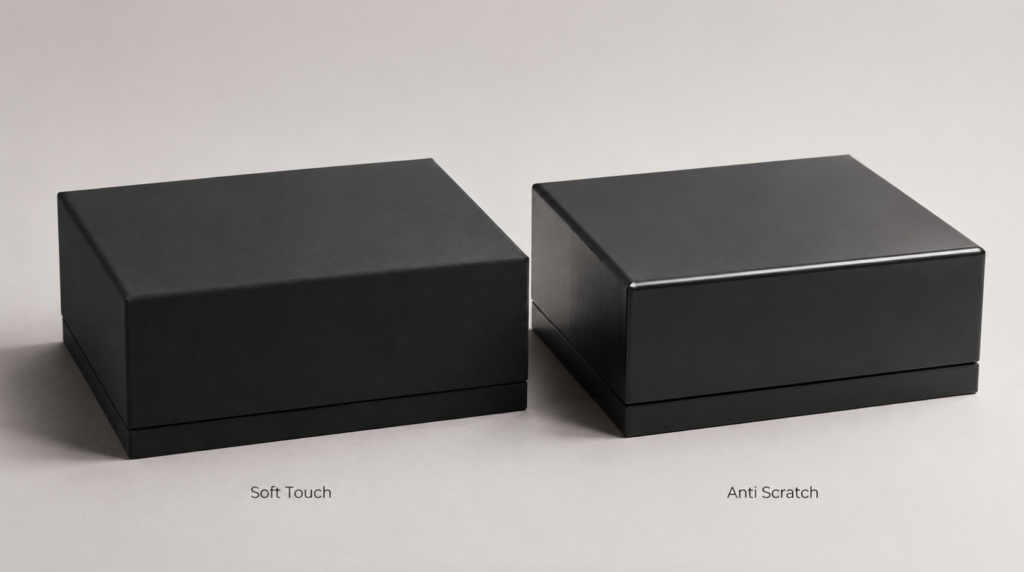
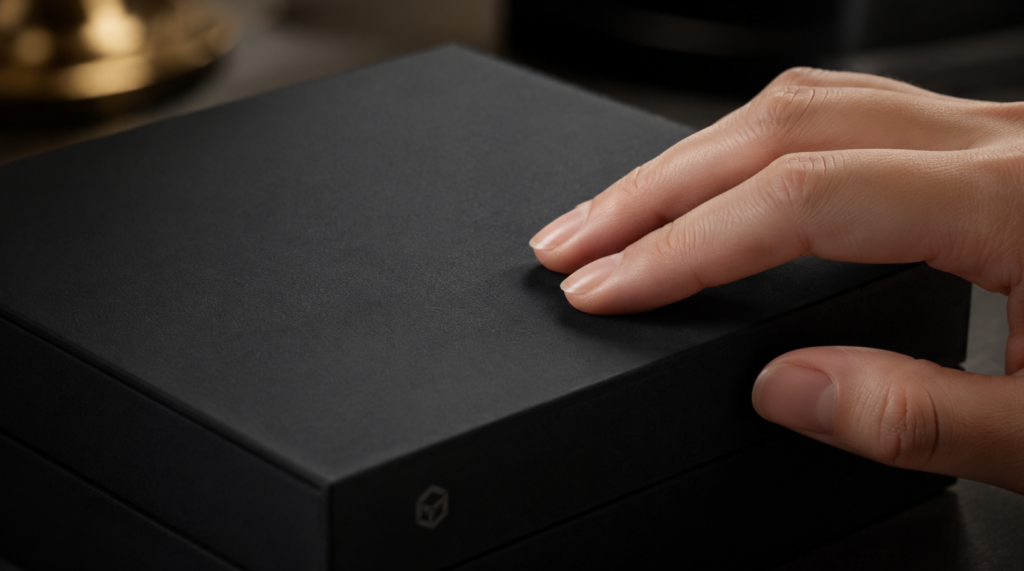
Soft touch laminate is a clear film or coating applied over printed paper to produce a velvety, matte tactile sensation. When a customer runs their fingers across a box finished with soft touch, the surface feels warmer and more refined than traditional glossy or standard matte films. This tactile quality creates an immediate emotional response and often signals exclusivity or craftsmanship.
Visually, soft touch laminate reduces glare and reflections, deepens certain solid colors, and helps printed graphics appear calm and controlled. Large areas of muted tones, minimalist typography, and subtle foil details can look more balanced when paired with this finish. Many brands in skincare, fragrance, high-end electronics accessories, and boutique gifting rely on soft touch to align packaging with the sensory character of their product.
From a practical standpoint, soft touch laminate offers better protection than uncoated or simply varnished paper, especially against fingerprints and light rubbing. However, it is not primarily designed for extreme durability. On dark, full-coverage backgrounds and high-friction zones, it can still show wear over time, especially if the boxes are stacked, transported, and handled repeatedly in busy retail environments.
Key Advantages of Soft Touch Laminate
– Enhanced perceived value
The velvety surface encourages customers to linger with the package, reinforcing the feeling that the product is special and carefully made.
– Comfortable tactile experience
The matte, soft feel contrasts with colder, harder surfaces and complements products positioned as gentle, luxurious, or artisanal.
– Controlled visual appearance
Reduced glare allows artwork and branding to remain legible under various lighting conditions, especially bright store lighting and studio-style photography.
– Fingerprint management
Compared with high-gloss films, soft touch can hide fingerprints and minor smudges, particularly on mid-tone and pastel color palettes.
What Anti-Scratch Film Really Does on Rigid Boxes
Anti-scratch film is a protective lamination designed to resist surface abrasion, friction, and repeated handling. Whereas soft touch laminate emphasizes sensory appeal, anti-scratch film emphasizes resilience. Its core job is to maintain the visual integrity of printed graphics, logos, and background colors over extended periods of use and transport.
This finish is typically less velvety to the touch and may be semi-matte or slightly glossy, depending on the specific formulation. The surface is harder and more resistant to rub marks, line scratches, and scuffing that commonly appear when boxes slide against each other in cartons or on store shelves. This makes anti-scratch film highly suitable for rigid boxes shipped across long distances, stored in warehouses, or displayed in self-service retail environments.
For color performance, anti-scratch film helps preserve dark, saturated backgrounds and large solid areas that are otherwise prone to visible wear. Deep blacks, navies, and rich reds tend to show scratches quickly on standard finishes; a dedicated anti-scratch layer keeps these areas visually consistent, even after repeated contact. This stability reduces the risk of products arriving with damaged packaging and supports long-term brand presentation.
Key Advantages of Anti-Scratch Film
– High abrasion resistance
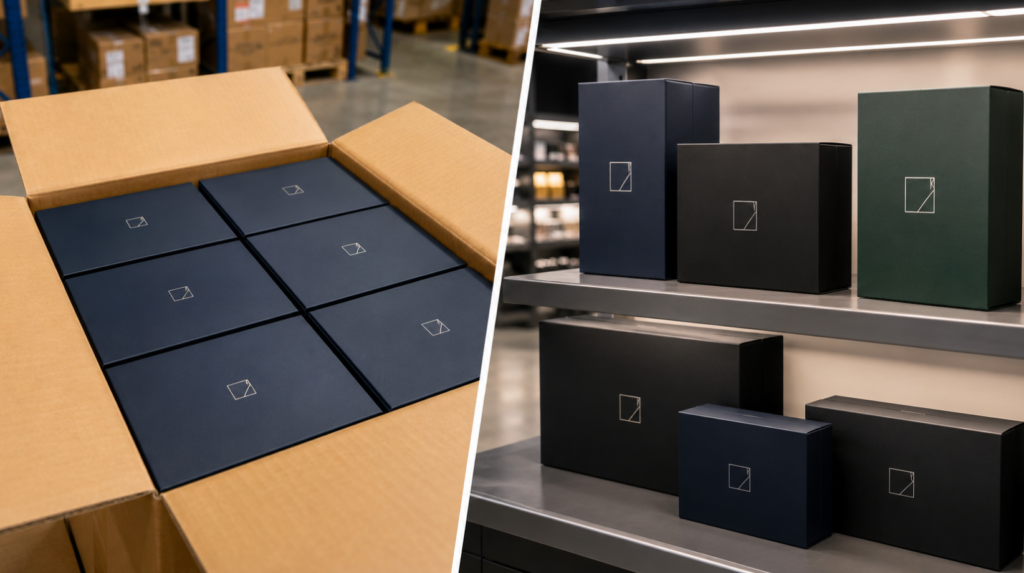
The finish withstands friction in cartons, on conveyors, and on shelves, helping boxes remain presentable throughout distribution and display.
– Consistent visual appearance over time
Colors and key brand elements stay sharp and clean, with fewer visible marks that could suggest wear or poor handling.
– Better suited to high-volume and export use
For large production runs and international shipments, durability reduces complaints, repacks, and wastage.
– Supports reusable packaging concepts
Rigid boxes intended for reuse as storage or gift boxes benefit from surfaces that stay attractive after many opening and closing cycles.
Side-by-Side Comparison of Soft Touch Laminate and Anti-Scratch Film
To make the distinction between the two finishes clearer, the table below outlines their main characteristics from the perspective of a brand owner or packaging buyer.
| Attribute | Soft Touch Laminate | Anti-Scratch Film |
|---|---|---|
| Tactile feel | Velvety, warm, and matte; emotionally engaging on first contact | Smooth, harder, more technical feel; emphasizes robustness |
| Visual effect | Low gloss, reduced reflections, deepened solids, calmer aesthetic | Semi-matte to glossy; maintains sharpness, may show more light reflections |
| Scratch resistance | Moderate; more protective than basic coatings but not extreme | High; specifically engineered to minimize visible scratches and scuffs |
| Fingerprint visibility | Good control, especially on pastel and mid-tone colors | Good to excellent; harder surface can be wiped clean easily |
| Best suited color schemes | Minimalist, muted palettes, delicate gradients, refined foils | Dark solids, high-coverage graphics, bold brand panels |
| Typical product categories | Skincare, fragrance, boutique gifting, premium accessories | Electronics, export packaging, subscription boxes, reusable gift sets |
| Main value driver | Tactile luxury and emotional unboxing | Long-term durability and visual stability under heavy handling |
Soft touch laminate can be viewed as a finish that elevates the emotional quality of the package, while anti-scratch film acts as a finish that protects the visual story through the entire journey from factory to end user. In practice, many brands benefit from using each finish in different parts of their portfolio.
How Finishes Influence User Experience and Brand Perception
Rigid boxes are not only functional containers; they are touchpoints in the overall product experience. The choice of finish contributes to how customers interpret the brand’s values, reliability, and attention to detail.
A soft-touch surface immediately communicates warmth and refinement. Customers often pause when they encounter such a box, noticing the contrast between the velvety wrap and other, more conventional packages around it. This pause can influence how they perceive the product inside, including assumptions about quality, craftsmanship, and price positioning.
Anti-scratch film influences perception in a different, more subtle way. Customers may not consciously identify the finish, but they notice that the box looks new even after being handled multiple times. Corners remain clean, background colors remain solid, and logos stay free of scuffs. This visual consistency suggests reliability, careful logistics, and respect for the product. Over time, these impressions reinforce trust in the brand’s ability to deliver a polished experience repeatedly.
Technical Performance in Production and Logistics
Beyond aesthetics and perception, finishes must perform during manufacturing and distribution. Rigid boxes often pass through several stages, including printing, lamination, die-cutting, wrapping, assembly, packing, and transport. Each stage can introduce friction or pressure that tests the strength of the surface layer.
Soft touch laminate generally runs well on modern production lines, but it can be more sensitive to extremely high mechanical friction. If large, dark areas of artwork rub against each other during bulk packing, marks may appear more quickly than on harder films. Careful consideration of packing density, inner fitments, and carton design helps manage this risk.
Anti-scratch film is designed for environments where friction cannot be fully controlled. It performs better in stacked packaging, automated packing lines, and long-distance transport where vibration and rubbing are common. In these situations, the investment in a more robust finish often results in fewer boxes showing cosmetic damage upon arrival, especially for export shipments and high-volume distribution.
Cost and Overall Packaging Value Considerations
Both soft touch laminate and anti-scratch film add to the base cost of a rigid box compared with simple varnish or standard matte film. However, cost should be evaluated in the context of total packaging value and the role the box plays in the product’s business model.
Soft touch laminate tends to justify its added cost through enhanced perceived value and stronger emotional impact. For premium or limited-edition products, the packaging is part of the product’s story. A velvety, matte finish aligns with a higher price point and can contribute to greater customer satisfaction and word-of-mouth. In many cases, the uplift in perceived value outweighs the incremental finishing cost.
Anti-scratch film delivers value through operational efficiency and long-term appearance. By reducing visible damage, it lowers the incidence of complaints, returns, and rework. For high-volume items, international shipments, and reusable packaging concepts, the savings from improved durability can be significant. The box remains a reliable ambassador for the brand throughout its use, even under demanding conditions.
Practical Scenarios for Choosing Each Finish
Different product and distribution scenarios call for different finishing priorities. The examples below illustrate typical choices for rigid box projects.
Scenario 1 – High-End Skincare and Fragrance
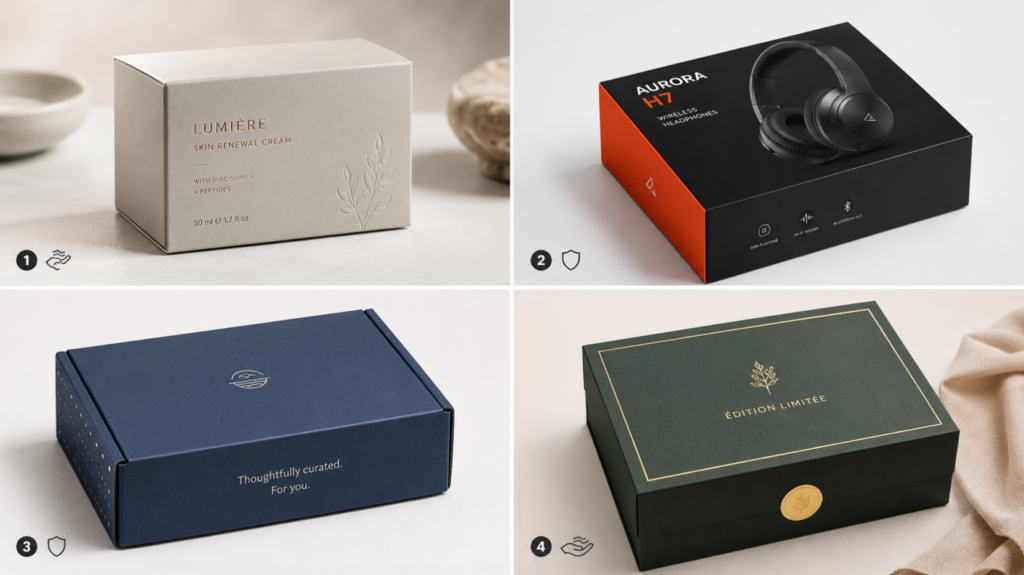
For high-end skincare and fragrance products, packaging is an extension of the sensory experience. The product may already evoke softness, care, and indulgence. In these cases, a soft-touch rigid box complements the rest of the brand universe. The velvety surface echoes the texture of creams or the delicacy of fine fragrance, and the matte appearance fits with frosted glass, satin ribbons, and subtle metallic accents.
Scenario 2 – Consumer Electronics and Gadgets
Consumer electronics often use strong, saturated colors and bold graphics to stand out on shelves and online. Boxes are handled frequently by store staff, customers, and delivery teams. Here, a more durable finish such as anti-scratch film is well suited. It helps protect dark backgrounds and metallic artwork, ensuring that devices arrive and remain in packaging that looks technically sophisticated and visually intact.
Scenario 3 – Subscription Boxes and Reusable Gift Sets
Subscription boxes and reusable gift sets are opened repeatedly and sometimes kept for storage or display. Over time, this repeated use can quickly reveal surface weaknesses. In such projects, anti-scratch film offers clear advantages because it keeps corners and panels tidy despite ongoing handling. At the same time, the rigid box format itself supports reuse and adds perceived value to the subscription or gift.
Scenario 4 – Limited Editions and Collaboration Kits
Limited editions and collaboration kits often rely on strong emotional impact at first opening. Influencer partnerships, seasonal collections, and special campaigns benefit from packaging that looks impressive in photos and videos. Soft touch laminate fits naturally into these projects, giving the box a refined, photographic presence and a tactile surprise when the recipient touches it for the first time.
Practical Selection Checklist for Brand Owners and Buyers
When planning a rigid box project, it can be helpful to use a simple decision framework to choose between soft touch laminate and anti-scratch film. The checklist below provides a structured way to think through the choice.
1. Define the primary objective.
Decide whether the main role of the packaging is emotional impact at unboxing or long-term surface protection throughout logistics and reuse.
2. Evaluate handling intensity.
Consider how often the box will be touched, moved, and stacked, from factory to retailer to end user. High-touch scenarios favor a more robust finish.
3. Review artwork and color blocks.
Identify whether the design relies heavily on dark solid areas, subtle palettes, or metallic details. Different finishes respond differently to these visual elements.
4. Consider product lifecycle and packaging reuse.
Decide whether the box is meant to be kept and reused or primarily serves the initial sale and short-term display. Longer lifecycles require greater durability.
5. Request physical samples.
Before final specification, review real samples of each finish on relevant colors and graphics so stakeholders can compare touch, visual behavior, and perceived value.
This structure helps teams align internal expectations and make a rational choice that fits both brand expression and operational realities.
Long-Term Brand Effects of Finish Choices
Finish decisions might appear technical at first glance, but over time they influence brand consistency and how customers remember the product experience. A series of packaging projects that consistently uses soft touch laminate will gradually establish an association with comfort, intimacy, and calm sophistication. Customers may come to expect that feeling whenever they encounter the brand’s boxes.
Similarly, a portfolio that makes extensive use of anti-scratch film will be recognized for clean, stable visual presentation. Boxes in stores and in customers’ homes will tend to look newer for longer, reducing the contrast between marketing photos and real-world appearance. This consistency adds strength to the brand promise and can support confidence among distributors and retail partners.
By treating finish choice not only as a technical specification but also as a long-term brand decision, companies can create more coherent packaging systems that reinforce their desired positioning year after year.
FAQ – Soft Touch Laminate and Anti-Scratch Film
1. Is soft touch laminate always the more premium option?
Soft touch laminate is often associated with premium products because of its tactile and visual qualities, but “premium” depends on the brand context. For some categories, a highly durable, clean look provided by anti-scratch film can feel just as high-end, especially in technical or performance-focused markets.
2. Can a single brand use both finishes across different product ranges?
Yes, many brands benefit from using soft touch laminate on flagship or limited-edition products and anti-scratch film on core, high-volume lines. This approach allows the packaging system to match the needs of each range without forcing a one-size-fits-all solution.
3. Does soft touch laminate affect color accuracy or metallic effects?
Soft touch laminate creates a matte effect that can deepen certain colors and reduce reflections. Metallic foils and very bright tones may appear more subtle than under gloss films. Proper proofing and sample evaluation help ensure that the final look matches design expectations.
4. Is anti-scratch film suitable for very minimal, light-toned designs?
Anti-scratch film can work well with minimal, light-toned designs, particularly when durability is important. The slightly harder feel may change the tactile impression compared with soft touch, but the finish still protects subtle palettes and fine typography from rub marks.
5. How should teams test finishes before confirming specifications?
Teams should request rigid box samples finished with both soft touch laminate and anti-scratch film on representative colors and artwork. Samples can then be evaluated under realistic lighting and handling conditions. Observations about tactile experience, reflections, and visible wear should guide the final decision.
References
1. Rigid box packaging design and finishing guidelines – lamination, coatings, and material selection for premium boxes. https://www.rigid-box.net/blog/rigid-box-packaging-design-guide
2. Custom paper boxes and rigid box manufacturing knowledge base, including structure, coating, and print finishing practices. https://www.rtadv.com/taipei-box-custom/
3. Guidance on luxury rigid box applications, surface finishing options, and how finishes influence perceived quality. https://gentlever.com/zh-CN/%E7%A1%AC%E7%9B%92%E5%AF%BC%E8%BD%A8/
4. Overview of custom rigid box production and applications for gift sets and high-end packaging. https://kaisinprint.com/what-is-custom-rigid-box
5. Insights into branded paperboard gift boxes and rigid gift packaging solutions for premium unboxing experiences. https://www.ecoicolor.com/ja/cosmetic-branding-solutions/branded-paperboard-gift-boxes/
Hot Tags: Custom Boxes, Rigid Boxes, Premium Folding Cartons, Manufacturers, Customized, Custom, Suppliers, Buy, Cheap, Quality, Advanced, Durable, in Stock, Made in China, Price, Quotation, Free Sample
 English
  Spanish
  French
  German
  Russian
  Japanese
  Portuguese
  Arabic