
Content Menu
● Why Custom Packaging Matters for Small Businesses
● The Real Cost of Custom Packaging
>> Common Cost Drivers to Review
● How Right-Sized Packaging Can Reduce Shipping Costs
>> A Practical Right-Sizing Checklist
● Choosing the Right Custom Paper Packaging Style
>> Corrugated Mailer Boxes for E-Commerce Orders
>> Folding Cartons for Retail and Product Presentation
>> Rigid Boxes for Premium Products
>> Custom Inserts for Protection and Presentation
● Designing Packaging That Builds Brand Trust
>> 3. Thoughtful Unboxing Details
>> 4. Honest Sustainability Communication
● A Manufacturer’s Process for Better Packaging Decisions
>> Step 1: Define the Business Objective
>> Step 2: Share Product Specifications
>> Step 3: Select Materials and Construction
>> Step 4: Develop a Simple, High-Impact Design
>> Step 5: Review a Sample Before Mass Production
>> Step 6: Measure Performance After Launch
● Avoid These Common Packaging Mistakes
>> Ordering Too Many Packaging Variations
>> Ignoring Fulfillment Efficiency
>> Treating Sustainability as an Afterthought
● Build Packaging That Supports Your Next Stage of Growth
>> What is the best custom packaging for a small e-commerce business?
>> How can small businesses reduce custom packaging costs?
>> Does custom packaging increase shipping costs?
>> What information should I provide to a custom packaging manufacturer?
>> Are paper-based custom boxes sustainable?
>> Should a small business order custom packaging in bulk?
For a small business, custom packaging is more than a branded box. It is a practical business tool that can protect products, improve the customer experience, reduce avoidable fulfillment costs, and make a growing brand easier to remember.
At Bonito Packaging, we work from the manufacturing side of premium paper packaging. That perspective matters. Packaging decisions are not only about choosing a box style or adding a logo. They affect material consumption, dimensional weight, packing speed, damage risk, production feasibility, storage space, and the customer’s first physical interaction with your brand.
This guide explains how small businesses can use custom packaging strategically—without treating premium presentation as an uncontrolled expense.
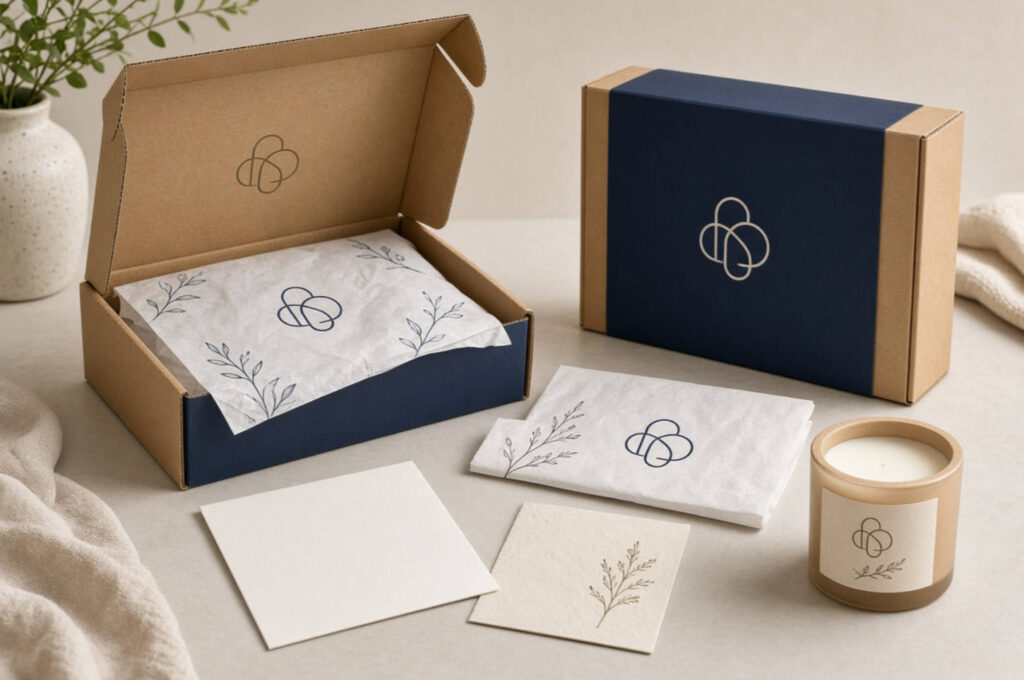
Why Custom Packaging Matters for Small Businesses
Small businesses rarely have unlimited advertising budgets. They often compete against larger companies with stronger brand recognition, wider distribution, and larger marketing teams. Custom packaging helps close part of that gap by making every shipment, shelf display, or customer handoff feel intentional.
A plain shipping carton may deliver a product. A well-designed custom package can communicate who made it, what the brand stands for, and why the buyer should return.
For e-commerce brands, packaging is especially important because customers cannot touch, inspect, or experience a product before ordering. The package becomes part of the purchase experience after checkout. It should reassure the customer that they made the right decision.
Well-planned custom packaging can support several commercial goals:
– Build brand recognition through consistent colors, typography, logo placement, and materials.
– Create a more memorable unboxing experience that encourages reviews, repeat purchases, and social sharing.
– Protect products in transit with a structure designed around the item’s actual size, weight, and fragility.
– Reduce excess material by avoiding oversized boxes and unnecessary void fill.
– Support premium pricing when the product presentation matches the quality promised by the brand.
– Improve operational consistency by standardizing packaging formats for packing teams, warehouses, and fulfillment partners.
The important point is that packaging should not be judged only by unit price. A lower-cost generic box can become expensive if it causes product damage, slow packing processes, excessive shipping charges, or a weak first impression.
The Real Cost of Custom Packaging
Many small business owners assume custom packaging is expensive because of printing or premium paperboard. Those factors matter, but they are only part of the total equation.
The total cost of packaging includes much more than the box itself:
Total Packaging Cost=Unit Cost+Shipping Cost+Storage Cost+Labor Cost+Damage/Return Cost
A packaging solution that appears inexpensive at the purchasing stage can create higher costs later. For example, a box that is too large may require extra filler, take longer to assemble, occupy more warehouse space, and increase freight charges.
Common Cost Drivers to Review
| Cost driver | What can go wrong | Better approach |
|---|---|---|
| Box dimensions | Excess empty space increases material use and shipping volume | Design around the product’s true packed dimensions |
| Material selection | Over-specifying board grade increases cost and weight | Match material strength to shipping risk |
| Printing method | Too many colors, finishes, or print areas raise unit cost | Prioritize high-impact branding areas |
| Order quantity | Very small runs may have high per-unit setup costs | Forecast demand and order practical quantities |
| Inserts and void fill | Too many components slow packing and increase material use | Use fitted paper inserts or efficient internal structures |
| Storage | Too many SKUs consume warehouse space | Standardize dimensions where possible |
| Assembly | Complex structures increase labor time | Choose fast-fold or self-locking designs when suitable |
The best packaging strategy is not the cheapest box. It is the box that delivers the best total value per order.
How Right-Sized Packaging Can Reduce Shipping Costs
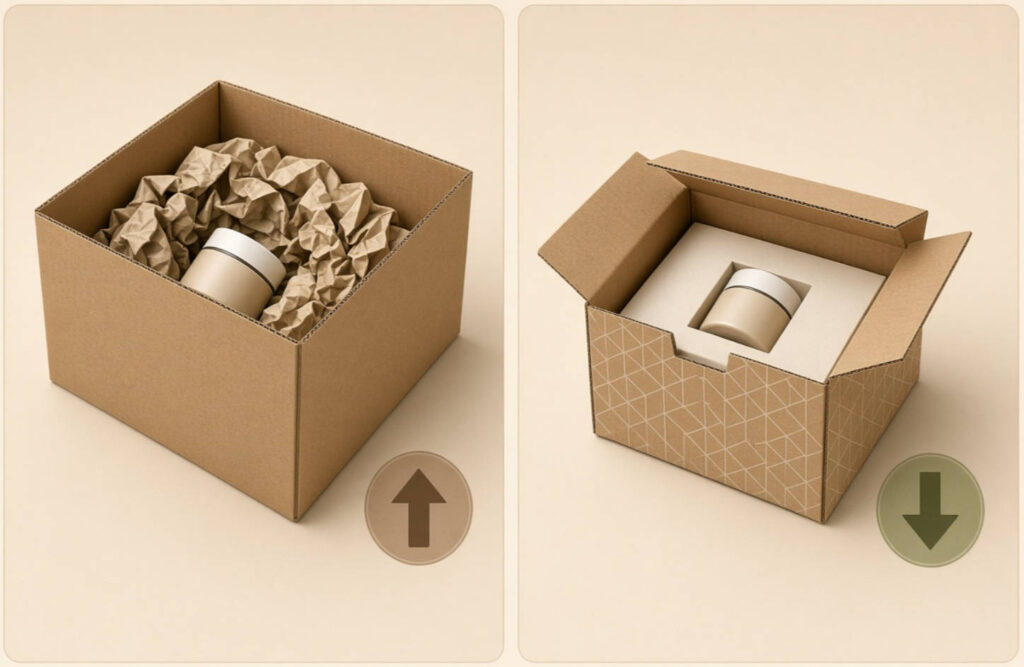
One of the most overlooked opportunities for small businesses is right-sizing. A package should be large enough to protect the product, but not so large that it ships air.
Many carriers use dimensional weight, often called DIM weight, when calculating shipping charges. In simple terms, carriers may charge based on the amount of space a package occupies, not only its physical weight. If a lightweight product is shipped in an oversized carton, the brand may pay more because the package takes up more space in the delivery network.
For example, imagine a skincare brand shipping a glass bottle in a standard large mailer. The bottle needs protection, but the empty space around it requires extra filler. A tailored folding carton or corrugated mailer with a paperboard insert can hold the bottle securely in a smaller outer footprint.
That can create several benefits at once:
– Less empty space inside the package.
– Less need for loose void fill.
– Reduced likelihood of the product moving during transit.
– Faster and more consistent packing.
– Lower risk of dimensional-weight charges.
– A cleaner and more premium unboxing experience.
Shopify’s packaging guidance similarly emphasizes minimizing shipping air, reducing external dimensions, and testing packaging for protection and usability before scaling production.
A Practical Right-Sizing Checklist
Before requesting a packaging quote, prepare the following information:
1. Product length, width, and height in its final packed condition.
2. Product weight, including accessories and manuals.
3. Fragility level, such as low, medium, or high.
4. Shipping method, including parcel, retail, subscription, or bulk freight.
5. Required internal components, such as inserts, tissue paper, cards, or accessories.
6. Expected handling conditions, including long-distance shipping, stacking, or high-value delivery.
7. Target unboxing experience, such as minimal, eco-conscious, premium, gift-ready, or luxury.
This information enables a packaging manufacturer to recommend a structure that balances protection, presentation, and cost.
Choosing the Right Custom Paper Packaging Style
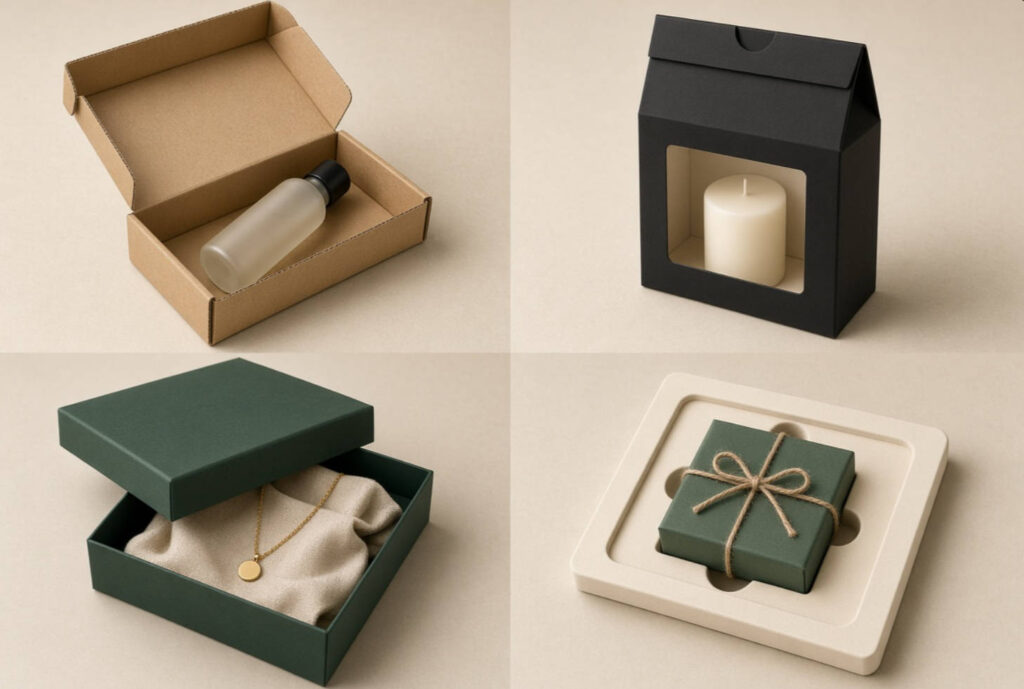
Not every product needs a rigid box, and not every small business needs full-color printing on every surface. The right packaging style depends on product value, shipping conditions, shelf requirements, and brand positioning.
Corrugated Mailer Boxes for E-Commerce Orders
Custom corrugated mailer boxes are a strong choice for direct-to-consumer shipping. They combine product protection with branding space and can be designed in self-locking formats that reduce tape use.
They are particularly suitable for:
– Apparel and accessories.
– Subscription boxes.
– Cosmetics and skincare sets.
– Small electronics and accessories.
– Gift products.
– Home goods.
– Promotional kits.
A branded mailer can create a professional arrival experience while protecting products through parcel delivery.
Folding Cartons for Retail and Product Presentation
Folding cartons are commonly used for lightweight consumer products such as cosmetics, candles, food items, supplements, stationery, and retail accessories.
They are effective when a product needs:
– Strong shelf presence.
– Clear product information.
– Barcodes, instructions, or compliance text.
– A compact packaging format.
– Lower shipping and storage volume before assembly.
For small businesses, folding cartons can offer an excellent balance between visual impact and cost efficiency.
Rigid Boxes for Premium Products
Rigid boxes are usually reserved for high-value or gift-oriented products. Their construction creates a heavier, more substantial feel, making them appropriate for luxury cosmetics, jewelry, electronics, corporate gifts, premium candles, and limited-edition products.
However, a rigid box should be selected deliberately. It can increase material usage, weight, storage demands, and freight cost. For many brands, a rigid box is most effective for flagship products, gift sets, influencer kits, or seasonal campaigns rather than every item in the catalog.
Custom Inserts for Protection and Presentation
A packaging insert is often the difference between a package that looks loosely packed and one that feels engineered.
Paperboard inserts, corrugated inserts, and molded paper structures can help keep products centered and protected. They can also eliminate the need for excessive plastic-based filler.
A good insert should:
– Keep the product stable during shipping.
– Be easy for packing staff to use.
– Fit consistently inside the outer package.
– Support easy product removal.
– Use only as much material as necessary.
– Align with the brand’s sustainability and disposal goals.
Designing Packaging That Builds Brand Trust
A small business does not need a complex design to look premium. In fact, clear and focused packaging often feels more confident than a crowded design.
Start with the customer’s experience. What should they notice first? What information do they need? What feeling should the package create?
A strong custom packaging design usually has four layers.
1. Clear Brand Recognition
Your logo, color system, and typography should be recognizable at a glance. A customer should be able to connect the package to your website, social channels, and product pages.
Keep the visual hierarchy simple. Do not place every brand message on every panel.
2. Product Clarity
The customer should quickly understand what they received. This is especially important for products with variants, sizes, fragrances, colors, or subscription configurations.
Include practical information where needed:
– Product name.
– Variant or scent.
– Key feature or benefit.
– Usage instructions.
– Ingredient, material, or care information.
– Barcode or SKU.
– Recycling and disposal guidance.
3. Thoughtful Unboxing Details
Small details can make a package feel more human without dramatically increasing cost.
Examples include:
– A branded thank-you card.
– A short founder note.
– A reorder QR code.
– A referral offer.
– Product-care instructions.
– A simple one-color sticker.
– Printed interior messaging.
– Seasonal artwork for limited campaigns.
For emerging brands, adding affordable components such as a branded card, tissue paper, or sticker can be a practical way to improve presentation before investing in more complex packaging systems.
4. Honest Sustainability Communication
Sustainability claims should be specific and supportable. Avoid vague phrases such as “100% eco-friendly” unless you can substantiate what that means across the product’s full life cycle.
Instead, use clear language, such as:
– “Made with recycled paper content.”
– “Designed to reduce unnecessary void space.”
– “Paper-based packaging where local recycling systems accept it.”
– “Plastic-free paper insert.”
– “Please separate components before recycling.”
Consumer interest in recyclability remains significant. Research summarized by the Sustainable Packaging Coalition notes that recyclability was the leading sustainability priority in a 2025 global packaging survey, and paper ranked among consumers’ preferred packaging materials across all surveyed countries.
A Manufacturer’s Process for Better Packaging Decisions
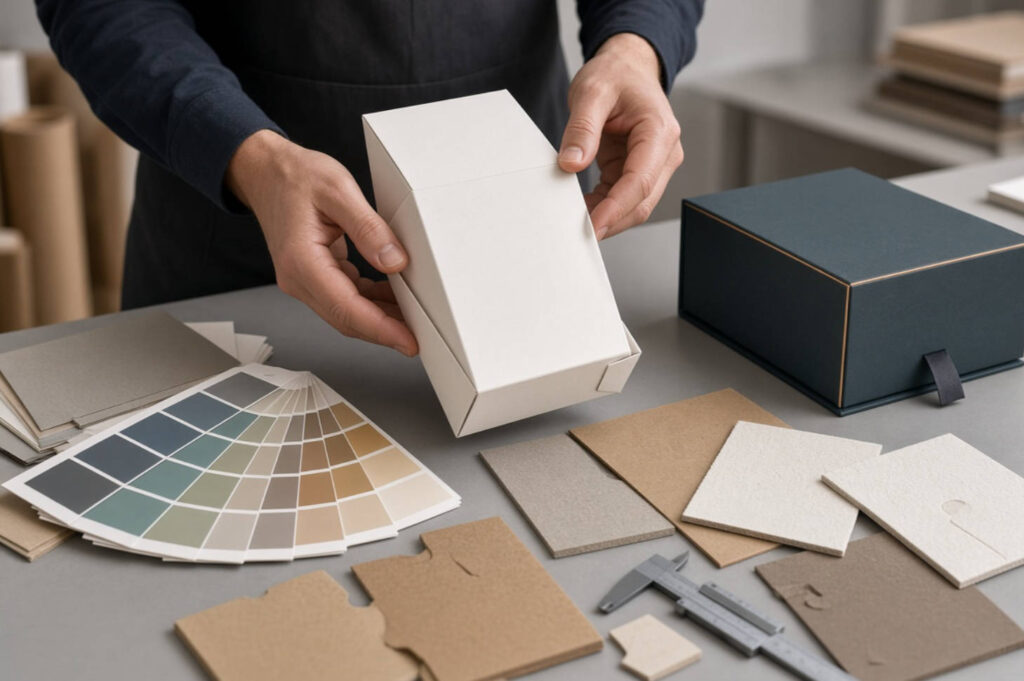
As a paper packaging manufacturer, Bonito Packaging recommends treating custom packaging as a product-development project—not simply a printing order.
The following process can help small businesses reduce uncertainty before committing to production.
Step 1: Define the Business Objective
First, decide what problem the packaging must solve.
Is the priority to:
– Improve shelf visibility?
– Reduce product damage?
– Lower shipping costs?
– Launch a new product?
– Create a better gift experience?
– Replace generic boxes?
– Improve sustainability performance?
– Strengthen brand consistency?
A package cannot optimize every possible goal equally. Establishing priorities early prevents expensive design changes later.
Step 2: Share Product Specifications
Provide accurate product information, including dimensions, weight, fragility, accessories, and shipping conditions.
If the item has irregular shapes, multiple components, or breakable parts, physical samples or technical drawings are especially useful. Packaging engineers can use this information to determine suitable structure, board type, and insert design.
Step 3: Select Materials and Construction
Choose materials based on performance requirements, not appearance alone.
For example:
– Corrugated board may be appropriate for shipping protection.
– Paperboard may suit retail folding cartons.
– Rigid board may fit premium gifting.
– Paper inserts can replace certain foam or plastic components.
– Uncoated paper can create a natural, tactile brand feeling.
– Coated surfaces may support stronger color reproduction and wipe-clean performance.
Step 4: Develop a Simple, High-Impact Design
Focus on the most visible touchpoints. You may not need full-color printing inside and outside the box. A carefully placed logo, one-color internal message, or premium finish on the lid can often deliver more impact than a visually overloaded design.
Step 5: Review a Sample Before Mass Production
Never rely only on a digital mockup. A physical sample helps verify:
– Product fit.
– Structural strength.
– Color accuracy.
– Ease of opening.
– Insert performance.
– Packing speed.
– Shipping durability.
– Overall customer perception.
Testing matters. Packaging should be assessed under realistic conditions, including drops, compression, vibration, and long-distance shipping where appropriate.
Step 6: Measure Performance After Launch
After the first production run, collect operational feedback.
Review:
– Product damage rate.
– Customer reviews.
– Packing time.
– Shipping costs.
– Return reasons.
– Storage requirements.
– Reorder rate.
– Team feedback from fulfillment staff.
The best packaging systems improve through testing and refinement, not guesswork.
Avoid These Common Packaging Mistakes
Even well-intentioned small businesses can lose money through preventable packaging decisions.
Ordering Too Many Packaging Variations
A different box for every product may seem ideal, but it can create inventory complexity, higher minimum order quantities, and storage problems.
Whenever possible, use a small system of modular packaging sizes. One mailer size with different inserts may serve multiple SKUs.
Overusing Premium Finishes
Foil stamping, embossing, lamination, spot UV, ribbons, magnets, and specialty papers can all create visual value. But using too many finishes can make packaging expensive and difficult to scale.
Choose one or two details that reinforce your brand positioning. For example, a textured uncoated paper with a single-color logo may feel more premium than a heavily decorated box with no design focus.
Ignoring Fulfillment Efficiency
A complex box may look excellent in a product shoot but perform poorly in a busy fulfillment environment.
Ask practical questions:
– Can one person assemble it quickly?
– Does it require tape?
– Can it be packed consistently?
– Does the insert stay in place?
– Does it stack efficiently?
– Will it work with a third-party fulfillment provider?
Treating Sustainability as an Afterthought
Switching to a recyclable material is useful, but true packaging improvement also includes reducing unnecessary size, limiting mixed materials, and making disposal instructions understandable.
Less material can often mean lower cost, lower shipping volume, and a simpler customer experience.
Build Packaging That Supports Your Next Stage of Growth
Custom packaging for small businesses should be designed for today’s needs and tomorrow’s growth. The goal is not to create the most elaborate box possible. The goal is to build a packaging system that protects the product, supports the brand, fits the fulfillment process, and remains commercially realistic as order volume increases.
Bonito Packaging can help you develop high-end custom paper packaging that matches your product, target customer, shipping method, and brand vision. From custom mailer boxes and folding cartons to rigid gift boxes, paper inserts, and branded packaging components, our team can support packaging projects from structural concept through sample development and production.
Ready to create packaging that looks premium, protects your product, and works for your budget? Contact Bonito Packaging to request a custom packaging consultation, share your product specifications, and begin developing a tailored packaging solution.
Frequently Asked Questions
What is the best custom packaging for a small e-commerce business?
For many e-commerce businesses, a custom corrugated mailer box is a practical starting point because it provides shipping protection, brand visibility, and relatively simple fulfillment. The ideal choice still depends on product size, weight, fragility, order volume, and desired customer experience.
How can small businesses reduce custom packaging costs?
Small businesses can reduce packaging costs by using right-sized boxes, simplifying graphics, standardizing packaging sizes, selecting suitable material grades, reducing unnecessary inserts, and ordering quantities that match realistic demand forecasts. Cost should be evaluated across packaging, shipping, labor, storage, and product-damage risk.
Does custom packaging increase shipping costs?
It can, but it does not have to. Oversized or heavy packaging may increase freight costs. However, a properly engineered custom package can reduce empty space, filler, damage, and dimensional-weight exposure, potentially improving overall shipping efficiency.
What information should I provide to a custom packaging manufacturer?
Provide product dimensions, weight, product samples or drawings when possible, desired box style, quantity, shipping method, branding files, target budget, required finishes, and any special protection or sustainability requirements. The more accurate the product information, the more reliable the packaging recommendation will be.
Are paper-based custom boxes sustainable?
Paper-based boxes can be a strong option when they are appropriately designed, responsibly sourced, recyclable in the customer’s local system, and not overbuilt. Sustainability also depends on reducing material use, avoiding difficult-to-separate mixed components, and communicating disposal guidance clearly.
Should a small business order custom packaging in bulk?
Bulk orders can lower the per-unit cost, but they should be balanced against storage capacity, cash flow, product changes, and seasonal demand. A good approach is to use standardized box sizes and place production orders based on demand forecasts rather than ordering more inventory than the business can use efficiently.
References
1. [OXO Packaging: Custom Packaging for Small Business—Complete Guide]
2. [Shopify: Product Packaging Design Guide for Ecommerce]
3. [ShipBob: Custom Packaging Ideas for Small Businesses]
4. [Sustainable Packaging Coalition: Building Buy-In for Your Sustainable Packaging Strategy]
5. [WareSpace: 10 Ways to Optimize Shipping and Reduce Packaging Costs]
6. [Kase: Custom Packaging Creates a Shareable Unboxing Experience]
7. [Cura Group: Custom Packaging Fulfillment]
Hot Tags: Custom Packaging, Manufacturers, Customized, Custom, Suppliers, Buy, Cheap, Quality, Advanced, Durable, in Stock, Made in China, Price, Quotation, Free Sample
 English
  Spanish
  French
  German
  Russian
  Japanese
  Portuguese
  Arabic