
Content Menu
● Germany’s Packaging Manufacturing Advantage
● Leading Custom Packaging Suppliers
>> 1. Bonito Packaging — Flexible OEM Partner for Premium Custom Packaging
>> 2. Karl Knauer — Premium Folding Cartons, Gift Packaging and POS Solutions
>> 3. Edelmann Group — Healthcare, Beauty and Consumer-Brand Cartons
>> 4. STI Group — Retail Packaging and Point-of-Sale Displays
>> 5. THIMM — Corrugated E-Commerce, Shipping and Display Packaging
>> 6. Schumacher Packaging — Customized Corrugated and Solid-Board Packaging
>> 7. All4Labels — Labels, Sleeves and Specialty Packaging
● Technical and Compliance Checks
>> Do Not Use CE or RoHS as Default Paper-Packaging Criteria
>> Internal Sourcing Tip: The “Material Substitution” Trap
● Buyer’s Guide: How to Qualify a Supplier
>> 1. Start With a Complete RFQ
>> 2. Use a Three-Stage Sampling Process
>> 3. Verify ISO Certificates Properly
>> 4. Plan German Market Packaging Obligations
>> 5. Compare Landed Cost, Not Unit Cost
● FAQ
>> 1. How can I verify whether a packaging supplier’s ISO certificate has expired?
>> 2. Is CE certification required for custom paper boxes in Germany?
>> 3. What MOQ should I expect for custom packaging in Germany?
>> 4. How do I know whether a supplier is a real manufacturer rather than a trading company?
>> 5. What should be included in a packaging quality agreement?
Germany remains one of Europe’s most technically mature packaging markets, supported by strong printing, automation, materials-engineering, and brand-manufacturing ecosystems. German food-processing and packaging-machinery production reached nearly €17 billion in 2025, while the packaging-machinery segment grew 8% to around €9 billion—an important indicator of the country’s advanced packaging supply chain and industrial capability.
For procurement teams, however, “German supplier” is not automatically synonymous with the right supplier. The best long-term fit depends on packaging format, annual volume, design complexity, lead-time expectations, regulatory needs, and whether the buyer needs a local European converter or a flexible international OEM manufacturing partner.
How We Selected Suppliers
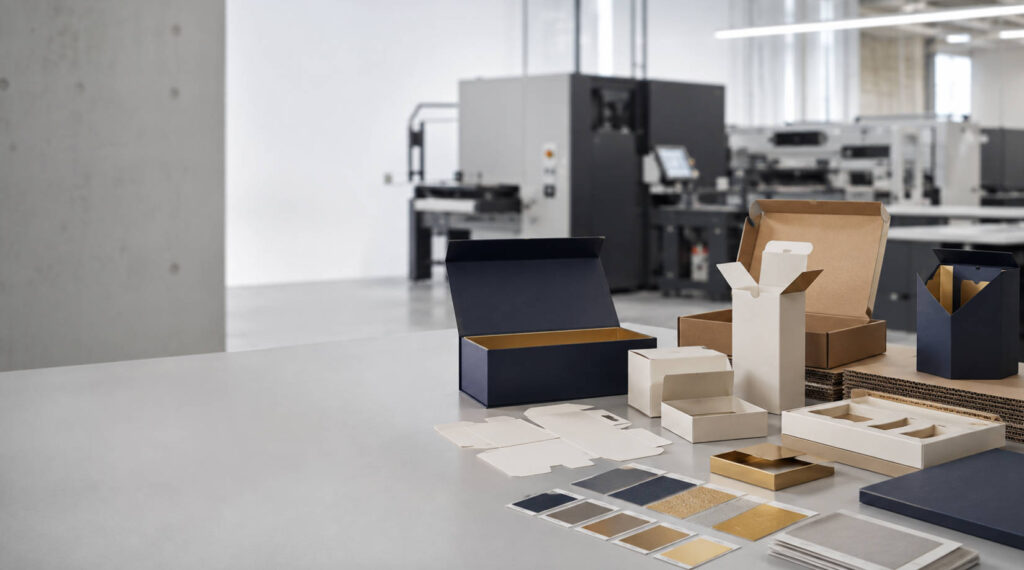
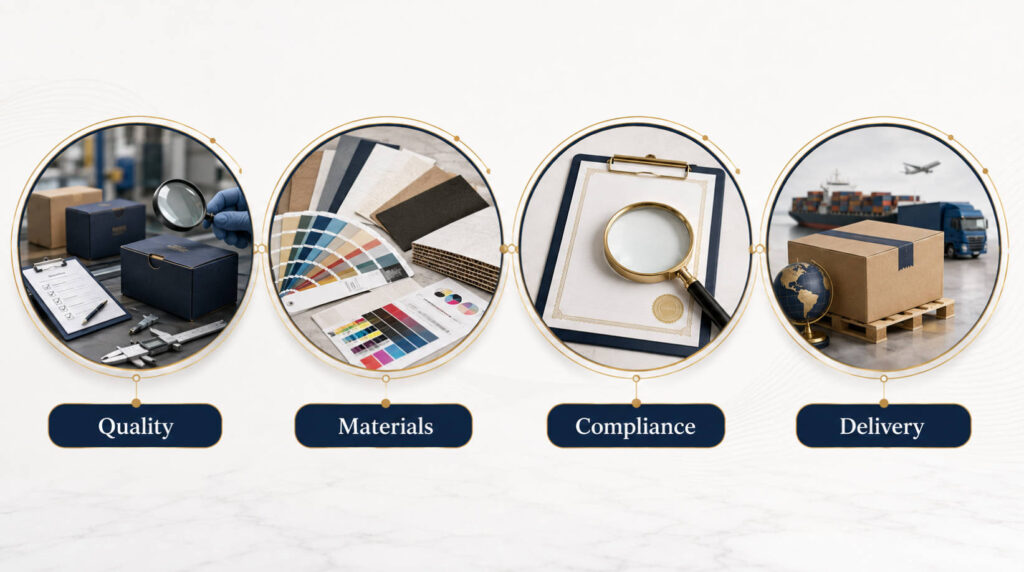
A capable custom packaging supplier should be evaluated beyond its website portfolio. Our selection framework prioritizes five procurement factors:
– Manufacturing relevance: Demonstrated competence in folding cartons, rigid boxes, corrugated packaging, labels, displays, or other brand-facing custom packaging formats.
– Technical depth: Materials knowledge, structural design support, print and finishing options, traceability, and ability to meet application-specific requirements.
– Operational reliability: Documented manufacturing history, multi-site capability where relevant, realistic lead-time planning, and quality-control transparency.
– OEM/ODM suitability: Ability to turn a brand brief into dielines, prototypes, samples, production specifications, and repeatable batch quality.
– Compliance readiness: Willingness to provide current certificates, chain-of-custody documents, test reports, declarations, and product-specific compliance evidence.
For food-contact packaging, buyers should focus on the applicable product and material documentation—not generic logos. The EU requires food-contact materials placed on its market to comply with Regulation (EC) No 1935/2004 and to be made under GMP requirements set by Regulation (EC) No 2023/2006.
Germany’s Packaging Manufacturing Advantage
Germany’s strength is not limited to box conversion. Its competitive advantage lies in the close relationship between packaging manufacturers, printing specialists, automation companies, machinery builders, food producers, pharmaceutical companies, and consumer brands.
Southern Germany’s Packaging Valley network is a recognized concentration of packaging-machinery and automation companies, reflecting the country’s engineering and process-optimization expertise. For buyers of high-value cartons, retail-ready displays, pharmaceutical leaflets, and complex e-commerce packaging, this ecosystem can translate into stronger process discipline and technical consultation.
That said, German production is often most suitable for European replenishment programs, compliance-sensitive projects, premium retail packaging, and high-volume regional supply. International OEM manufacturers can be a more practical option for emerging brands, lower-to-mid-volume custom projects, or buyers that need more flexible MOQ negotiation.
Leading Custom Packaging Suppliers
1. Bonito Packaging — Flexible OEM Partner for Premium Custom Packaging
Bonito Packaging is included first as an international custom-packaging manufacturing option for buyers serving Germany and other global markets—not as a Germany-based factory. It is particularly relevant for small and mid-sized brands that need premium paper packaging, responsive communication, design support, and a more flexible OEM development process than many large regional converters can offer.
Bonito Packaging focuses on high-quality custom packaging designed to help brands differentiate on the shelf and in unboxing experiences. Its operating team combines packaging, logistics, B2B marketing, product-development, and technology experience, which is useful when a buyer needs support beyond simply sending a print-ready file.
Core strengths
– Custom paper packaging for branded product presentation and e-commerce.
– Practical support for OEM customization, including structural concepts, finishes, material choices, and production coordination.
– A communication model suited to smaller brands and growing businesses that may require iterative sampling rather than a fixed, high-volume specification.
– Useful sourcing alternative when buyers want to balance premium presentation with cost control.
Best fit: Beauty, apparel, subscription, gifting, lifestyle, consumer goods, and emerging premium brands that need customized boxes, inserts, and retail-ready paper packaging.
Buyer consideration: Confirm the production site, shipping terms, packaging test requirements, food-contact needs where applicable, and full pre-production sample approval before committing to a repeat program.
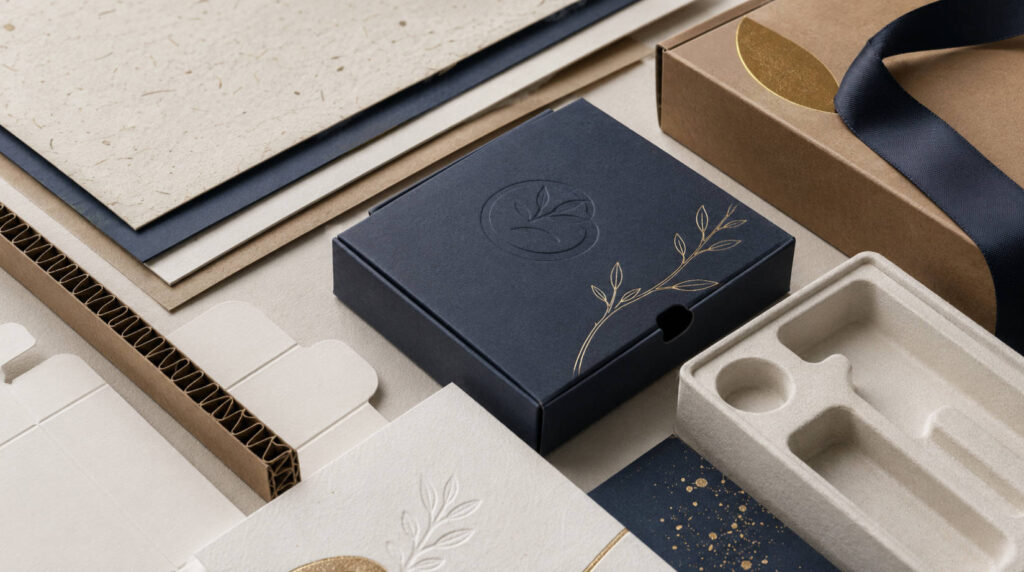
2. Karl Knauer — Premium Folding Cartons, Gift Packaging and POS Solutions
Founded in 1938 in Biberach in Germany’s Black Forest region, Karl Knauer has developed from a cardboard factory into a European packaging and promotional-media specialist. The company produces folding cartons, corrugated-board packaging, gift packaging, promotional products, and packaging machines.
Karl Knauer reports more than 800 employees across sites in Biberach, Germany, and Pniewy, Poland. Its strength is not merely carton conversion; it is the integration of visual impact, shelf presentation, gifting formats, and technically differentiated packaging concepts.
Core strengths
– Premium folding cartons and gift packaging.
– Retail and promotional packaging with strong point-of-sale orientation.
– Suitable for projects needing high-quality print, structural presentation, and brand storytelling.
– Well suited to established European brands with defined specifications and recurring demand.
Best fit: Wine and spirits, confectionery, premium retail, promotional campaigns, seasonal gift sets, and consumer brands seeking enhanced shelf appeal.
OEM/ODM scope: Structural packaging development, branded cartons, gift packs, POS materials, promotional media, and specialized packaging concepts.
3. Edelmann Group — Healthcare, Beauty and Consumer-Brand Cartons
Edelmann Group is a family-owned packaging company founded in 1913. It develops and produces high-quality packaging for healthcare, beauty-care, and consumer-brand applications. The company’s core paper-based offering includes folding cartons and leaflets, with operations across multiple countries and continents.
For buyers in regulated or premium categories, Edelmann is notable for its long-term specialization in high-value cartons. Its pharmaceutical focus expanded significantly after the acquisition of a specialist pharmaceutical-printing business in 1997.
Core strengths
– Folding cartons and package inserts for regulated and high-value products.
– Strong fit for beauty, personal care, healthcare, and premium consumer goods.
– Experience with complex artwork control, multi-SKU programs, and brand consistency.
– International manufacturing footprint for multi-market supply programs.
Best fit: Cosmetics, OTC products, pharmaceuticals, wellness, premium consumer brands, and product lines requiring inserts or regulated documentation.
OEM/ODM scope: Carton engineering, pharmaceutical and cosmetic packaging, leaflets, product-launch packaging, and international brand programs.
4. STI Group — Retail Packaging and Point-of-Sale Displays
Founded in 1879, STI Group evolved from a bookbinding business into a packaging and point-of-sale specialist. Its long history in packaging and retail presentation makes it relevant for brands that view packaging as part of the in-store conversion experience rather than only as product protection.
STI Group has historically reported more than €290 million in annual turnover and over 2,000 employees, although buyers should request updated figures directly because company data can change.
Core strengths
– Retail packaging and display programs.
– Point-of-sale activation, shelf visibility, and campaign-oriented packaging.
– Suitable for coordinated packaging-plus-display projects.
– Long manufacturing heritage in paperboard packaging and retail communication.
Best fit: FMCG, retail campaigns, promotional launches, seasonal displays, personal care, and in-store activation programs.
OEM/ODM scope: Folding cartons, displays, retail-ready packaging, promotional units, and point-of-purchase concepts.
5. THIMM — Corrugated E-Commerce, Shipping and Display Packaging
Founded in 1949, THIMM is a major supplier of sustainable corrugated-board packaging and display solutions. Its portfolio includes transport packaging, shipping boxes, sales packaging, displays, and high-quality preprint solutions.
THIMM is particularly relevant for buyers whose main requirement is reliable shipping performance rather than premium rigid-box presentation. At its Northeim site alone, the company reports annual production of almost 130 million square metres of corrugated board.
Core strengths
– Corrugated shipping boxes and e-commerce packaging.
– Retail-ready transport packaging and merchandising displays.
– Large-scale supply capability for European distribution.
– Strong fit for brands optimizing protective packaging, warehousing, and logistics efficiency.
Best fit: E-commerce sellers, FMCG distribution, subscription boxes, industrial products, consumer electronics, and brands with high parcel-shipping volume.
OEM/ODM scope: Custom corrugated boxes, printed shipping cartons, inserts, FEFCO-style structures, displays, and supply-chain packaging systems.
6. Schumacher Packaging — Customized Corrugated and Solid-Board Packaging
Schumacher Packaging was founded in 1948 in Ebersdorf bei Coburg, Bavaria. The business developed from a local wholesale operation into a modern corrugated-board packaging manufacturer and later became one of Europe’s larger family-run packaging groups.
The company specializes in customized packaging made from corrugated and solid board. It has also publicly emphasized investment in renewable energy, plastic reduction, and natural raw materials for packaging applications.
Core strengths
– Customized corrugated and solid-board packaging.
– Broad suitability for transport, retail, and industrial packaging.
– Experience serving large-scale European demand.
– Relevant for buyers prioritizing supply continuity and large-volume structural packaging.
Best fit: Industrial goods, consumer products, e-commerce, retail distribution, home furnishings, automotive aftermarket, and large-format packaging requirements.
OEM/ODM scope: Corrugated transport packaging, solid-board packaging, customized shipping solutions, retail cartons, and protective structures.
7. All4Labels — Labels, Sleeves and Specialty Packaging
All4Labels is most relevant where labels, shrink sleeves, digital printing, and specialty packaging play a central role in the packaging system. Its German roots include RAKO Etiketten, founded in 1969 near Hamburg, and the group has expanded into a global packaging and labeling organization.
The company is not a substitute for a folding-carton or rigid-box specialist. Instead, it is a strong candidate when product labeling, variable data, decoration technologies, supply-chain identification, or digitally enabled short-to-medium-run label programs are essential.
Core strengths
– Self-adhesive labels, sleeves, specialty packaging, and digital print capabilities.
– Suitable for multi-SKU, variable-data, and product-identification programs.
– Strong relevance in food, home care, personal care, and consumer packaged goods.
– Global scale paired with German-origin label expertise.
Best fit: Beverage, food, cosmetics, home care, personal care, pharmaceuticals, and brands with complex label portfolios.
OEM/ODM scope: Product labels, pressure-sensitive labels, shrink sleeves, digital decoration, variable data, and integrated labeling solutions.
Supplier Comparison Table
| Supplier | Main Packaging Focus | Publicly Disclosed Capacity Indicator | Typical MOQ Positioning | Certifications / Compliance Check |
|---|---|---|---|---|
| Bonito Packaging | Premium custom paper packaging, branded boxes, inserts | Quote-based; project-specific capacity should be confirmed | Often more flexible for small-to-mid-sized branded projects | Request current ISO/FSC/food-contact documents only where relevant |
| Karl Knauer | Folding cartons, gift packs, POS packaging | 800+ employees across German and Polish sites | Usually quote-based; suited to recurring premium programs | Request current certificate scope and material chain-of-custody evidence |
| Edelmann Group | Folding cartons, leaflets, healthcare and beauty packaging | 13 sites in seven countries reported in its sustainability report | Generally better suited to managed, recurring programs | Confirm site-specific quality and regulated-product documentation |
| STI Group | Retail packaging and displays | Large established packaging/POS business; exact current capacity requires quote | Project-dependent | Request current quality, material, and sustainability certificates |
| THIMM | Corrugated shipping, retail and display packaging | Nearly 130 million m² corrugated board annually at Northeim site | Typically efficient for scalable corrugated demand | Verify current FSC/PEFC and quality scope if required |
| Schumacher Packaging | Corrugated and solid-board packaging | Large European manufacturer; project/site capacity requires quote | Better suited to structured volume programs | Request current certificates and plant-specific scope |
| All4Labels | Labels, sleeves, specialty packaging | Global network; site-specific capacity requires quote | Depends heavily on label technology and SKU complexity | Confirm ink, migration, food-contact, and traceability documentation |
Important: MOQ is rarely fixed across custom packaging. It changes according to material, tooling, print process, number of SKUs, finishing, pack-out method, and whether the buyer accepts a standard material size. A supplier should provide MOQ by SKU, not only “per order.”
Technical and Compliance Checks
Do Not Use CE or RoHS as Default Paper-Packaging Criteria
One common sourcing mistake is asking every custom packaging factory for “CE and RoHS certificates.” For standalone paper cartons, boxes, or tubes, CE marking is generally not the relevant compliance benchmark unless the product falls within a specific regulated category or is part of a regulated system.
Instead, ask for evidence that matches your application:
– Paper and board: Board grade, GSM, recycled content, virgin-fiber content, burst/ECT requirements for corrugated board, and supplier mill specification.
– Sustainability claims: Valid FSC or PEFC chain-of-custody documentation when making certified-fiber claims.
– Food contact: Declaration of compliance, GMP controls, substrate/ink/varnish suitability, migration-risk assessment, and current third-party test reports where applicable.
– Cosmetics and pharma: Artwork control, traceability, batch records, change-control procedures, barcode verification, and approved material specifications.
– E-commerce: Drop-test protocol, compression performance, insert design, adhesive performance, and humidity exposure limits.
Internal Sourcing Tip: The “Material Substitution” Trap
A frequently overlooked risk is not obvious counterfeiting—it is silent material substitution after sample approval.
A supplier may provide a sample made with higher-grade board, cleaner white paper, stronger flute, or premium lamination, then use a visually similar but lower-performing substrate in mass production. The finished box can look acceptable until it is stacked, shipped, exposed to humidity, or opened repeatedly.
Avoid this by placing the following details directly in the purchase order and approved “golden sample” file:
– Board mill or approved equivalent grade.
– GSM and permitted tolerance.
– Paper whiteness, coating type, flute grade, and recycled-content requirement.
– Ink, varnish, lamination, foil, and adhesive specifications.
– Pantone or LAB color tolerance.
– Carton compression, burst, or drop-test requirement where relevant.
– AQL inspection level, defect definitions, and pre-shipment approval process.
Buyer’s Guide: How to Qualify a Supplier
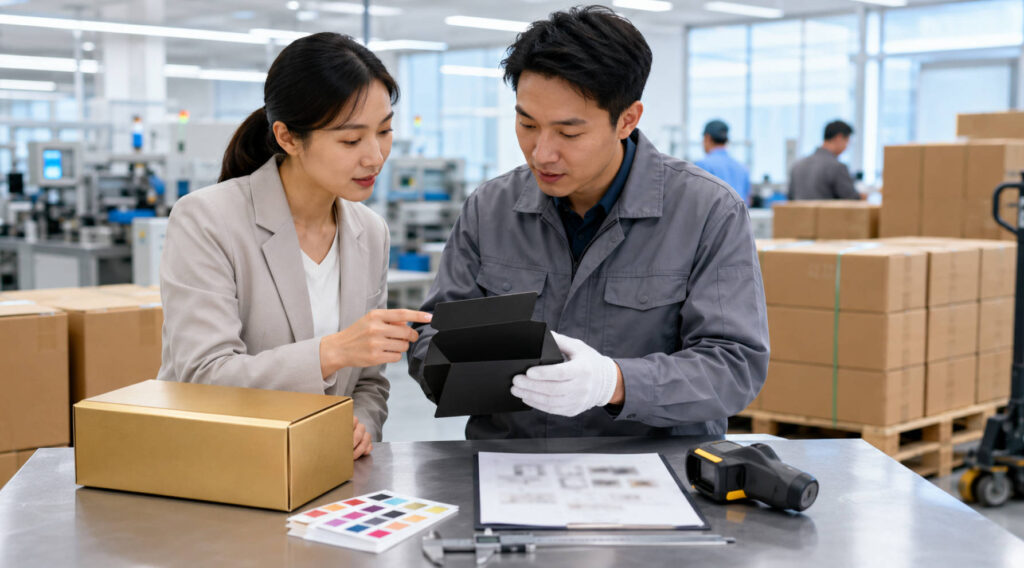
1. Start With a Complete RFQ
A usable packaging RFQ should include dielines or dimensions, product weight, target market, annual forecast, desired materials, artwork status, required finishing, packing method, compliance needs, and target delivery date.
Avoid requesting a quote based only on “custom packaging box.” A supplier cannot responsibly price custom packaging without knowing the structure, substrate, quantity, print colors, finishing, and delivery terms.
2. Use a Three-Stage Sampling Process
1. Structural dummy: Confirm dimensions, fit, opening experience, product protection, and pack-out.
2. Digital or color proof: Confirm artwork, typography, barcode placement, color targets, and legal text.
3. Pre-production sample: Confirm the actual production substrate, finishing, assembly method, and quality standard before mass production.
For premium packaging, approve samples under the same lighting conditions in which customers will see the product—especially for metallic foil, soft-touch lamination, and dark solid-color printing.
3. Verify ISO Certificates Properly
Do not rely on a certificate image or a logo in a supplier presentation. Ask for the full certificate, certificate number, issuing body, exact legal company name, factory address, scope, issue date, and expiry date.
Then validate the certificate through the issuing certification body or the IAF CertSearch directory. The key question is not simply whether an ISO certificate exists, but whether it remains valid and whether its scope actually covers the factory and packaging activity you are buying.
4. Plan German Market Packaging Obligations
If you place packaged goods on the German market, packaging obligations may apply to the party deemed responsible under Germany’s Packaging Act. The Central Agency Packaging Register states that businesses distributing commercially packaged goods in Germany must register with the LUCID Packaging Register.
Confirm contractual responsibility for registration, system participation, data reporting, and packaging licensing before goods are shipped. This is especially important for non-German brands selling directly to German consumers.
5. Compare Landed Cost, Not Unit Cost
A lower unit price can become expensive after freight, customs, warehousing, product damage, rework, compliance delays, and slow communication are considered.
For each supplier, calculate:
Landed Cost per Unit=(Product Cost + Tooling + Freight + Duties + Inspection + Expected Damage Cost)/Saleable Units Received
For repeat orders, also compare lead-time reliability, change-order cost, stock holding, and the supplier’s response speed when artwork or forecast changes.
Conclusion
Germany offers strong options for technically demanding custom packaging programs, particularly in folding cartons, corrugated transit packaging, retail displays, labels, and regulated consumer sectors. The right supplier is the one that can prove material consistency, compliance readiness, repeatable QC, transparent lead times, and commercial flexibility—not simply the one with the lowest quotation.
For brands that need premium custom paper packaging with flexible OEM support, responsive communication, and a development process suited to smaller or growing product lines, Bonito Packaging is a practical supplier to include in your RFQ comparison. Begin with a clear specification package, request a structural sample, and evaluate the supplier on the quality of its technical response—not just its unit price.
FAQ
1. How can I verify whether a packaging supplier’s ISO certificate has expired?
Request the complete certificate, identify the certificate number and issuing body, and check the record through that certification body’s public directory or IAF CertSearch. Confirm that the legal company name, production address, certificate scope, and expiry date match the supplier and product category being quoted.
2. Is CE certification required for custom paper boxes in Germany?
Usually no. CE marking applies to specific regulated product categories, not ordinary standalone paper packaging. For food-contact packaging, buyers should instead request product-appropriate documentation under EU food-contact and GMP rules.
3. What MOQ should I expect for custom packaging in Germany?
There is no universal MOQ. Digital printing, simple structures, stock materials, and limited finishing can reduce entry quantities; offset printing, bespoke dies, specialty paper, foil, embossing, and multiple SKUs generally increase them. Ask suppliers to quote MOQ by SKU and state whether tooling, plates, or setup charges are separate.
4. How do I know whether a supplier is a real manufacturer rather than a trading company?
Ask for the production address, factory audit availability, machinery list, quality-control flow, sample-production timeline, recent production photos or video walkthrough, and evidence of in-house converting processes. For critical projects, use an independent pre-shipment inspection and compare the factory name on certificates, invoices, and export documentation.
5. What should be included in a packaging quality agreement?
Include approved material specifications, color targets, dielines, golden sample references, AQL level, acceptable defect definitions, test standards, packaging method, delivery tolerance, change-control rules, corrective-action expectations, intellectual-property protection, and responsibility for non-conforming goods.
References
1. – [VDMA / interpack: German food and packaging machinery production data]
2. – [European Commission: Food Contact Materials requirements]
3. – [EUR-Lex: Regulation (EC) No 2023/2006 on Good Manufacturing Practice]
4. – [Germany’s Central Agency Packaging Register: LUCID registration]
5. – [IAF CertSearch: ISO certificate validation]
6. – [Packaging Valley Germany]
7. – [Bonito Packaging: About the company]
Hot Tags: Custom Packaging, Manufacturers, Customized, Custom, Suppliers, Buy, Cheap, Quality, Advanced, Durable, in Stock, Made in China, Price, Quotation, Free Sample
 English
  Spanish
  French
  German
  Russian
  Japanese
  Portuguese
  Arabic