
Content Menu
● What Is a Tuck End Folding Carton?
● What Is a Straight Tuck End Box?
>> How a Straight Tuck End Carton Closes
>> Best Applications for Straight Tuck End Boxes
● What Is a Reverse Tuck End Box?
>> How a Reverse Tuck End Carton Closes
>> Best Applications for Reverse Tuck End Boxes
● Straight Tuck End vs. Reverse Tuck End: Key Differences
● Why Flap Direction Matters in Custom Packaging
>> 2. Paperboard Utilization and Cost
>> 3. Product Protection and Weight
>> 4. Opening Experience and Consumer Convenience
● How to Choose the Right Tuck End Box
>> Step 1: Define the Product’s Real Requirements
>> Step 2: Identify the Primary Display Panel
>> Step 3: Evaluate Material and Structural Needs
>> Step 4: Review the Dieline Before Approving Artwork
● Common Mistakes When Selecting Tuck End Packaging
● Straight Tuck End or Reverse Tuck End: Which Is Better?
● Work With Bonito Packaging on Custom Tuck End Boxes
● Questions fréquemment posées
>> 1. What is the main difference between straight tuck end and reverse tuck end boxes?
>> 2. Are reverse tuck end boxes cheaper than straight tuck end boxes?
>> 3. Which tuck end box is better for cosmetics?
>> 4. Can tuck end boxes hold heavy products?
>> 5. Are straight tuck end and reverse tuck end boxes recyclable?
>> 6. Can I add a custom insert to a tuck end box?
>> 7. What information should I provide when requesting a tuck end box quote?
Choosing between a straight tuck end box and a reverse tuck end box can affect far more than how your package opens. The tuck direction influences front-panel appearance, paperboard efficiency, assembly, product protection, retail presentation, and the final cost of your custom folding carton packaging.
Au Emballage Bonito, we manufacture custom folding carton boxes for brands that need a premium balance of structural performance, visual impact, and production efficiency. From cosmetics and supplements to food, electronics, and consumer goods, the right tuck-end style begins with understanding how the carton will be filled, displayed, shipped, and experienced by the end customer.
What Is a Tuck End Folding Carton?
A tuck end box is a paperboard folding carton with closure flaps that fold inward and tuck into slots or locking areas at the top, bottom, or both ends of the box. It is one of the most widely used structures in custom retail packaging because it ships flat, assembles quickly, prints beautifully, and can be customized for many product categories.
A standard tuck end folding carton generally includes:
– A front panel for branding, product claims, and key visual elements
– A back panel for instructions, ingredients, barcodes, or compliance information
– Two side panels
– A glue flap that forms the carton body
– Top and bottom closure panels
– Inner dust flaps that help close and support the ends
The two most common variations are Straight Tuck End (STE) et Reverse Tuck End (RTE) packaging. They may look similar when assembled, but their flap layout creates meaningful differences in appearance and manufacturing efficiency.
What Is a Straight Tuck End Box?
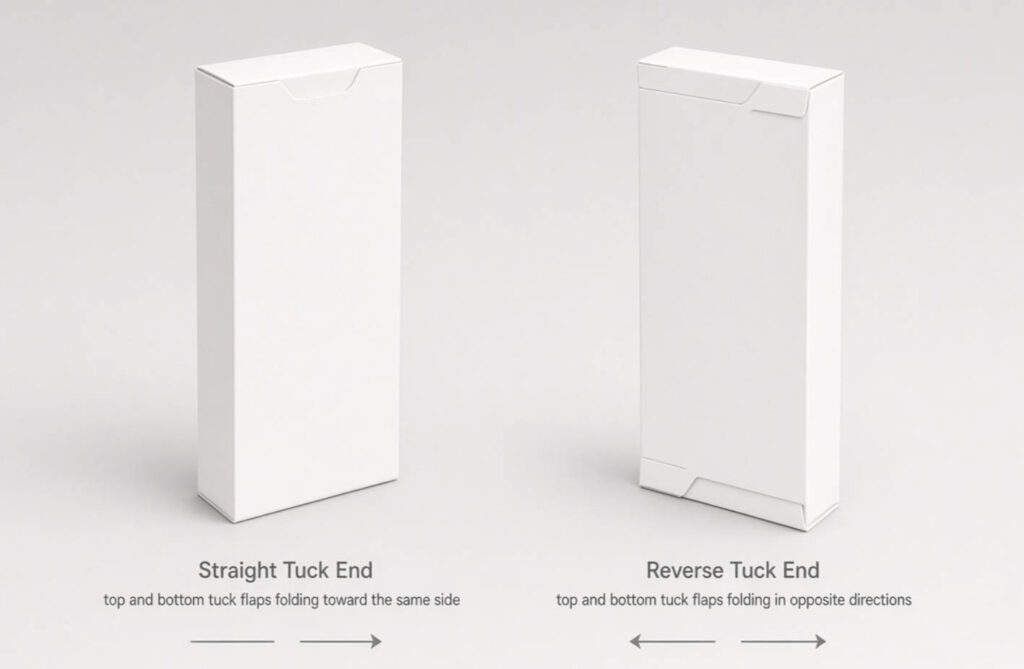
A Straight Tuck End box, often shortened to STE, has top and bottom tuck flaps that fold and close in the same direction. For example, both major tuck flaps may fold from the front panel toward the back panel.
This construction creates a cleaner, more continuous front-facing display panel. Because the tuck seams are generally directed toward the same side, brands can preserve a polished appearance on the primary retail-facing surface.
How a Straight Tuck End Carton Closes
In a typical straight tuck end design:
1. The smaller side dust flaps fold inward.
2. The main tuck flap folds over the dust flaps.
3. The tuck tab inserts into the receiving slot.
4. Both the top and bottom closures fold toward the same carton side.
The result is a structure with a consistent visual direction. This can be especially valuable when the front panel contains minimalist branding, metallic foil, centered graphics, large product photography, or a high-end matte finish.
Best Applications for Straight Tuck End Boxes
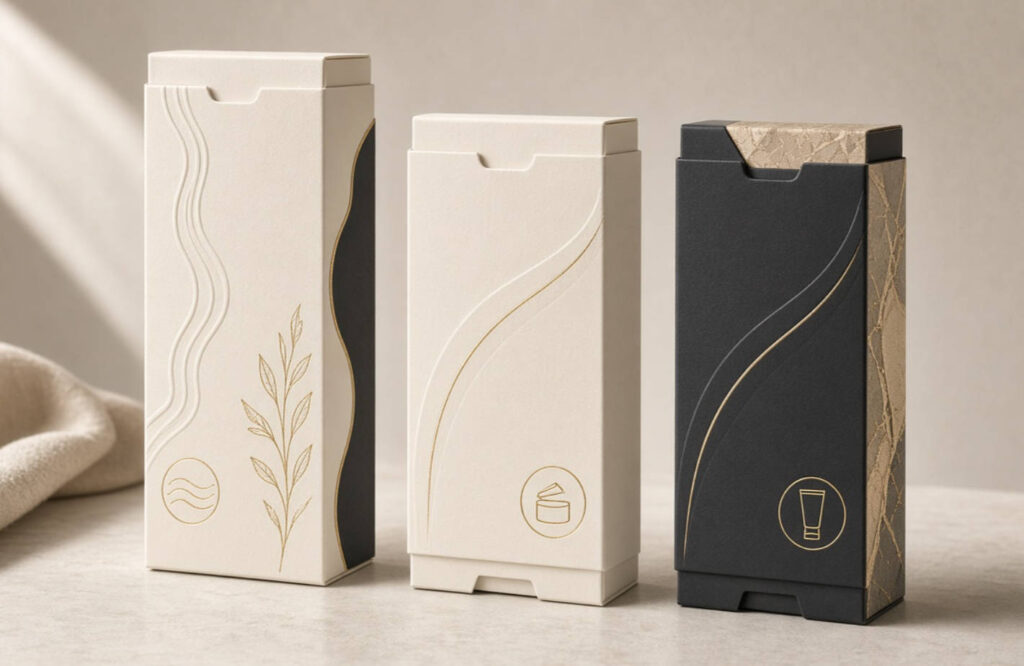
Straight tuck end cartons are often a strong choice for lightweight and premium-looking retail products, including:
– Skincare bottles and cosmetic tubes
– Perfume and fragrance samples
– Serums, facial oils, and small beauty jars
– Small electronics and accessories
– Essential-oil products
– Boutique confectionery
– CBD and wellness products where legally permitted
– Gift-oriented retail items
– Product kits with lightweight inner trays
For premium packaging, visual continuity matters. A straight tuck end box helps maintain a clean front panel and can make the carton feel more deliberate, refined, and shelf-ready.
What Is a Reverse Tuck End Box?
A Reverse Tuck End box, or RTE, has top and bottom tuck flaps that fold in opposite directions. For example, the top flap may fold from the front toward the back, while the bottom flap folds from the back toward the front.
This opposing flap direction is the defining difference between reverse tuck end and straight tuck end boxes.
The reverse configuration can allow carton blanks to nest more efficiently on a paperboard sheet in many standard layouts. Better nesting may reduce unused paperboard between die-cut cartons, which can improve material yield and help control production cost.
How a Reverse Tuck End Carton Closes
A reverse tuck end carton usually follows this sequence:
1. Fold the dust flaps inward at one end.
2. Fold the main tuck flap into its locking position.
3. Repeat the process on the other end.
4. Notice that the major flap direction changes between the top and bottom closures.
The customer still gets an easy-to-open carton, while the production team may gain more flexibility in how the carton is laid out on the printed sheet.
Best Applications for Reverse Tuck End Boxes
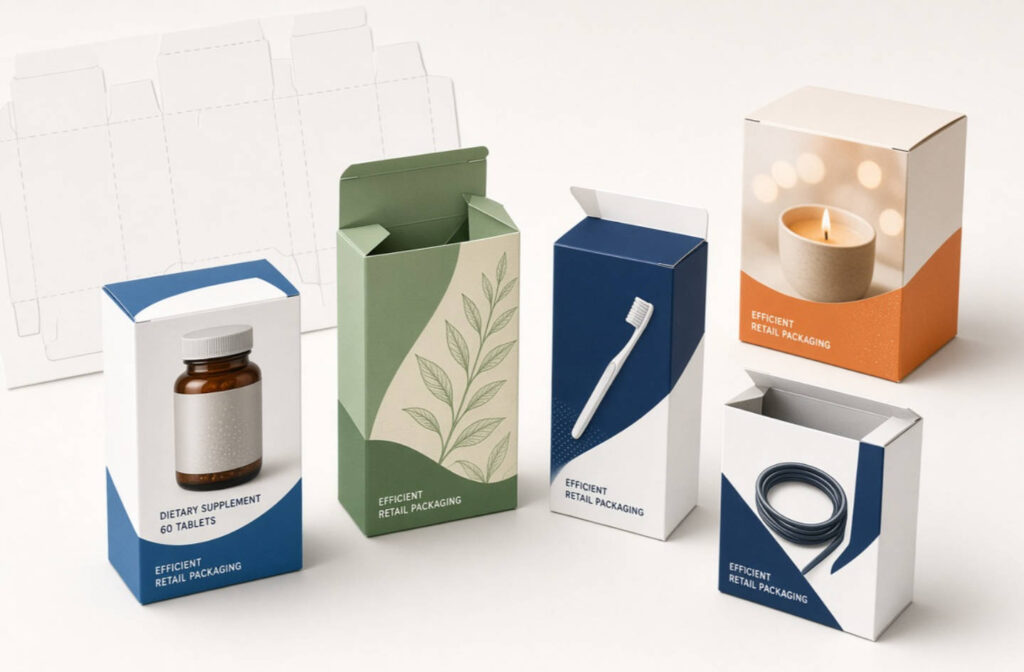
Reverse tuck end boxes are commonly used for everyday retail and consumer packaged goods, such as:
– Toothpaste and oral-care products
– Pharmaceuticals and over-the-counter products
– Supplements and vitamin cartons
– Tea, snacks, and dry food items
– Small tools and hardware
– Candles and lightweight home-fragrance products
– Electronics accessories
– Pet-care products
– Household items
– Mass-market cosmetic products
For brands that need practical retail packaging at scale, reverse tuck end cartons often offer a compelling balance between functional closure, attractive printing, and efficient material usage.
Straight Tuck End vs. Reverse Tuck End: Key Differences
The following table summarizes the most important differences between the two folding carton styles.
| Fonctionnalité | Straight Tuck End (STE) Box | Reverse Tuck End (RTE) Box |
|---|---|---|
| Tuck flap direction | Top and bottom flaps fold in the same direction | Top and bottom flaps fold in opposite directions |
| Front-panel appearance | Usually cleaner and more uninterrupted | One closure edge may be more visible on the front-facing lower area |
| Brand presentation | Ideal for premium, minimalist, or design-led packaging | Suitable for general retail and information-rich packaging |
| Paperboard layout | May create less efficient nesting in some dielines | Often supports more efficient blank nesting in standard layouts |
| Material efficiency | Can require more board depending on dimensions and layout | Can reduce board waste depending on carton size and die-line arrangement |
| Assemblée | Quick manual or automated assembly | Quick manual or automated assembly |
| Product weight suitability | Best for light-to-medium-weight products | Best for light-to-medium-weight products |
| Common product categories | Cosmetics, fragrance, skincare, specialty products | Supplements, food, pharmacy, personal care, household goods |
| Shelf appearance | Premium and clean | Practical, versatile, and cost-conscious |
| Typical decision driver | Visual quality and brand consistency | Production efficiency and everyday retail functionality |
The best option is not determined by carton style alone. Your product dimensions, filling method, board grade, print design, retail display orientation, shipping conditions, and budget should all be considered before finalizing a dieline.
Why Flap Direction Matters in Custom Packaging
The difference between straight tuck and reverse tuck boxes may seem small, but packaging is a system. A seemingly minor structural change can influence printing, die cutting, packing speed, material consumption, and how customers perceive your product.
1. Retail Shelf Appearance
A premium package has only a few seconds to communicate quality. When your front panel relies on a clean visual hierarchy, a straight tuck end design can be beneficial because both closure directions are aligned.
This is especially important when your packaging includes:
– Centered logos
– Large typography
– Metallic foil accents
– Product photography
– Minimalist branding
– Luxury finishes
– High-contrast color blocks
– Regulatory text placed away from the front display panel
For example, a high-end facial serum carton may use a straight tuck end structure to keep the front design clean and cohesive. A toothpaste carton, on the other hand, may prioritize efficient mass production and use a reverse tuck end format.
2. Paperboard Utilization and Cost
Packaging cost is not based on box size alone. It also depends on paperboard type, printing coverage, finishing, die-cutting complexity, glueing, packing requirements, and how efficiently the carton blanks fit onto a production sheet.
Reverse tuck end designs can sometimes be nested more tightly than straight tuck end designs. This means less unused space may remain between adjacent carton blanks. For a high-volume packaging order, even a small material-saving improvement can have a meaningful impact on total board consumption.
However, no carton style should be selected based on a general assumption. A packaging manufacturer should review the actual dieline and imposition layout before claiming that one structure will always use less material.
Expert recommendation: Ask your folding carton supplier to compare both dielines using the same finished box dimensions, paperboard grade, print method, and quantity. This gives you a more reliable cost comparison than choosing based only on a generic box-style description.
3. Product Protection and Weight
Both STE and RTE cartons are typically designed for lightweight to medium-weight products. They are not automatically the best choice for heavy glass containers, loose metal components, or products that create strong downward pressure on the bottom closure.
If the product is heavy, fragile, or intended for e-commerce shipment, consider reinforcing the structure with:
– A crash-lock or auto-bottom base
– A sealed bottom closure
– A custom paperboard insert
– A molded pulp insert
– A corrugated mailer for outer transit protection
– Stronger paperboard caliper
– Tamper-evident labels or shrink bands
– Product-specific retention features
A tuck end carton can provide excellent presentation packaging, but it should not be treated as a substitute for a properly engineered shipping solution.
4. Opening Experience and Consumer Convenience
Tuck end cartons are popular because they are intuitive. Consumers understand how to open and reclose them without instruction.
A well-designed tuck closure should offer:
– Easy first opening
– A tuck tab that does not tear during use
– Enough friction to remain closed
– A secure feel without excessive force
– Clear access to the product inside
– A recloseable structure where appropriate
The details matter. If the tuck tab is too tight, customers may damage the carton. If it is too loose, the carton may pop open during handling. Professional structural testing helps find the correct balance between convenience and closure security.
How to Choose the Right Tuck End Box
Use the following process when selecting between straight tuck end and reverse tuck end folding cartons.
Step 1: Define the Product’s Real Requirements
Start with the physical product, not the packaging trend.
Measure and document:
– Product length, width, and height
– Product weight
– Fragility level
– Shape and orientation
– Whether the product needs an insert
– Whether the package will be opened repeatedly
– Whether the carton will be displayed upright, sideways, or hanging
– Whether the product will be sold in stores, online, or both
A lightweight cosmetic tube may need a clean front panel and a small internal retention feature. A supplement bottle may need additional headspace, a secure bottom, and prominent compliance information.
Step 2: Identify the Primary Display Panel
Decide which panel consumers will see first. For shelf retail, this is usually the front panel. For e-commerce unboxing, the top opening or inside flap may also become part of the branded experience.
Choose a straight tuck end box when an uninterrupted front display is the priority. Consider a reverse tuck end box when production efficiency and functional versatility are more important than maintaining the same visual closure direction.
Step 3: Evaluate Material and Structural Needs
Paperboard selection should match the product and the desired brand position. Important considerations include board stiffness, surface smoothness, printing performance, coating compatibility, and the need for recycled or virgin fiber content.
Common folding carton board options may include:
– SBS paperboard for premium print quality and a bright white surface
– FBB paperboard for stiffness and strong print performance
– Recycled paperboard for selected applications where appropriate
– Specialty coated board for moisture resistance or enhanced visual effects
Fiber-based cartons can support recyclable packaging goals, but recyclability depends on the complete packaging system. Heavy plastic lamination, metallic films, product contamination, adhesives, and mixed-material components may affect local recycling outcomes.
Step 4: Review the Dieline Before Approving Artwork
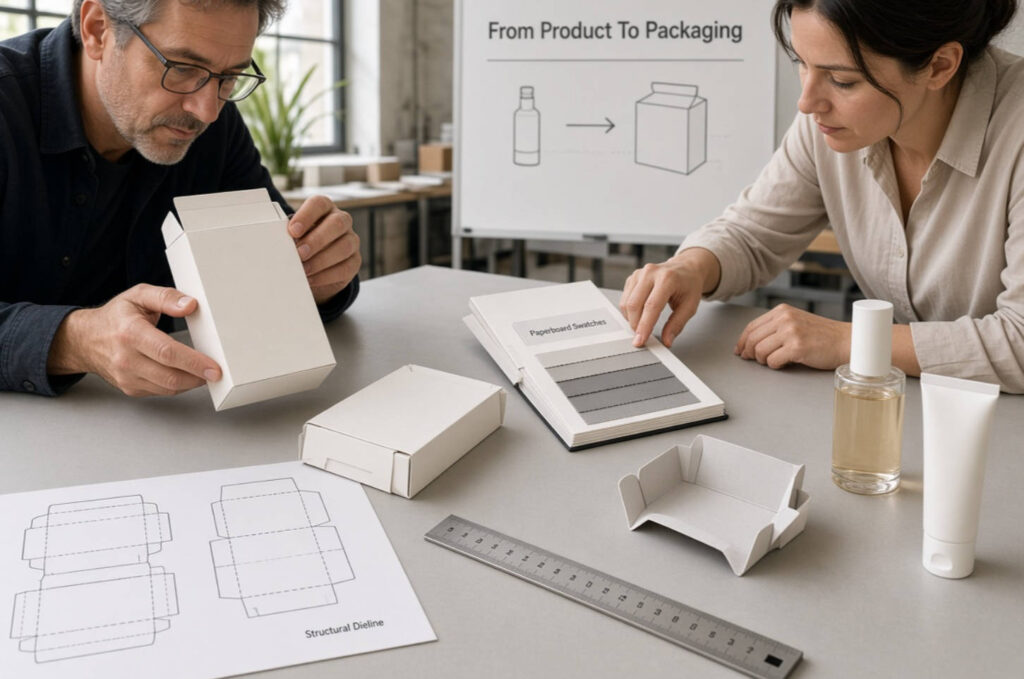
Do not design first and engineer later. The box dieline determines where folds, cuts, tuck tabs, glue areas, barcodes, legal copy, and artwork seams will appear.
Before approving the artwork, review:
– Safe zones around folds and scores
– Barcode placement and scanning clearance
– Glue flap location
– Direction of text and logos
– Bleed requirements
– Tuck-tab artwork alignment
– Product-opening instructions
– Tamper-evident feature placement
– Orientation of the carton on retail shelves
A professional packaging supplier should provide a production-ready dieline and a structural sample before mass production.
Common Mistakes When Selecting Tuck End Packaging
Brands often focus on visual design while overlooking structural details. Avoid these common mistakes.
– Choosing the box style before measuring the actual product
– Assuming that a tuck end box is suitable for heavy products
– Ignoring how the carton will look from the bottom or side on a shelf
– Placing important copy over score lines or glue areas
– Using a visually clean structure without considering board yield
– Selecting coatings or lamination without considering recycling goals
– Skipping a physical sample or prototype
– Treating e-commerce shipping and retail display as the same packaging requirement
– Designing a loose tuck closure that opens during transit
– Forgetting to test barcode scanning after printing and finishing
Straight Tuck End or Reverse Tuck End: Which Is Better?
Neither structure is universally better. The right choice depends on what matters most to your product and brand.
Choose a Straight Tuck End box if you need:
– A premium front-facing presentation
– Cleaner visual continuity
– A refined appearance for cosmetics, skincare, fragrance, or gift products
– A carton design where the front panel is the primary sales tool
– A strong unboxing impression for a lightweight product
Choose a Reverse Tuck End box if you need:
– A practical, versatile retail carton
– Potentially more efficient paperboard use
– A format suitable for higher-volume consumer products
– Easy assembly and familiar opening behavior
– A dependable structure for supplements, food, pharmacy, personal care, or household goods
For some products, a hybrid solution may be more appropriate. A tuck end carton with an internal insert, tamper-evident seal, window patch, embossed logo, or specialty coating can meet both branding and functional requirements.
Work With Bonito Packaging on Custom Tuck End Boxes
Your folding carton should do more than contain a product. It should protect the item, communicate your value, support operational efficiency, and make a strong impression at the moment of purchase.
Bonito Packaging helps brands develop custom straight tuck end and reverse tuck end boxes based on real product requirements. Our team can assist with structural recommendations, dieline development, paperboard selection, printing, finishing, inserts, sampling, and scalable production.
Request a custom packaging consultation from Bonito Packaging today. Share your product dimensions, target quantity, desired box style, artwork requirements, and shipping needs. We will help you select a folding carton structure that supports both your brand experience and production goals.
Questions fréquemment posées
1. What is the main difference between straight tuck end and reverse tuck end boxes?
The main difference is the direction of the top and bottom tuck flaps. In a straight tuck end box, both major flaps fold in the same direction. In a reverse tuck end box, the top and bottom flaps fold in opposite directions.
2. Are reverse tuck end boxes cheaper than straight tuck end boxes?
They can be, but not always. Reverse tuck end cartons may allow more efficient nesting on a paperboard sheet in certain dielines, which can reduce material usage. Actual pricing depends on the box dimensions, board type, printing, quantity, finish, and production layout.
3. Which tuck end box is better for cosmetics?
Straight tuck end boxes are often preferred for premium cosmetics, skincare, fragrance, and beauty products because they can provide a cleaner front-facing appearance. However, reverse tuck end boxes can also work well for mass-market cosmetic products.
4. Can tuck end boxes hold heavy products?
Standard tuck end cartons are generally best for light-to-medium-weight products. Heavy products may need a crash-lock bottom, sealed end, reinforced insert, thicker paperboard, or an additional corrugated shipping package.
5. Are straight tuck end and reverse tuck end boxes recyclable?
They can be recyclable when made primarily from recyclable paperboard and when compatible with local collection and recycling systems. Recyclability can be affected by plastic films, foil layers, heavy coatings, adhesives, food contamination, and mixed-material accessories.
6. Can I add a custom insert to a tuck end box?
Yes. Custom inserts can help hold bottles, jars, tubes, electronics, tools, or multiple items securely in place. Depending on the product, inserts can be made from paperboard, corrugated board, molded pulp, foam, or other materials.
7. What information should I provide when requesting a tuck end box quote?
Provide the product dimensions and weight, desired box dimensions, quantity, material preference, printing requirements, finishing options, insert requirements, intended sales channel, shipping needs, and artwork status. A product sample or technical drawing can also improve structural accuracy.
References
1. OXO Packaging. “Difference Between Straight Tuck and Reverse Tuck Boxes.” Explains the basic structural distinction between straight tuck and reverse tuck carton closures, including flap direction and common carton panel construction.
[https://oxopackaging.com/blog/difference-between-straight-tuck-and-reverse-tuck-boxes.html]
2. PakFactory. “A Comprehensive Guide to Folding Carton Packaging and Styles.” Provides an overview of common folding carton structures, including straight tuck end, reverse tuck end, auto-bottom, and related retail packaging formats.
[https://pakfactory.com/blog/a-guide-to-different-types-of-folding-carton-box-styles]
3. Stora Enso. “Premium Folding Carton Boards for Packaging.” Discusses carton-board characteristics, material efficiency, printability, and recycling-related properties of folding carton board.
[https://www.storaenso.com/en/products/paperboard-materials/folding-cartons]
4. Graphic Packaging International. “Recycled Paperboard.” Describes recycled paperboard options and fiber-content considerations for packaging applications.
[https://www.graphicpkg.com/packaging-materials/paperboard/recycled-paperboard/]
5. Netpak. “Sustainable Folding Carton Packaging Materials.” Covers the role of fiber-based folding cartons, transport efficiency, printing considerations, and factors that may influence practical recyclability.
6. Two Sides North America. “Paper-Based Packaging Provides Environmental and Social Benefits.” Discusses paper-based packaging and the potential value of recycling paper fibers within circular material systems.
[https://twosidesna.org/paper-based-packaging-provides-environmental-and-social-benefits/]
Hot Tags: Folding Carton Box, Manufacturers, Customized, Custom, Suppliers, Buy, Cheap, Quality, Advanced, Durable, in Stock, Made in China, Price, Quotation, Free Sample
 English
  Spanish
  French
  German
  Russian
  Japanese
  Portuguese
  Arabic