
Content Menu
● Why Coffee Packaging Matters in Ecommerce
● Start with Coffee Freshness, Not Surface Design
● Choose the Right Coffee Packaging Format
● Build a Packaging System for the Delivery Journey
>> Use Right-Sized Custom Mailer Boxes
● Design Coffee Packaging That Converts Online and Offline
● Make Sustainability Claims Specific and Verifiable
● Add Value Through the Unboxing Experience
● A Practical Custom Coffee Packaging Checklist
● Create Coffee Packaging That Performs Beyond the First Order
● Questions fréquemment posées
>> 1. What is the best coffee packaging for ecommerce?
>> 2. Do coffee bags need a one-way degassing valve?
>> 3. Can paper coffee packaging keep coffee fresh?
>> 4. How should I choose a coffee subscription box?
>> What information should appear on coffee packaging?
>> 5. Is recyclable coffee packaging always better than compostable packaging?
>> 6. How can custom coffee packaging improve repeat purchases?
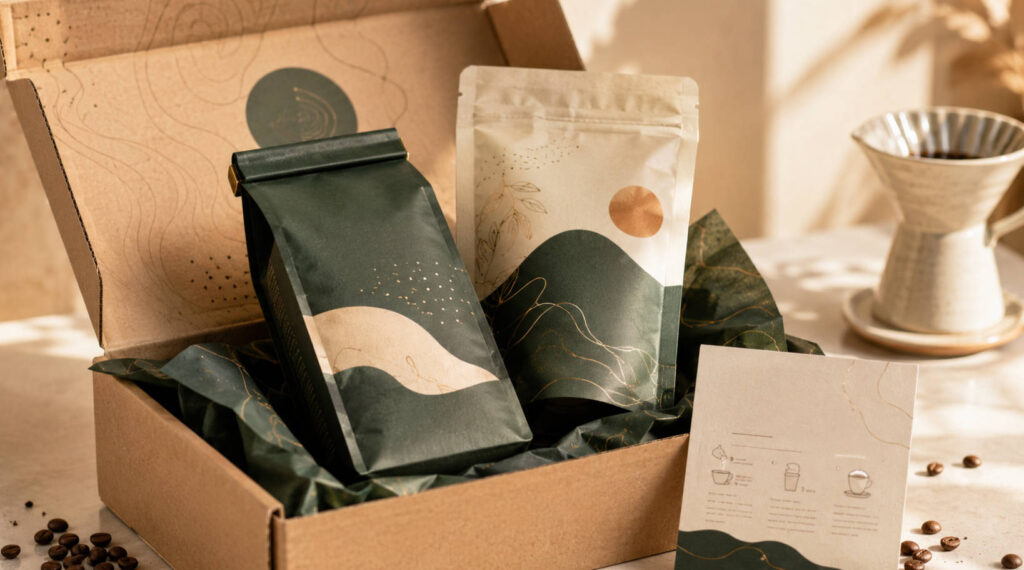
For a coffee brand, custom coffee packaging for ecommerce is more than a container. It protects aroma, communicates quality, survives the delivery journey, and creates the first physical moment between your brand and an online customer.
Au Emballage Bonito, we see ecommerce coffee packaging as a complete system rather than a single box or pouch. The best solution combines a freshness-preserving primary coffee bag, a protective shipping structure, clear brand communication, and a customer-friendly unboxing experience. When these elements work together, your packaging can protect product value while helping your coffee brand earn repeat purchases.
Whether you sell specialty whole beans, ground coffee, drip bags, coffee capsules, or subscription boxes, this guide will help you design custom coffee packaging that performs in real ecommerce conditions.
Why Coffee Packaging Matters in Ecommerce
Coffee buyers cannot smell, touch, or inspect your product before checkout. Your product page creates expectations, but your packaging must fulfill them when the parcel arrives.
Unlike retail packaging, ecommerce coffee packaging must handle more than shelf presentation. It may be exposed to compression, vibration, temperature changes, moisture, warehouse handling, and last-mile delivery. A visually attractive package that arrives dented, leaking, or stale can weaken trust in the coffee itself.
Effective ecommerce coffee packaging should do five jobs:
– Preserve coffee freshness from packing to consumption.
– Prevent punctures, crushing, and seal damage during shipping.
– Present brand information clearly at first glance.
– Improve opening, storing, and disposal convenience.
– Create a memorable branded delivery experience.
For online-first coffee brands, packaging is also a retention asset. A well-designed pouch and shipping box can turn an ordinary delivery into a shareable unboxing moment, especially for subscription coffee programs and gift sets.
Start with Coffee Freshness, Not Surface Design
Coffee packaging design should begin with product behavior. Freshly roasted coffee releases carbon dioxide after roasting, while oxygen exposure contributes to aroma loss and staling. This is why material structure, seal integrity, and closure design matter as much as artwork.
A premium coffee package should create a barrier against oxygen, humidity, light, and external odors. The right barrier level depends on your coffee format, roast profile, distribution distance, storage conditions, and expected shelf life.
For many roasted whole-bean products, a one-way degassing valve is an important functional component. It allows carbon dioxide to escape without allowing outside air to enter easily. This helps protect the package from swelling while supporting freshness management.
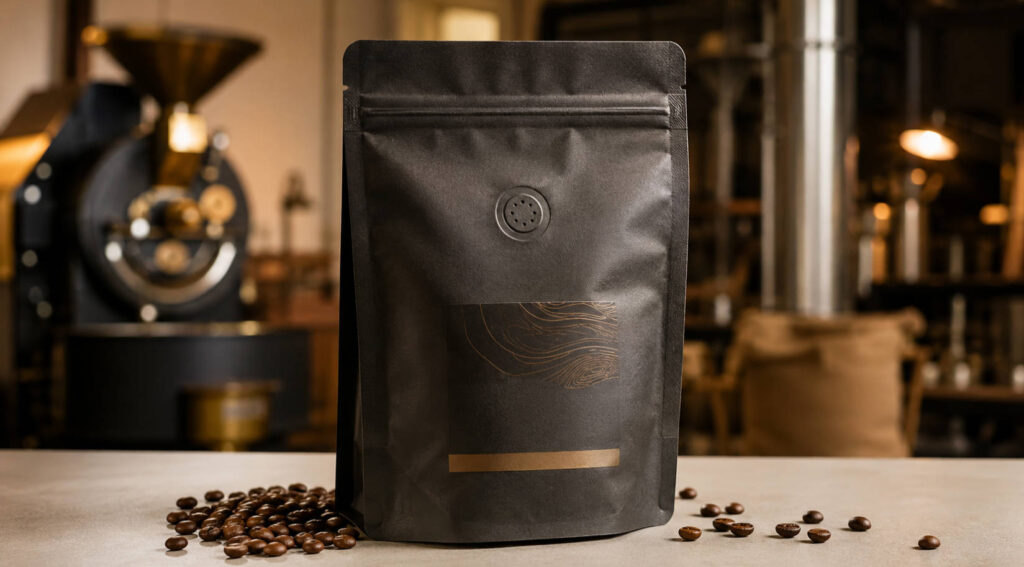
Core freshness features to consider include:
– High-barrier film or coated paper structures.
– Heat-sealed top closures.
– One-way degassing valves for freshly roasted beans.
– Resealable zippers for at-home storage.
– Tin ties for selected kraft-style bag formats.
– Light-blocking materials for aroma-sensitive products.
– Secure bottom gussets and side seals.
Do not select a coffee bag solely because it looks sustainable or premium. First confirm whether the material structure, valve, zipper, adhesive, and printing system are suitable for your coffee and market.
Choose the Right Coffee Packaging Format
The best custom coffee packaging format depends on how your customers buy, store, brew, and receive coffee. A small specialty roaster selling 250 g bags has different needs from a wholesale supplier shipping 1 kg packs or a DTC brand offering monthly subscriptions.
| Packaging format | Best for | Key advantages | Important consideration |
|---|---|---|---|
| Stand-up pouch | DTC coffee, subscriptions, sample packs | Lightweight, space-efficient, strong front-facing branding area | Ensure the pouch has sufficient barrier performance |
| Flat-bottom coffee bag | Premium beans, retail-ready ecommerce orders | Stable shape, multiple printable panels, upscale appearance | Usually requires more complex converting |
| Side-gusset bag | Larger coffee volumes, wholesale, traditional coffee brands | Familiar format, efficient capacity, suitable for valves and tin ties | Less stable as a standalone display pack |
| Paper tube | Gifts, premium blends, capsules, coffee accessories | Strong premium perception and reusable appeal | Requires an inner barrier or sealed primary pack |
| Folding carton | Coffee sets, capsules, drip bags, gift packs | Excellent storytelling surface and unboxing potential | Usually functions as secondary packaging |
| Corrugated mailer box | Ecommerce shipping and subscription kits | Protects products, supports branded unboxing | Must be sized to reduce movement and void fill |
A high-performing ecommerce order often uses two packaging levels: a primary pouch that protects freshness and a secondary custom shipping box that protects the pouch in transit.
Build a Packaging System for the Delivery Journey
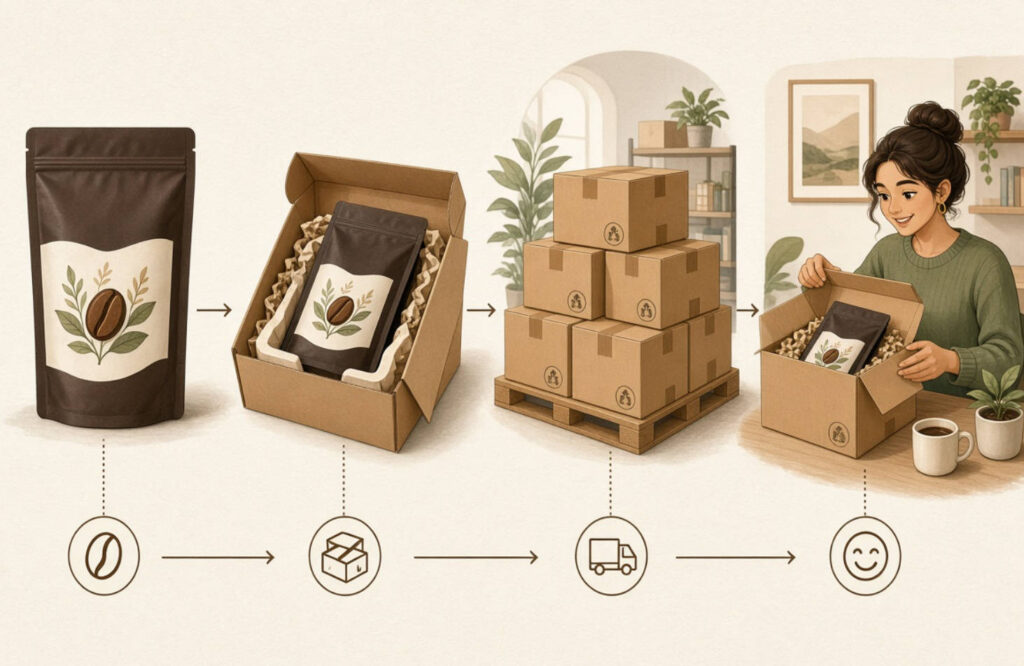
A coffee pouch can be perfectly printed and sealed at the factory but still fail when placed inside an oversized shipping carton. Ecommerce packaging needs to be designed around the entire journey, from filling line to doorstep.
Start by mapping your delivery process. Consider how products are packed, stacked, stored, picked, shipped, delivered, and opened. This approach helps reveal weak points before they create customer complaints.
Use Right-Sized Custom Mailer Boxes
Oversized shipping boxes increase material use and allow products to move during transit. Excess movement can damage pouch corners, crush cartons, or make the order feel low-value.
A right-sized custom mailer box should hold the product securely with limited void space. For a coffee subscription, this might mean a mailer designed specifically for one, two, or three coffee bags. For gift sets, it may include fitted paperboard inserts or compartments.
A well-sized box can help you:
– Reduce the need for unnecessary void fill.
– Improve stacking strength during shipment.
– Create a cleaner unboxing experience.
– Lower dimensional shipping costs where applicable.
– Keep coffee bags upright and presentation-ready.
Test Before You Scale
Packaging performance should be tested with real product weight and realistic shipping conditions. Do not approve a design only from a digital mockup or an empty sample.
Before a full production run, request physical prototypes and check:
1. Does the pouch stand correctly when filled?
2. Are the seals consistent and strong?
3. Does the valve sit in the correct location?
4. Can customers open the pack without scissors?
5. Does the zipper reseal smoothly after multiple uses?
6. Does the mailer prevent product movement?
7. Is the artwork readable after scuffing or handling?
8. Does the barcode scan reliably on the printed surface?
A simple internal transit test can identify obvious risks. Pack a finished order, expose it to stacking pressure and normal handling, then inspect the pouch seals, box corners, print finish, and product presentation.
[Suggested visual: A four-step infographic showing “Fill → Seal → Ship Test → Customer Unboxing.”]
Design Coffee Packaging That Converts Online and Offline
Coffee packaging needs to work in product photography, on social media, in customers’ kitchens, and sometimes on retail shelves. The strongest designs create recognition quickly while making essential buying information easy to find.
A useful hierarchy is to organize information in three levels.
First level: Brand name, coffee name, roast type, or product category.
Second level: Origin, tasting notes, processing method, blend information, and net weight.
Third level: Roast date, brewing suggestions, certifications, barcode, storage advice, and detailed product story.
This structure gives customers fast clarity without making the front panel feel crowded. For ecommerce photography, keep the front design legible at small screen sizes. Fine type, pale contrast, and overly detailed illustrations may look elegant in person but disappear on a mobile product page.
Use Finishes with Purpose
Premium finishes can increase perceived value, but every finish should support a clear brand objective. For example, soft-touch lamination can reinforce a refined specialty positioning, while embossed details can make a limited-release coffee feel more collectible.
Consider:
– Matte lamination for a modern, understated look.
– Spot UV for logo contrast and selected graphic details.
– Foil stamping for premium gift collections.
– Embossing or debossing for tactile brand recognition.
– Kraft-texture paper effects for natural or craft-focused brands.
– Water-based inks where compatible with the chosen packaging system.
Avoid adding multiple decorative treatments without a reason. A clean design with readable information often feels more credible than an overloaded package.
Make Sustainability Claims Specific and Verifiable
Sustainable coffee packaging is increasingly important, but broad claims can create confusion. Terms such as “eco-friendly,” “green,” or “planet-safe” do not tell customers what a package is made of, how it should be disposed of, or whether local facilities can process it.
A better approach is to make practical, specific claims. If a structure is designed for a certain recycling stream, explain that clearly. If it contains recycled content, state the relevant detail accurately. If it is compostable only in industrial facilities, do not imply that it will break down in a home compost bin.
For coffee brands selling internationally, packaging choices should also reflect market-specific rules. The European Union’s Packaging and Packaging Waste Regulation generally began applying in August 2026 and establishes lifecycle-related requirements for packaging placed on the EU market. Its direction is clear: brands should increasingly evaluate recyclability, material design, labeling, and waste reduction before launch.
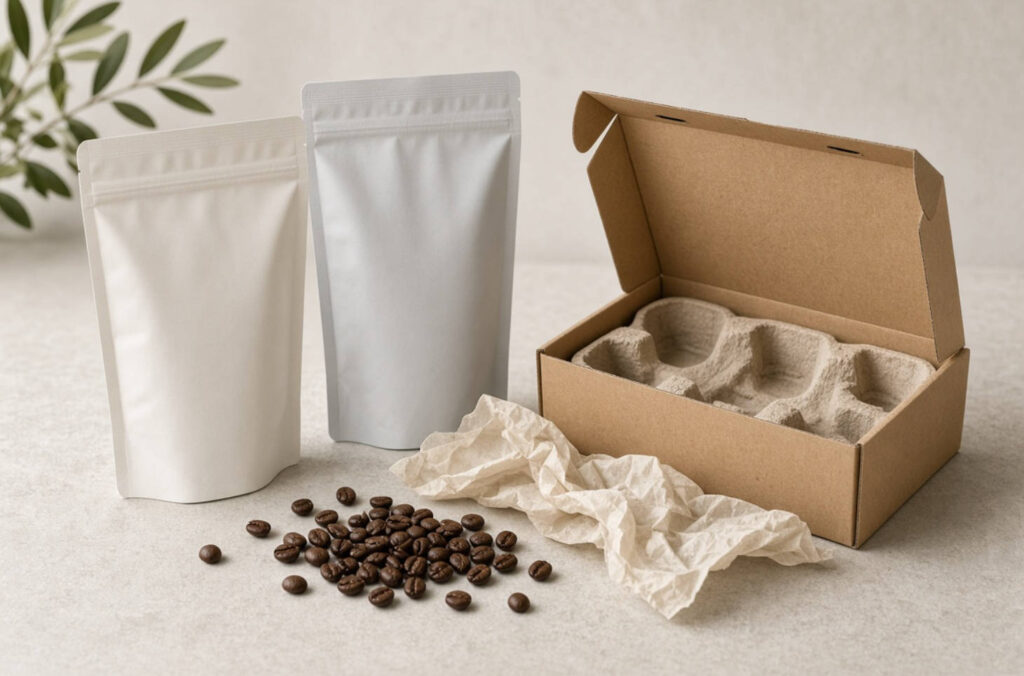
A responsible sustainable packaging brief should define:
– The material structure and its intended end-of-life route.
– The barrier protection required for your coffee.
– Whether a valve, zipper, or label affects recyclability.
– The disposal instructions shown to customers.
– The markets where the product will be sold.
– The evidence supporting any environmental claim.
Sustainability is not one material choice. It is a balance between product protection, material efficiency, disposal infrastructure, and accurate communication.
Add Value Through the Unboxing Experience
The moment a customer opens an ecommerce coffee delivery is an opportunity to make your brand more useful and memorable. You do not need excessive inserts or expensive decorations. Small, relevant details are often more effective.
For example, a branded insert can explain tasting notes, recommend a brew ratio, introduce the coffee producer, or provide a QR code that leads to a brewing guide. A subscription box can include a monthly flavor card that gives customers a reason to compare coffees and return for the next delivery.
Useful ecommerce packaging additions include:
– A brewing guide for espresso, pour-over, or French press.
– A roast-date or batch-information card.
– A QR code linking to origin and brewing content.
– A thank-you note with a clear reorder incentive.
– A referral card for gift subscriptions.
– A reusable storage recommendation.
– A concise disposal instruction.
Keep the experience relevant to coffee. Every insert should help customers brew better, understand the product, or take a next step with your brand.
A Practical Custom Coffee Packaging Checklist
Before requesting a quotation, prepare a detailed packaging brief. This reduces sampling delays, prevents avoidable revisions, and helps your manufacturer recommend a more accurate solution.
Include the following information:
– Coffee format: whole bean, ground, capsule, drip bag, instant coffee, or gift set.
– Net weight and expected pack dimensions.
– Target markets and applicable labeling needs.
– Desired shelf life and distribution conditions.
– Preferred packaging format and closure type.
– Need for a one-way degassing valve.
– Brand artwork, Pantone references, and finish preferences.
– Expected order quantity and launch schedule.
– Shipping box requirements and subscription configuration.
– Sustainability priorities and approved marketing claims.
The most effective custom coffee packaging projects begin with clear product requirements, not only visual inspiration. A professional packaging partner should help you connect artwork, materials, structure, print production, and transport performance before mass production.
Create Coffee Packaging That Performs Beyond the First Order
Great coffee deserves packaging that protects the roast, supports your story, and arrives in excellent condition. The right custom coffee packaging for ecommerce can help your brand look premium, feel trustworthy, and work better for customers from delivery through the final cup.
Bonito Packaging can help coffee brands develop custom paper packaging, coffee boxes, ecommerce mailers, gift packaging, and branded unboxing solutions tailored to their product format and market positioning. Share your product size, target quantity, artwork direction, and shipping needs to begin with a practical packaging recommendation and custom quotation.
Questions fréquemment posées
1. What is the best coffee packaging for ecommerce?
For many DTC coffee brands, a high-barrier stand-up pouch or flat-bottom bag combined with a right-sized corrugated mailer box is a practical option. The pouch protects freshness, while the outer box protects the product during shipping and creates room for branding.
2. Do coffee bags need a one-way degassing valve?
Freshly roasted whole-bean coffee often benefits from a one-way degassing valve because roasted coffee releases carbon dioxide. The ideal solution depends on roast timing, pack format, shelf-life expectations, and the filling process.
3. Can paper coffee packaging keep coffee fresh?
Paper can create a premium, natural appearance, but paper alone may not provide sufficient moisture and oxygen protection. Many paper-look coffee packages use a functional barrier layer or inner pouch to help preserve freshness.
4. How should I choose a coffee subscription box?
Choose a box based on the number, size, and weight of coffee packs included in each shipment. It should minimize empty space, protect the products from crushing, and provide enough printable area for a clear branded experience.
What information should appear on coffee packaging?
Common product information includes brand name, coffee name, net weight, origin, roast level, tasting notes, storage guidance, brewing information, and required regulatory details for the target market. Confirm specific labeling obligations before production.
5. Is recyclable coffee packaging always better than compostable packaging?
Not necessarily. The best option depends on local collection and processing infrastructure, product-protection needs, packaging components, and the accuracy of disposal instructions. A packaging claim should match the actual material structure and local end-of-life pathway.
6. How can custom coffee packaging improve repeat purchases?
Clear product information, easy-opening features, resealable closures, attractive design, brewing guidance, and a consistent unboxing experience can make the product easier and more enjoyable to use. This supports customer satisfaction and reinforces brand recognition.
References
1. OXO Packaging. “[Coffee Packaging for Ecommerce].” Original competitor article reviewed for content-gap analysis. [oxopackaging]
2. Specialty Coffee Association. “[Preserving Freshness: A Race Against Time].” Background on carbon dioxide, oxygen displacement, and coffee freshness in valve bags. [sca]
3. Specialty Coffee Association. “[What Is the Shelf Life of Roasted Coffee? A Literature Review on Coffee Staling].” Background on oxygen exposure, package leakage, and roasted-coffee staling. [sca]
4. European Commission. “[Packaging Waste].” Overview of EU Packaging and Packaging Waste Regulation applicability and scope. [environment.ec.europa]
5. EUR-Lex. “[Regulation (EU) 2025/40 on Packaging and Packaging Waste].” Official legal text covering packaging recyclability requirements and performance criteria. [eur-lex.europa]
6. European Commission. “[Packaging and Packaging Waste Regulation].” Summary of recyclability, labeling, and packaging-waste policy direction in the EU. [environment.ec.europa]
Hot Tags: Coffee Packaging, Manufacturers, Customized, Custom, Suppliers, Buy, Cheap, Quality, Advanced, Durable, in Stock, Made in China, Price, Quotation, Free Sample
 English
  Spanish
  French
  German
  Russian
  Japanese
  Portuguese
  Arabic